Showing posts sorted by relevance for query itzamna, maya god. Sort by date Show all posts

Saturday, May 26, 2012

NW Yucatan Part 10: The Maya Cosmos

Incense burner shaped in the image of a Maya god. Mérida's Museum of Anthropology and History (see also Part 9 of this series) contains an excellent section on Maya religion, including this burner for copal incense. The Maya worshiped a pantheon of at least two dozen major gods, and many other minor ones. Most of the gods ruled over multiple areas of life, and often these areas overlapped with other gods. In addition, a god might be known by several different names. All this tends to make Maya religion exceedingly complex. In general, Maya gods were benevolent, charitable, and accessible, unlike the severe and threatening gods of Central Mexico. The Maya gods could, however, punish those who didn't worship them with respect and the proper rituals. Unfortunately, not all of the artifacts depicting gods were labeled with their names. This handsome fellow may (or may not) be Ah Kin, god of the sun, or Ah Puch, god of death, or even Itzamna, the father of the gods.


Itzamna, the "father of the gods". This image was definitely identified as Itzamna (the Godfather, to you Mario Puso fans). He is both a hero and a god, making him a rather enigmatic figure. Itzamna ruled the heavens, controlling day and night. As such, he is related to the sun, the moon, rain, agriculture, maiz (corn), medicine, divination, and the celestial bodies of the Pleiades and Venus. He is also considered the god of knowledge and is credited with the invention of hieroglyphic writing, the calendar, and the writing of the codices (religious texts and histories). He is usually represented, as in this statue, as old, lean-faced, with sunken cheeks, and toothless. Any of us would look like this, with all those responsibilities!


Hun Nal Yeh, the god of maiz and forests. Also known as Yum Kaax, he is unlike many of the other gods in his appearance. Most of the others, like Itzamna, are represented as old, haggard, and sometimes with monstrous features. Hun Nal Yeh, by contrast, appears as youthful, smooth-faced, and vigorous. Maiz, or corn, was the staff of life for the ancient Maya. They believed that humans were created from maiz by the Hero Twins, a pair of figures who were somewhat less than gods and somewhat more than human. Hun Nal Yeh also ruled the forests surrounding the Maya that produced most of the other foods and materials necessary for daily life. Overall, he represented abundance and prosperity. Hun Nal Yen was therefore an extremely important god, even though below Itzamna in the pecking order.


Another unnamed, but no doubt important, member of the pantheon. This statue is part of another large censer. In addition to an extravagant head dress, he is shown with a long, animal-like snout with his tongue hanging out like a panting dog. With his left hand, he holds out a small cup or pot, a gesture often seen in these god figures. The vessels often hold materials related to the area of life over which the god rules. His appearance and posture somewhat resemble Ah Puch, the god of death, also known as Yum Kimil, and Kisin. The titles of Ah Puch included Prince of Darkness and Lord of Drought. Oddly, he was seen as a timid sort, even though he was also related to sacrifice and war. The Maya saw the cosmos as 13 superimposed heavens, from the sky down to the earth. Below the earth were 9 additional levels, the lowest of which was Mitnal, over which Ah Puch ruled.


Sacred decorations

A human figure emerges from the open jaws of a snake (Uxmal between 800 AD -950 AD). This sculpture was once mounted high on a wall at Uxmal, one of the greatest of Yucatan's ancient cities. Uxmal was the most important city in the Puuc area south of Mérida, and remained important even after the Mexicanized Maya invaded and conquered it in the Post Classic era. Representations of human figures emerging from snakes' mouths are also found at Tollan, the capital of the Toltec Empire, another of the curious similarities archaeologists have found between the these two geographically separated civilizations. When I first saw carvings like this, and the ones at Tollan, I thought the snake was devouring the human. Later, I learned that these are a symbols of rebirth. For the Maya death was not final, but merely one stage in a continuous cycle, represented by the disappearance and reappearance of Venus, the Morning Star.


An Atlantean, doing its bit to hold up the world. The figure probably was one of four holding up  corners of a stone altar, which represented the world. Atlanteans are yet another cultural crossover found both at Tollan and at Chichen Itza. In the Maya context, the figures were called Bacab and represented the four immensely strong gods who held up the four corners of the world, with each corner being one of the cardinal directions.


Stone censer, probably from Chichen Itza. One way of showing devotion to the gods was the burning of copal, a fragrant tree resin. Copal is actually a derivative of the Nahuatl word copalli, meaning "incense". The Maya call it pom, and continue to burn it as part of rituals that have ancient roots. The sculptured head of this censer has the look of the rigid, militarized society that emerged after the takeover by the Itzas.


Maya warfare

Stone head of a helmeted warrior (Chichen Itza between 850 AD-1100 AD). Up until the 1970s, many archaeologists believed the Maya to be peaceful stargazers and mystics. Then, experts like Linda Schele began to decode the Maya hieroglyphics, and a new picture emerged. It turned out that the last two descriptions were true, but they they were definitely not peaceful. Long before the Mexicanized Maya invasion of the 10th Century AD, the Maya city states in Yucatan, Chiapas, and Central America had fiercely warred among themselves. Sometimes the cause was dynastic, sometimes it was a struggle over trade routes or precious resources like jade deposits, and sometimes it may have been a quest for captives to sacrifice to the gods.


An ancient warrior crouches, ready for combat.  Clutching a spear in his right hand and a round shield in his left, he wears a helmet on his head and a ferocious, narrow-eyed expression. Armor would have been made of wood, leather, or quilted cotton. Warfare was an elite occupation in which the general population probably did not participate, except in case of the overthrow of a ruler. Armies were not large, probably in the range of 500-1000 men on a side, organized and led by a figure known as the Halach Uinic. Since there was a close relationship between religion and warfare, campaigns were often timed around celestial events such as the cycles of Venus.


A selection of Maya weapons. These include spear and arrow points, large blades for hand weapons, and smaller blades for daggers. On the upper right is the stone head of a club or hand axe. In general, our information about ancient battle tactics is unclear, but surprise attacks sometimes occurred like the one in which the ruler of the subordinate state of Quiriguá ambushed, captured, and sacrificed his overlord, the ruler of Copan. In a pitched battle, two armies would approach each other close enough to launch long-range missiles. To give extra distance and force, warriors often used the atlatl, or spear-thrower. Bows and arrows also were used, but not widely. When the distance weapons were exhausted, the armies would close for hand-to-hand combat, using their obsidian and chert bladed weapons. At this point, any discipline probably broke down and the battle would have become a melee between individuals. Since everyone knew the fate of captives was torture and sacrifice, the fighting would have been fierce.


The Ball Game

Nobles watch the ball players from the the walls of the Great Ball Court of Chichen Itza. In overall size, this was the largest court in all of Mesoamerica, exceeded in length only by the court at the Guachimontanes in Western Mexico. The ball game served both religious and political purposes, and in many ways simulated combat. On a religious level, the struggle in the ball court reenacted that of the Hero Twins against the Lords of Xilbalba (the Underworld). In addition, the game was sometimes used as an alternative to war to settle disputes between city states. In the drawing above, you can see the Temple of Kulkulkan in the upper left background. On top of the wall to its right is the Temple of the Jaguars. Set into the far wall about 7 meters (21 ft) above the players is a stone ring which casts a long diagonal shadow across the wall.


Stone ring from the Ball Court of Oxkintok, dated 713 AD. Like Maya military tactics, the precise rules of the ball game are unclear. One way of scoring was apparently to pass the ball through the ring. This would have been exceedingly difficult since it was set so high on the wall, and the players could move the heavy rubber ball only with their hips, chests, and heads. One theory is that the object of the game, other than scoring through the ring, was somewhat like badminton, i.e. to keep the ball off the ground and in play. From the carvings on the walls at Chichen Itza, it is clear that some of the players were sacrificed after the game. Whether those accorded this dubious honor were the losers or the winners is the subject of an on-going dispute. Although the Maya built the greatest of all the ball courts, and played the game nearly everywhere in their world, they did not invent it. The ball game appears to have originated with the Olmecs who built the earliest known court in approximately 1400 BC. Today, indigenous people in the northern state of Sinaloa still play a version of the ball game called ullama (without human sacrifice, however).


Cenote offerings


Offerings thrown into cenotes ranged from small jade pieces to the occasional human being. Cenotes are limestone sinkholes formed when water filtering down to underground rivers weakens the limestone above. When it collapses, a circular or oval pit filled with water is formed. Cenotes are found along the stress lines in Yucatan's limestone shelf formed by the impact of the great meteor which hit the Yucatan coast 65 million years ago, killing off the earth's dinosaurs. Cenotes, along with the springs found in caves, formed the primary source of water for many of the pre-hispanic cities of northern Yucatan. Accordingly, water and caves strongly influenced Maya religious practices. They believed Chaac, the god of rain, lived in cenotes. The caves were viewed as entrances to Xibalba.


Carved jade cenote offering. The Maya saw jade as being of divine origin and much more important than gold. It was used both for religious objects and for personal decoration. Jade is a very hard material and therefore difficult to carve, especially with little more than stone or bone tools. Regardless, Maya craftsmen created countless exquisitely detailed pieces, as can be seen on the fragment above. The kinds of jade jewelry created included ear plugs, pendants, necklaces, masks, pectorals wristbands, bracelets, and even jade chips to insert into people's teeth.


Many jade necklaces were also found in the cenote. As a divine material, jade was associated with fertility, and the green shoots of new corn. Bodies of the dead, particularly royal figures and the nobility, were often adorned with jade jewelry. Pakal, the Great King of Palenque, was buried in his pyramid tomb wearing a beautifully constructed jade death mask. Dead kings wore such masks so that the Lords of Xibalba would accord him the proper respect. Jade beads were often placed in the mouths of the dead as a kind of spiritual food. Other objects offered up to cenotes, included copper and gold bells, masks, cups, figurines, and the human being. As the 20th Century dawned, American archaeologist Edward Thompson dredged the Chichen Itza cenote and recovered many of the objects already mentioned, but also the bones of men, women, and children.


The Cult of Death

Bust of a war captive from the Owl's Temple, Chichen Itza. By the expression on his face, this fellow is extremely unhappy with his situation. However, the real tipoff may be his crossed arms. This is a posture often found on images of captives, when they aren't shown with hands bound behind them. Given the jade bracelet on his right wrist, and his necklace, he was probably a noble captured in battle. The fate of such captives was rarely good, since high-status captives were nearly always sacrificed, sometimes after extensive torture. While it is true that human sacrifice in the Maya Classic Era world was never on the assembly-line basis found among the Aztecs of the Post-Classic world, it was far from rare. This became particularly true after the Itzas and other Mexicanized Mayas arrived on the scene. These Gulf Coast Maya tribes had wholeheartedly adopted the Toltec death cult and all of its images, as well as the sophisticated Toltec military organization and tactics which enabled their rapid conquest of Yucatan.


Chac Mool found at Chichen Itza. The concept of Chac Mools like the one above may have originated with the Toltecs, and many have been found at Tollan, their capital. Both there and at Chichen Itza, they are closely associated with warrior temples and human sacrifice. A Chac Mool nearly always has certain features. The figure lies on its back, knees bent, while leaning on its elbows. The head, always wearing a distinctive hat and large square ear projections, is turned and gazes off into the distance. The hands meet at the stomach and hold a bowl or plate, possibly to receive the still warm and bleeding heart of the freshly sacrificed captive.


Stone skulls from a tzompantli, or skull rack. Tzompantli are prominent features of both Chichen Itza and Tollan. In both ancient cities, great platforms stand on which skull racks once rose high. In both cities, these platforms are immediately adjacent to large ball courts, and not far from shrines to the eagle and jaguar military cults. The stone skulls above were merely symbols of the real thing. Both the Itzas and the Toltecs mounted recently decapitated and skinned heads on long racks containing hundreds of previously placed skulls. There were row upon row of skulls, and the rows were stacked many layers high. Tzompantlis did not originate with either the Toltecs or Itzas, however. Archaeologists have found evidence of skull racks in Oaxaca State dating as far back as 1500 BC, the beginning of the Olmec era. The purpose of the skull racks seems to have been intimidation of foreign or domestic enemies. Had I lived in that era, they certainly would gotten my attention.

This completes Part 10 of my NW Yucatan series. I hope I have been able to give you a glimpse of the complex religious practice of the Maya, which interwove religious, military, and political themes. If you would like to make a comment, please do so in the Comments section below, or email me directly. I always welcome feedback.

If you leave a question in the Comments section, PLEASE leave your email address so I can respond.

Hasta luego, Jim

Monday, April 18, 2011

Guatemala Part 2a: Maya rulers & religion

Detail of Maya altar at Guatemala's Museo Nacional de Arqueología y Etnología. We visited the National Museum of Archaeology and Ethnology during our brief stay in Guatemala City as part of our Caravan Tour of the country. This is a spectacular museum, with displays and artifacts representing all the major archaeological sites in Guatemala, and all of the stages of Maya civilization's development. In addition, there was a knockout display of textiles and Maya traditional clothing styles. The altar shown above, and also later in this posting, was one of my favorite pieces. The craft, realism, and sensitivity of the stone work was amazing. In this detail, you can see every fingernail, every stray wisp of hair, and the jewelry and finery of a noble figure of the time. The figure is carrying on an animated conversation with another different but equally detailed noble. Their expressions and gestures are lively and realistic. In addition, every available surface was covered with Maya hieroglyphic text, beautiful in itself. For a map of Guatemala City showing how to find the museum, click here.

Because the museum's displays were so extensive, I got a huge number of wonderful photos. After agonizing over choosing which to use, I decided to do two postings rather than one. The first will focus on the ruling class, religion, the Maya Codex, and artistic representations of the human face. The second will cover day-to-day life, with pottery, tools, objects of personal adornment, and artifacts which artfully use human and animal representations. Woven through both postings will be an italicized account of Pre-Columbian Maya history in Guatemala.


Museo Nacional de Arqueología y Etnología

The National Museum is sparkling clean and very well arranged. Jorge, our tour director, gave us a walking tour through the main exhibits, then left us to wander on our own. I like the solo wandering best because it is difficult to take photos and follow a tour. Not only do I miss out on the tour monologue, but too many people get in the middle of my photos.

Archaeologists believe the first humans arrived in what is now Guatemala as early as 18,000 BC. The earliest settlements were by hunter-gatherers known as Paleo-Indians in about 6500 BC. Pollen samples of cultivated maize (corn) have been dated as early as 3500 BC. Ceramic pottery was in use as early as 2500 BC in lowland settlements on the Pacific Coast and the northern area known as Petén. Between 2000 BC and 400 BC, people in the mountain valley around present-day Antigua were using pottery showing that they had trade relations with people on the Pacific Coast.


Statue of a Maya warrior-noble. This piece was one of two guarding the main entrance of the museum. Although it was carved by a modern artist, it faithfully represents what such a Maya warrior-noble would have worn and how he would have carried himself. His headdress would have been made of multicolored feathers. The object in his right hand is a wood and jade hand-axe, a formidable weapon against anything but the steel armor worn by the conquistadors. Bernal Diaz del Castillo, the young officer under Hernán Cortéz who wrote "The Discovery and Conquest of Mexico" had great respect for the skill, discipline, and bravery of the indigenous warriors he fought. After the Conquest, Diaz del Castillo spent the last part of his life in Guatemala where he wrote his History and where the original is now kept.

Archaeologists have divided the time between these early settlements and the Spanish Conquest into three broad eras. The Preclassic (2000 BC-250 AD), Classic (250 AD-900 AD), and Postclassic (900-1520 AD). It is also worth noting that archaeology is a constantly developing field. New discoveries regularly change our understanding of different periods, and the cultures involved. The Olmecs have long been considered the "mother of Mesoamerican cultures". However, recent discoveries in Monte Alto (Pacific Coast of Guatemala) show a culture distinct from the Olmecs which may even pre-date them as the first complex culture of Mesoamerica. The Olmecs, great traders and travelers, definitely had an impact on the ancient Maya culture in a number of areas, and in Retalhuleu (southwest Guatemala) we find the only ancient city in the Americas with clearly Mayan and Olmec features.


Circular courtyard of the National Museum. The museum is itself architecturally beautiful. In the center is a round courtyard, open to the sky. Behind the pillars ringing the edge stand incredibly intricate stelae. Such sculpted stone shafts rise as high as 35 feet and weigh as much as 60 tons in sites like Quiriguá, but are smaller at the museum. They were used as historical monuments, and announcements of accessions to the throne and great victories. Stelae were closely associated with the concept of divine kingship.

Recent discoveries at a Preclassic site called El Mirador (600 BC-300 BC), on the northern border between Guatemala and Mexico, show a far greater level of civilization than anyone imagined existed in the Preclassic era. La Danta Pyramid at El Mirador contains a volume of over 2,800,000 cubic meters, making it one of the largest in the entire world. The vast number of structures at the site indicate the population of this city may have been greater than any other in the Americas. Archaeologists working at the site believe the Maya in this area organized the Kan Kingdom in 1500 BC, the first political state in the Americas. The kingdom included 26 cities connected by broad, raised, limestone and stucco highways called sacbeob that cut arrow-straight through the dense jungle.


Maya kingdoms and their rulers and religion

A Maya ruler arrives for a temple ceremony. The museum has a number of small displays like this to help visitors visualize life in ancient Maya times. Here, a ruler is borne by slaves carrying his litter into a small plaza. Awaiting him are a variety of feathered and jeweled nobles and servants. One blows a long horn in greeting. Waiting at the top of the temple steps sits the priest of the temple. Maya civilization was not an empire in the same way that Teotihuacan, or the Toltecs, or the Aztecs had empires. Maya power was dispersed among city-states, each ruled by a divinely-sanctioned dynasty of kings.

Classic era Maya civilization in Guatemala was centered in the Petén area in the northern pan-handle of the country. Petén is a huge, flat or gently-rolling lowland area, with a limestone base and covered by thick jungle. In the approximate center is Lago Petén Itza. Most of the western border with Mexico is set by the winding course of the Usumacinta River. The eastern border with Belize is simply a straight north-south line through the jungle, as is the east-west line of the northern border with Mexico. Of course, none of these borders would have meant anything to the ancient Maya. Numerous rivers cut through the Petén, in addition to the Usumacinta on the west, making it much better watered than the Yucatan Peninsula which is Petén's northern extension. Classic era Maya cities are thickly distributed throughout the Petén. Tikal, perhaps the largest and greatest of all Classic Maya cities is located about a 1 hour drive to the northeast from the modern city of Flores on the shore of  Lago Petén Itza.


El Cargador, an Olmec-style stela from the Preclassic era. Modern-day politicians habitually hark back to "the forefathers" to support their own legitimacy. The early Maya were no different. The stela above was created some time between 400 BC and 200 BC by an early Preclassic ruler. He ordered the sculptor to use a style that melded Olmec with Maya. The Olmec civilization had ended by 400 BC and was already looked upon as "the good old days". Then, about 150 AD, near the end of the Preclassic era, another ruler named Tak'alik Ab'aj unearthed the stela and reused it to connect himself to the ancient, almost-mythical-by-now, Olmec civilization. Talk about recycling!

The great city of El Mirador was overwhelmed by the military power of the newly ascendant Tikal right about this time. The Classic era of Maya civilization ran from about 200 AD to 800 AD. Art, architecture, mathematics, astronomy, and literature flowered. The Classic era's geography centered on Tikal, the largest city, but extended from the highlands of Chiapas, Mexico to northern Honduras and from Guatemala's Pacific Coast to the northern tip of the Yucatan Peninsula. Politically, it was not an empire, but was more like ancient Greece, with competing city-states alternately warring and trading with one another.


Sitting in solitary splendor, a Maya king gazes out from centuries past. Wearing an elaborate headdress, and a richly embroidered cape thrown over his shoulders, this Maya ruler exudes power and confidence. Of course, that is exactly the image that stelae are supposed to present to the world, sort of a billboard for the Big Guy. Most billboards don't last 1,500 years, however.

In the Classic Maya world, Tikal was contemporaneous with Palenque in Chiapas, Mexico, and Uxmal in Yucatan, Mexico, among others. The cities of the Classic Maya world would have been in contact with each other through trade and sometimes warfare. In addition, they were in contact with the other great civilizations outside the Maya world such as Monte Alban of the Zapotecs in Oaxaca, Mexico, and Teotihuacan, just north of present-day Mexico City. In fact, Teotihuacan artifacts such as censers (incense burners) found at Tikal were on display at the museum. There is also evidence that a Teotihuacan prince named K'ak'Sih ("Fire-born") became ruler of Tikal during the Classic period, and died there in 402 AD. 


Magnificent throne from the Maya city of Piedras Negras. The face on the left side of the back of the throne is the same as in the first picture in this posting. Aside from the gorgeous carving, the most interesting aspect of the throne is that the back of it is actually the large face of a supernatural being. The holes around the two small faces are the eyes and in between is the nose. The hieroglyphs that cover the front and legs tell the story of the enthronement and succession of various kings of Piedras Negras. The whole throne, beginning with the two nobles conversing so animatedly, is a masterwork of grace and technique.

The throne was created in the late Classic period at the western Petén city of Piedras Negras on the Usumacinta River. Piedras Negras was an important independent city state occupied from the mid-7th Century BC to 850 AD. Its position on the Usumacinta was strategically important both for trade and for warfare. Piedras Negras was allied with the city of Yaxchilan, about 40k (20 mi) up the river in what is now Chiapas, Mexico. Piedras Negras' greatest period was from 400 AD to about 810 AD. At its peak, 50,000 people may have lived in or around the city. One of the unique artistic aspects of Piedras Negras are the existence of "artists' signatures" on some monuments that have enabled the identification individual artists who did various work.


The king and his captives. Above, a ruler sits cross legged on a low stool while two men, bound at the wrists, kneel before him. From their headdresses and earrings, they appear to be captured nobles. Both men seem to be earnestly supplicating the ruler, while he points, rather disdainfully, at the captive on the left. The small dot just in front of the ruler's nose indicates speech. The men look anxious, and should, since their fate is almost certainly sacrifice. Among the variety of reasons a Maya ruler might go to war, the capture of nobles, or even a rival king, for sacrifice stood out. Decapitation was often the method used. Battles were fought twice, once for real, and once as a elaborate ceremony with the live captives paraded before their final act. 13 Rabbit, the king of the northern Honduras city of Copán, lost his life in just this way. His rival, the king of Quiriguá in nearby Guatemala, captured and executed him, a disaster for Copán.

Things began to fall apart in 600 AD, when all the temples and elite palaces in Teotihuacan were torched. The common people stuck around for another 150 years, but by 750 AD, the capital of that great empire stood empty. Monte Alban lasted a bit longer, but by 900 AD, its day was over too. Palenque and the other cities of the Chiapas highlands were ruins after 800 AD. Tikal and the great cities of the Maya heartland of Petén followed suit, and before long stood silent as the jungle enveloped them.


Playing "top dog" over a big cat. The stela above is a masterpiece of political propaganda. The ruler appears to be dancing, with one foot raised and his arms swaying. Underneath his feet lies a jaguar, looking up at the ruler with respectful awe. The jaguar is the largest and most powerful cat in the Western Hemisphere. In the world, only the African lion and Indian tiger are larger. To the ancient Maya he represented power, agility, hunting skill, bravery, and a connection with another world. Jaguars hunt at night and the Maya believed night and day are two different worlds. The day is the place of the earth and the living, the night is the world of the spirits and the ancestors.  By doing his "happy feet" jig above the supine--and obedient--jaguar, the ruler is portraying himself as all powerful. However, in the late Classic era, things were deteriorating, with droughts and failing crops caused in part by deforestation and overpopulation. Wars and uprisings were increasing. The common people were losing faith. As Shakespeare said, the ruler "doth protest too much".

 After about 800 AD, Mesoamerica entered a period called the Postclassic which was similar to the Dark Ages in Europe. Warfare between the remnants of great states raged over resources. A militarized state called the Toltec empire arose with a lust for war, barbarity, and human sacrifice that was almost Nazi-like. Maya who had adopted Toltec modes of warfare seized northern Yucatan cities like Chichen Itza, Uxmal, and Mayapan. Archaeologists call them "Mexicanized Maya." This Postclassic period includes the Aztecs, who were a late part of the waves of Chichimec invaders from the north. The earlier waves had brought down even the Toltecs. The Aztecs, who greatly admired the Toltecs, went on to found a brilliant civilization of their own. The dark side of Aztec civilization was human sacrifice on an industrial scale. And then came the ultimate holocaust, the Spanish Conquest. By the time Hernán Cortés passed through Guatemala in the 1520s, the Classic era Maya cities had been lost deep in the jungle for 7 centuries.


Maya Religion

One of the supports for a late Classic altar at Piedras Negras. This huge, rather grumpy-looking stone monster head supported a temple altar at Piedras Negras about 790 AD. It would no doubt inspire the requisite degree of awe among those who approached. Maya societies were theocratic, that is to say the kings were also high priests and considered divine in themselves. The chief god was Hunab Ku, creator of the world. Another incarnation of Hunab Ku was Itzamna, lord of the heavens, and of day and night. He brought rain and was the patron of medicine and writing. Itzamna was worshiped by the priests and was the patron of royal dynasties. Two gods important to common people were Yum Kaax, god of maize (corn) and Chac who was actually four gods in one. Chac was responsible for rain and there was one Chac for each of the 4 cardinal directions. The rainbow god Ix Chel was responsible for healing, childbirth, and weaving, areas of special concern to women. There was even the god Ixtab, who saw to it that suicides went to a special heaven. In addition, each day, month, and year was controlled by special gods. All this was almost as complicated as Christianity, with its Trinity and pantheon of innumerable saints, angels, and Old Testament prophets.


Kneeling priest carries a censer in his left hand. He may be sprinkling something with his right. Every  important ritual involved burning copal incense in devices called censers. Some were small and relatively simple like the hand-held one above. Others were large and incredibly elaborate. They have been found everywhere from temple steps, to caves, to the insides of pyramids. Censers were often associated with rulers and rulership. Copal, or pom as the Maya call it, is a very aromatic tree resin that has been used from Olmec times until today. While visiting churches in remote Guatemalan villages, we found Maya women burning copal on the front steps. Other expressions of worship included feathered banners hung from doorways, and dances by men and women in the plaza wearing feathers and bells and accompanied by drums, whistles, rattles, flutes, and wood trumpets like that in the temple scene shown earlier in this posting. Participants often took hallucinogenic mushrooms, or smoked strong tobacco to produce similar effects. Such experiences were also produced through pain, by self-piercing the tongue or genitals with sharp spines. Myself, I'd go with the mushrooms.


Ball game marker from Kaminaljuyu, associated with a tomb. Made of volcanic basalt, it is similar to those found in Teotihuacan, a further demonstration of the influence of that far-away trading empire. The ball game had a religious significance throughout Mesoamerica. At least in some areas, the game was considered a re-enactment of the victory of the Hero Twins over the Lords of the Underworld, part of the Maya creation myth. The ball game was also associated with human sacrifice, but it is not clear whether the losers or the winners were sacrificed, nor what the actual rules of the game were. It is known that the players used a hard rubber ball, ranging in size from a grapefruit to smaller than a soccer ball. In some courts, there were stone rings set in the walls through which the ball must pass to score. Players wore helmets and leather padding around their waists and hips. Relief carvings at ball courts indicate that the use of hands or feet to move the ball was forbidden. Nearly every ancient Mesoamerican city we have visited, whether Maya or not, has possessed at least one ball court, and sometimes several.


Recreation of a Maya tomb. Archaeologists working with the museum created a display showing a Maya tomb they had found. The body is laid out full length on some sort of matting. Nearby are "grave goods", typically food and other small items to help the departed on his journey to the underworld. Covering the walls are paintings related to death and the underworld. The Maya deeply respected death and thought that certain forms of death were more noble, such as that occurring in battle, suicide, or childbirth. Such people would immediately be transported to heaven. Evil and guilty people suffered during their stay in Xibalba, the Underworld. The body in tombs often had maize in its mouth, both as food for the journey and because maize represents rebirth. Other favorites for placement in the mouth were jade or stone beads to be used as currency in the passage through Xilbalba. Often graves were located in or near caves, which were considered entrances to Xilbalba. Red was considered the color of death and the bodies were often covered by cinnabar, a reddish mineral.


The famous Maya Codex

A long section of an original Maya codex was on display. A codex is a folding book made from the bark of a wild fig or Amate tree. The Maya called the paper from the bark huun. The brown lines separating panels in the photo above are crease marks from the folds in the ancient and very fragile document. Huun was developed around the 5th Century AD, and was superior to the papyrus paper used by the Romans of the same era. The codices were written by special scribes under the sponsorship of the Tonsured Maize God and the Howler Monkey God. Their subjects included religion, astronomy, and Maya histories reaching back 800 years or more.


Detail of Maya codex: battling a serpent. In the panel above, a half-human, half-monster wrestles with a huge blue snake. The half-human figure wields a Maya battle ax with a jade blade as he prepares to smite the snake. He appears to be standing in a shower of water, and the snake is also associated with such showers in other panel. Four horizontal rows of Maya hieroglyphs cross the panel from left to right. Such hieroglyphs on codices and on stone monuments baffled European explorers and later archaeologists for hundreds of years. Some thought they were simply decorative elements. Others thought they were picture-writing like Egyptian hieroglyphs, and still others thought they might be purely phonetic. Many thought they could never be decyphered. Finally, beginning in the 1970s, the code was cracked by a team led by an archaeological artist named Linda Schele. They realized that the script was a combination of picture-writing and phonetics, and that there was still a connection with modern Maya languages. Suddenly a window swung open on the ancient world of the Maya. Many beliefs about them underwent drastic changes, including the one that they were non-violent mystics chiefly engaged in stargazing.


Codex detail: more snakes and monsters. In another panel, the snake on the right appears to wear a top hat while pursuing a couple of the monster figures. The monster figure in the middle is upside down, which usually represents someone dead or at least defeated. Score one for the snake. Both the defeated monster and the one on the left are carrying Maya battle axes. The snake is again shown under what appears to be a shower of water. There was no interpretation at the display so I am only reporting my observations and impressions. Tragically, almost all the Maya codices were seized and burned by Catholic priests shortly after the Conquest. One of the leading figures in this tragic episode was Bishop Diego de Landa who organized a huge bonfire in the Yucatan in 1562. The conversions of the Maya had not been going well, and many slipped back into the old religions. Landa felt that the existence of the codices encouraged these desertions. When the Spanish priests lit the bonfire, de Landa and the others were astonished to see the anguish of the Maya, as they watched their entire history and culture go up in flames. Only a few codices survived, including this one in the National Archaeological Museum.


Human faces in Maya art

Late Classic Stucco head from ancient Ceibal in the Petén. Moulded sometime between 600 AD and 900AD, this is one of the many unusual busts I found in the museum. It actually struck me as rather modern-looking. The Maya artists were members of the elite, sometimes minor sons of the ruler. They made stucco through mixing burned limestone with an organic adhesive from a local tree called Holol, adding another mineral called Sascab to complete the mix. Sometimes the human representations were of actual people, and this may have been one.


Stone fragment from a late Classic censer from La Joyanca in Petén. Dated between 600 AD - 925 AD, this face is unusual because it portrays a man with a very distinct goatee. Indigenous people of the Western Hemisphere generally have less facial hair than Europeans or others of the Eastern Hemisphere. I once got a rather indignant comment from a person taking exception to my statement that some of the Olmec carvings show bearded men. The person was convinced that this was impossible. And yet, how do you argue with a sculptural fragment like that shown above? Clearly some Maya grew beards.


Stylized stone profile was associated with a tomb. The closed eye and relaxed face seem to indicate a person asleep, or perhaps dead. I have seen very similar profiles at Monte Alban in Oaxaca, Mexico. In that case, the profile was associated with the ball game. Since the Zapotecs of Monte Alban and the Maya regularly traded, there may indeed be some connection. Of course, since there was no sign with this profile, the above is only my own educated speculation.


Stucco mask of the Classic era (250 AD - 925 AD) from Cancuen, in Petén. Again, a rather realistic stucco face. I believe this may be a mask, given the eye-holes. The Maya wore masks during important events, including everything from births to battle. The most elaborate masks tended to be used to cover the faces of the dead, such as the famous jade mask of Palenque ruler Pakal. Sometimes they showed the faces of ordinary people, such as the one above, in weddings and to commemorate births and deaths.

This concludes the first of two parts on Guatemala's National Museum of Archaeology and Ethnology. I hope you have enjoyed this tour of the museum and of Guatemala's ancient Maya history. I always appreciate feedback, and if you'd like to comment, please do so in the Comments section below, or email me directly.

If you leave a question in the Comments section, PLEASE leave your email address so I  can respond.

Hasta luego, Jim

Friday, April 12, 2019

Dzibanché Part 4 of 4: The Acropolis of Kinichná

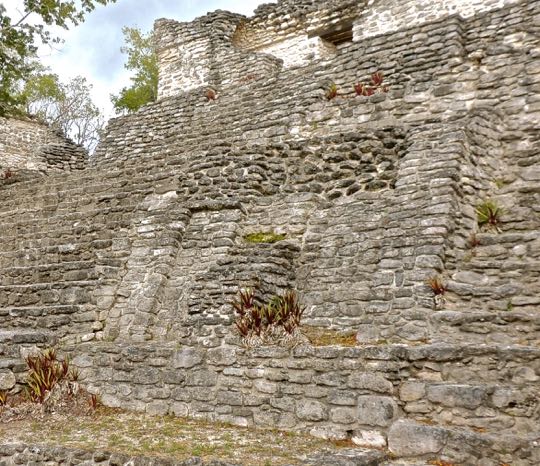
The Acropolis of Kinichná, viewed from the southwest corner. An acropolis is a citadel built on an area of high ground. Kinichná  ("The House of the Sun God") is a massive, four-level, pyramidal structure, with five temples on its upper three levels. Within the interior of the Acropolis, a royal crypt was found that contained the remains of two people. Scattered around the base of the structure are the remains of several small residential palaces which were the homes of a branch of Dzibanché's Kaan (Snake) Dynasty.

Kinichná is connected to the core of Dzibanché by a broad, flat causeway, called a sacbe, which is surfaced with limestone stucco. Sacbe means "white road", a name that refers to the color of the stucco surface. The one that runs between Dizbanche and Kinichná is 2km (1.2mi) long. The ancient Maya constructed many such roads to connect important precincts within a city, as well as to connect one city with another. After visiting Dzbanché's ceremonial complex, we drove the short distance to Kinichná to check it out. (Photo from Shore Excursioneer website)


Overview:

Unusual tree near the entrance of Kinichná. The Acropolis and its associated structures are surrounded by thick jungle full of unusual trees and plants. However, all this grew up after the site was abandoned, approximately 1300 AD. Before then, for at least a thousand years, the elite areas were surrounded by the homes of those who serviced their needs and, beyond that, by lush fields growing maiz and other crops.

The area around Dzibanche has an abundant supply of surface water, which is not typical of the rest of the Yucatan Peninsula. Most of the rest of  the Peninsula is a flat shelf made of porous limestone. Water, in those areas, does not remain on the surface to create rivers and lakes, but seeps down into underground caverns and river systems. In northern Yucatan, cenotes (sinkholes) provide nearly the only reliable access points. In areas lacking cenotes, the ancient Maya created channels to direct rainwater to bottle-shaped, underground storage pits called chultunes.

However, surface water is abundant in the southeastern Peninsula. Around Dzibanché, low lying areas collect rain water to form aguadas (seasonal ponds). One of these is adjacent to Kinichná. The aguadas were sometimes natural, but often were engineered. In addition, large swampy areas called bajos not only provided water, but also created a build-up of fertile sediments. The combination of water and fertile soil allowed for an agricultural system capable of providing sustenance to a large population. As a result, during the Classic Era, Dzibanché grew to cover 40 square kilomenters. Archeologists theorize that Kinichná was founded as a way to exert control over the fertile bajos to the north of Dzibanche's center.


A royal figure is dressed by servants in preparation for a great ceremony. The servant on the left adjusts a jade bracelet while the one on the right mixes pigment to be applied as makeup. The ruler is dressed in an elaborate costume, including a large quetzal-feather head dress and the skin of a jaguar. His lower legs and ankles are adorned by more jade. While the photo above is from a reproduction of a mural from another city, the rulers at Dzibanché probably looked very similar in appearance and dress. (Photo taken at the Museum of Maya Culture in Chetumal)

The Maya system of governance during the Classic Era bore some resemblance to the feudalism of Medieval Europe. The ruler of a single city was called ajaw (lord).The top figure in a city like Dzibanché was called kaloomté (overloard). The title indicates that ajaws from surrounding cities or towns owed him allegiance and probably tribute.

Many of Dzibanché's subject cities were ruled by members of the Kaan Dynasty, These ajaws often achieved their positions through marriage alliances or conquest. The images of the seventeen captives carved into the stone steps of the Temple of Captives were those of ajaws captured during conquests by Yuknoon Ch'een I, the kaloomté of Dzibanché in 495 AD. Almost certainly, the captives depicted were sacrificed and then replaced by Yuknoon Ch'een's relatives or trusted subordinates.


Maya rulers maintained and extended their domains using a warrior elite. It is probable that Kinichná was protected by warriors like these. In the center of the scene above, the leaders of two groups of warriors each grip the shaft of the same spear. This may indicate a meeting of allies, or perhaps a ritual in preparation for conflict between the two groups. The elite status of these warriors can be seen in their elaborate and expensive costumes. These include jaguar skins, exotic bird feathers, and even a crocodile totem. (Photo taken at the Museum of Maya Culture in Chetumal)

Maya warriors wore cotton under-armor, covered by palm-fibre armor. Other items of dress included a rigid waistband from which a long embroidered sash hung down the front. A short skirt made of flexible strips and knee protectors completed their battle dress. The warriors carried shields, either small and round or large and rectangular, depending upon their weapons. They were armed with a 2m (6ft) spear, as well as hand weapons made of wood and edged with obsidian. During the middle of the Classic Era, the influence of Teotihuacan was very strong. As a result, the Maya adopted the atlatl, a spear-throwing device used by Teotihuacano warriors. Not much is known about tactics, but the opposing armies appear to have fought in close order, with the ajaw and top nobility clustered in the center of the battle line. In addition to the political and economic goals of the war, capturing the enemy for sacrificial purposes was considered important.

The societal impact of Maya warfare appears to have reached far beyond the elite class and its warriors. The winning side often experienced an increase in population and wealth. Major building projects often occurred after victorious wars, enabled by captive labor. The losing city's population tended to decrease. Outlying districts were often abandoned, with the remaining population settling closer to the urban center. Building projects decreased or ceased for a time, as did inscriptions on stelae.

During the first half of the Classic Era, warfare was controlled and there appears to have been a code of behavior that inhibited wars of mass destruction and annihilation. However, by the end of the Classic Era, warfare seems to have become much more intense and widespread. All this violence was one of the causes of the collapse of the Classic Maya society between 900-1000 AD. However, it has recently been determined that Dzibanché, unlike its contemporaries, continued as a functioning Maya city state until about 1300 AD.


Level A: The base of the Acropolis


Large trees grow on the broad staircase leading from the plaza to Level B. I am not certain whether the trees were retained for aesthetic purposes or possibly to help maintain the stability of the structure. Level A is a huge, pyramidal foundation and is the tallest of the four levels of the Acropolis.


The stone walls on either side of the staircase are filled with large, abstract designs. Their meaning is unknown, at present. The designs may extend all the way around the base of the Acropolis, but much of the structure has yet to be excavated.


The un-excavated rear of the Acropolis. This is how the whole structure would have appeared when it was discovered in 1927 by an amateur British archeologist named Thomas Gann.


Level B's twin south-facing temples

Topographical schematic showing the approximate location of Level B. As you can see, the Acropolis completely dominates the landscape around it. As a man-made structure, it must have taken immense effort and thousands of man-hours to build. As an expression of Kaan power, it was intended to impress both Dzibanché's own population and the rest of the Maya world.


Level B contains two, identical, south-facing temples, one at either end of its broad terrace. These structures each have two levels, with a staircase on their south sides leading up to the temple on top. The rounded corners in the center of the photo show the influence of the Petén-style of architecture, popular in the Early Classic period (200-600 AD). All three levels of the Acropolis are from that era, along with its five temples and the royal burials under the top temple. At some point in the distant past, the temple above was looted.


The interiors of the twin temples each have two vaulted galleries. The temples are entered from a single doorway at the top of the temples' stairways. This photo was taken at the entrance of the west temple, looking toward the rear. The galleries have an east-west orientation and were once covered by corbel ceilings.

While the gods and rituals associated with these temples remain a mystery, there may be a hint in their geographic orientations. Both face south, which is one the five cardinal directions sacred to the Maya. In fact the entire Acropolis is aligned on a north-south, east-west basis. In the view of the ancient Maya, the cardinal directions (north, south, east, west, and center) were not simply set on a horizontal plane, but were three dimensional. North and south also represented up and down.


View of the back of the east-side twin temple. Both of the twin structures underwent at least three stages of construction involving enlargements of their bases, but no change to the temples themselves.

The orientation of the Acropolis and its temples is significant because the cardinal directions were considered sacred. Itzamna, the Maya creator god, had four sons called the Bakab. Each was assigned to hold up one of the four corners of the world, which corresponded to four of the cardinal directions. Itzamna was apparently in the center. The Bakab named Hosanek was given responsibility for the world's southern corner. The four Bakab were also associated with Chaak, the all-important god of rain. So, it is possible that prayers and rituals associated with Hozanek, or Chaak, or both, could have taken place here.


Drawing of a small figure found on Level B. It is probable that the little statue had some ritual purpose. The figure stands with its hands raised, wearing what looks like modern boxing gloves. The closed eyes, expressionless face, and raised hands give the appearance of prayer. However, that may only reflect my modern perceptions.


A broad staircase extends up from Level B's terrace to Level C. A tourist steps carefully as she makes her way down the ancient steps. Level C's east and west temples face each other on either side of the top of the stairs. Between and above them stands the the top-most temple, a dark doorway showing its single entrance. On either side of the staircase are four large, sloping panels which can also be seen in the first photo of this posting. Two panels are on each side, with one above the other. Each of these panels once contained a big stone mask.


Lower right panel, next to the staircase. In the middle of the panel are the remains of the mount where the mask was placed. The masks are believed to have represented Kinich Ahau, God of the Sun. The discovery of a Sun God mask gave the Acropolis its name: House of the God of the Sun, or Kinichná. Similar masks of Kinich Ahau are still in place on either side of a temple staircase in the ancient Maya city of Kohunlich, not far to the south of Dzibanché. We will visit Kohunlich in a later posting.


Level C's twin temples face west and east.

The front of the west temple faces the rising sun. Level C's twin temples each have a single gallery, oriented on a north-south basis. Each also has a single entrance, which is gained by a four step stairway. Of the five temples on the Acropolis, these are the only ones that do not face south. Once again, the gods and rituals connected with Level C's temples are not known. However, Kinich Ahau is associated with the east, where they believed the sun is born each day. A priest facing outward from the doorway of the temple above would be looking east, toward the rising sun.


The twin temple on the east side of Level C faces toward the west. The four steps leading up to the temple can be seen in this photo. If you stand in the doorway of this temple, looking out, you face in the direction of the setting sun. That is where the sun goes to die, before being reborn the next morning. Other interesting features of the twin temples include the sloping walls, or pediments, leading from the base of the temples down to the Level C terrace. Directly above each sloping wall is a vertical panel. This arrangement may reflect the talud y tablera architectural style of Teotihuacán. The influence of Teotihuacán on the Maya was greatest during the Early Classic period when the Acropolis was built.


The topmost temple

The temple at the Acropolis' summit faces south. The staircase ascending from the Level C terrace to the temple has nine steps, a significant number to the ancient Maya. Xibalba, the underworld of the dead, had nine levels. The number of stairs here may be a reference to the tomb found under the temple. In terms of the sacred directions, this is the most northern of the five temples and occupies the highest position on the Acropolis. In addition, the temple faces south and looks down to the plaza far below. Thus, from the Maya point of view, the temple has both horizontal and vertical orientations. Itzamna is associated with both the sky and the center of the world. This temple is both the highest point on the Acropolis and the center of the whole structure. Given all that, my best guess is that Itzamna may have been worshipped here.


The front gallery of the top temple. The temple has two galleries, or corridors, laid out east to west. Above, you can see the remains of the corbel arch that once formed the ceilings of both galleries. The entrance is on the right, above, and the passage continues through to the back gallery. Against the wall of this gallery you can see two low benches, or possibly altars. Underneath the temple floor, archeologists found a tomb containing the remains of two people.


Finely carved jade masks were among the grave goods buried in the tomb. The drawing above is an artist's rendering of the masks. I have been unable to find any photographs specifically identified as the masks from this tomb. The tomb's location, as well as the amount and quality of carved jade and other grave goods, both suggest the burial of at least one kaloomté from Dzibanché's early Kaan Dynasty. It is possible that the second set of remains belongs to his wife or a close relative.


View toward the southeast from the front of the topmost temple. Given the height of the Acropolis, and the generally flat terrain around it, the vista is magnificent. I was glad that the authorities have not yet prohibited climbing its daunting set of staircases. Now, the real fun begins because the climb down from one of these places is always the most precarious.

This completes Part 4 of my Dzibanché series and marks the end the series itself. I hope you have enjoyed visiting Dzibanché and learning about its powerful Kaan Dynasty. If you would like to contribute any thoughts or leave a question, please do so in the Comments section below, or email me directly.

If you leave a question in the Comments section, PLEASE leave your email address so that I can respond.

Hasta luego, Jim