Showing posts with label Concepción de Buenas Aires. Show all posts

Friday, March 3, 2023

The Virgin of Guadalupe parade at Concepción de Buenos Aires: Part 2 of 2

A lone devotee prays at the chapel of the Virgen de Guadalupe. The flower-bedecked chapel is located in the Parroquia (parish church) on the Plaza, which was the end point of the parade. The Virgen de Guadalupe is not only a powerful religious symbol in Mexico but has great political and historical significance. In 1810, a banner with her image was chosen by Miguel Hidalgo, the Father of Mexican Independence, as his battle standard. 

In Part 2 of this series, I will show you the parade held in her honor on December 12 at Concepción de Buenos Aires. I'll wind up this posting with a great little spot for lunch, should you choose to visit this pueblo in the future. To locate the town, check out the map and directions I provide in Part 1.

The Virgen de Guadalupe Parade

A tractor from a local farm towed the lead float. Everything about the parade was obviously put together by the local people with great care and devotion. Nothing about it pandered to foreigners like us. All that made the experience even more interesting and downright charming.


View of the lead float from its rear. Almost hidden by the mounds of flowers, a lone charro stands watch over the statue in the front of the float. The Virgen de Guadalupe is nearly always portrayed in exactly the same posture and clothing. She first appeared to a Christianized Aztec man near Mexico City in 1531. Everything about her image and the legends that surround her carries both Catholic and pre-hispanic pagan meanings. 


A second float carried a live tableau. A woman kneels reverently before a young girl who is dressed as the Virgin. Mexicans are very attracted to religious pageantry and living tableaux. Sometimes, living actors even portray inanimate statues.


Children are often incorporated into the tableaux. Rural communities like Concepción de Buenos Aires are deeply religious. While parades like this are entertaining for everyone, there is always an underlying seriousness to these kinds of religious events.


In the back of the second float, another tableau. A pretty young mom and her daughter ride quietly by a spectator watching the parade. The mom gave me a Mona Lisa smile but her little girl looked a bit concerned by my photographic efforts.


And here come the charros. These were the last three in the line of horsemen, but certainly not the least. The streamers they ride under are in the colors of the Mexican flag. Along with the music, it was this set of streamers that originally attracted our attention to the point far down the street from the Plaza where the parade had originally gathered.


The local band brought up the rear. The group was made up of two drummers, a pair of saxophonists, one trumpeter and a tuba player sporting a large blue instrument. They banged and tootled along merrily, if somewhat off key at times. 


A cohetero prepares to fire. A cohete is a small rocket, about the size of a cigar, attached to a long stick. They are lit off by men known as coheteros, who are ubiquitous at fiestas of all kinds. Their rockets don't set off a visual display, other than the small cloud of smoke that appears when they explode high in the sky. The main effect is the deafening blast. Individually, this is startling but tolerable. However, when shot off in a barrage, the effect is akin to the Battle of Stalingrad. 


Small groups of spectators gathered  to watch. Multiple generations crowded together in doorways and storefronts. I particularly liked the little girl who wears a huge heart on her chest.


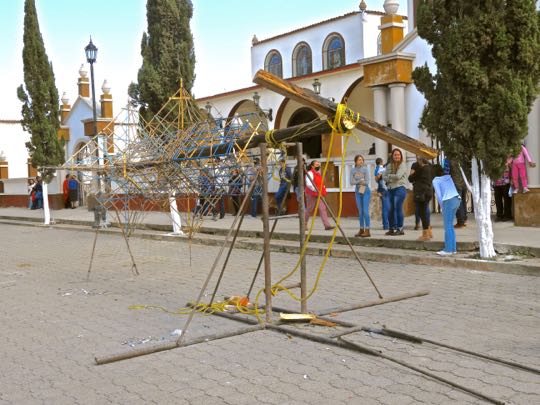
A castillo lies on its side in front of the Parroquia at the Plaza. A castillo (castle) is a pyrotechnic structure that vaguely resembles a Christmas tree. To erect it, a street will sometimes be dug up and the center post set in the ground. In this case, the castillo has a cross- piece to rest upon when it is upright. It will become the focus of the fiesta this evening.

The structure is festooned with small rockets that are interconnected by fuses. When the castillo is lit off, the many small circular devices connected to it will spin wildly, propelled by the rockets attached to them. The whole affair will be quite a spectacle as it showers sparks in every direction. However, we will be long gone by then.


Lunch at El Tio Lucas Bar and Restaurant

Jerry approaches Tio Lucas Bar and Restaurant. In Spanish, Tio Lucas means "Uncle Luke". The one-story brick structure occupies the corner of the Plaza at Calles Aquiles Serdán and Álvaro Obregón. I found it a little odd that the structure is entirely brick since wood is so heavily used in this town. The style suggests a 19th century creation.


A bearded barman, presumably Tio Lucas, sat ready to take any orders. The restaurant-bar was very cozy and homey. While our waiter didn't speak English, we knew enough Spanish to read the menu and order without difficulty. Photos of local people covered the walls. Some were of charros, while others were of local school sports teams and families celebrating various rural events.


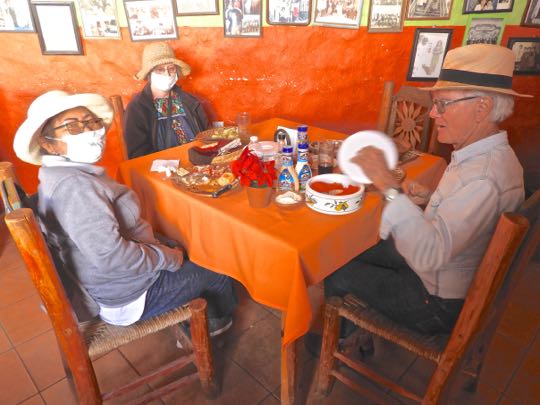
Jerry opens a dish of hot tortillas as we get ready to dive into lunch. The tasty menu mainly listed traditional Mexican dishes. These included the usual standards of enchiladas and tacos, along with salads and frijoles, but there were also some local specialties. Tio Lucas is definitely a good spot for a meal during a visit here.

The masks Lori and Carole are wearing were due to the heightened level of covid-19 in the area during December. Quite a number of our friends and acquaintances came down with it at the time. I wear one too, when in crowds or confined spaces like this. Better safe than sorry.


This friendly pair agreed to a photo as I passed through the Plaza. The guy is probably the abuelo (grandpa) of the young girl. He looks like a prosperous local farmer, in town for the big event. I get some of my best "people" shots when I encounter folks sitting in plazas like this. They almost never say "no" to a photo.

This concludes Part 2 of my series on Concepción de Buenos Aires and completes the series itself. I hope you have enjoyed it and, if so, you will leave any thoughts or questions in the Comments section below or email me directly. Please remember that if you leave a question, you need to include your email address so that I can respond in a timely manner.

Hasta luego, Jim


Tuesday, February 21, 2023

The mountain pueblo of Concepción de Buenos Aires celebrates the Virgin of Guadalupe Fiesta - Part 1 of 2

A local charro awaits the beginning of the Virgin of Guadalupe parade. A charro is not just a cowboy, but a skilled horseman who performs in charreadas (Mexican rodeos) and other events like fiestas. Last December, Carole and I and some friends decided to visit Concepcion de Buenos Aires. The small pueblo lies deep in the mountains of the Sierra del Tigre south of Lake Chapala. It was a crisp, gorgeous day, but it didn't occur to us at the time that it was the December 12. 

That is the day when the Fiesta de Virgen de Guadalupe is celebrated in Mexico. So, our short trip was rewarded not only with the pleasure of visiting this beautiful little town, but we were able to enjoy their local fiesta as a bonus. This two-part series will first focus on the pueblo itself and the charros and others who gathered for the parade. Part 2 will follow the parade itself. I'm hoping to provide you with a feel for how Mexicans in these small towns celebrate their fiestas. 


17th century aqueduct that once fed water to ex-Hacienda Toluquilla. The little pueblo of the same name is located about 1/2 way between the turnoff of Highway 405 and Concepcion de Buenos Aires. If you want to visit, watch carefully for the sign because Toluquilla itself is almost invisible from the road. The aqueduct can be found behind a gate across the road from the street that leads into the pueblo. Little else remains of the hacienda except a few adobe walls in the town.

In Part 3 of my 2012 Sierra del Tigre series, I show ex-Hacienda Toluquilla, and detail some of its 19th century history, along with how Concepción de Buenas Aires was founded on its lands. The hacienda was begun by Don Alonso de Ávalos, a captain under Conquistador Hernán Cortéz. The descendants of Ávalos eventually sold it to the Echuarri family, one of the three richest in Guadalajara during the 18th century. 

The Echuarris held it as part of a mayorazgo (entailed estate) for about 150 years from the beginning of the 18th century until 1853. A majorazgo was a hacienda (or collection of them) which couldn't be broken up but had to be passed intact to a designated heir. This was a strategy to avoid the fragmentation of estates that was a common problem during the colonial era. 

Among the various estates within the mayorazgo, the family also owned Hacienda San Francisco Javier, near Tizapan on Lake Chapala's South Shore, and Hacienda San Jose de Gracia, on the far side of the mountains that rim the South Shore. Both are sites that I have visited over the years.


How to get there. The route is fairly simple and requires about a 90 minute drive. The roads are all well-paved and quite good. Follow the road from Ajijic through Jocotopec to Highway 15. Then head to Tuxcueca on the South Shore, where you turn right on Highway 405 toward Mazamitla

After ascending the South Shore mountains, you descend into a valley where you turn right at the sign for Concepción de Buenos Aires. When you get there, you will see a large colorful sign on your right with the name of the town. Continue for another 7 blocks to Calle Constitución. Take a right and go 4 blocks to the Plaza Principal, also called the Jardin Central.


A town right out of a cowboy movie

A saddled horse waits patiently for its rider in the Plaza. This town could almost be a movie set for a Clint Eastwood western. I was reminded of one of those scenes where a gunfight is imminent and the whole town seems eerily empty. The word that always comes to my mind in describing Concepción de Buenos Aires is "pristine". 


Pillars line the arcade along Calle Constitución. Golden winter sunshine bathed the walls and streets, making for great photographic opportunities. The altitude of the town is 2126m (6975ft) which provides for a mild-to-cool year-round temperature. Light jackets or sweaters were all we needed in mid-December. The feel of a 19th century cowboy town was further enhanced by the almost complete lack of motor vehicles on the streets around the Plaza.


Calle Aquiles Serdan, looking west along the side of the Plaza. The mountains all around are thick with forests, so most of the pillars and rafters of the arcades around three sides of the Plaza are made from wood. Most of the buildings around the plaza and the area surrounding it are 1-2 stories, which helps maintain the old-fashioned feel of the place.


A small girl sits in the center of Calle Aquiles Serdan. She sat there for quite a long time, totally undisturbed by vehicle traffic of any sort. This underlined just how quiet the town was when we arrived. The church overlooking the Plaza is the Parroquia Inmaculada Concepción, devoted the the version the Virgin Mary who has the same title.


Calle Constitución, looking east toward Hotel Linda Vista. Only a single motor scooter and a couple of pedestrians break the spell of an old-west movie set.


Corner of Calle Constitución and Calle Ignacio Silva Romo. The old-fashioned building above is the Hotel Linda Vista. When I occasionally stay in a small Mexican town, I will often seek out an old hotel like this. The amenities are often limited, but the atmosphere is wonderfully antique. I have found the owners of such places always eager to tell stories about their hotel's history. Soon it is a case of "mi casa es su casa" (my house is your house).


Plaza Principal, also known as the Jardin Central. The Plaza is spacious, with lovely gardens, fountains, cast iron benches, and the almost obligatory kiosco (bandstand). As was the case everywhere else, it was virtually empty when we arrived.


Gathering for the Virgin of Guadalupe Parade

A motorcyclist passes under patriotic streamers on Calle Constitucíon. The colors are red, white, and green, the same as the Mexican national flag. The Virgin of Guadalupe is a political symbol in Mexico, along with her religious importance. In the distance, we could faintly hear a band playing so we decided to investigate. Mexicans often leave fiesta decorations up long after the celebration, so, at this point it still hadn't dawned on us that this was the 12th of December.


Ermita de la Virgen de Guadalupe. This elaborate monument sits in a small plaza at the south end of Calle Hidalgo, seven blocks south and one block east of the the Plaza. When we looked down the street toward the music, we could see more streamers and a small crowd of people, so we decided to walk down and investigate.


At the monument, charros were gathering for the parade. As soon as we saw the monument and the charro outfits, it dawned on us that we had stumbled into one of Mexico's annual Virgen de Guadalupe events. While vaqueros (cowboys), with their traditions and techniques, have been around since the Spanish Middle Ages, charros are a phenomenon that followed the Conquest of Mexico.

Ironically, although charros are respected and honored today, the term was once one of contempt. It used to mean uneducated, unpolished, rough, rustic, clownish, and ill-bred. The term probably originated from Arabic or possibly from the Spanish Basque term txar

It first appears in 1627 and it wasn't until 1803 that it began to have a more neutral meaning. The status of charro steadily improved during the 19th century, particularly during and after the War of Independence, when charros played key roles as mounted militia organized by hacienda owners to fight against insurgents and bandit gangs.


The distinctive charro outfit has become a symbol of Mexico. It is worn not only by horsemen, but mariachi bands and others seeking to invoke the tradition. The most obvious part of the charro outfit is the wide-brimmed sombrero. Its high crown and the up-turned edges of the broad rim are often embroidered. Tight-fitting shirts or jackets, along with tight pants, are often adorned with silver trimming. Tooled leather boots and jangling spurs complete the picture.

The man who legitimized charros more than any was Emperor Maximilian, who was installed by France between 1862-67. He both admired charro horsemanship and sought to ingratiate himself with the people. Later in the 19th century, the dictator Porfirio Diaz recruited charros into his rurales (rural police) to chase down bandits as well as workers fleeing debt-slavery on haciendas. The association with the rurales conveyed manhood, strength, and nationhood.  


A charro practices his rope work. The practical use of the rope is to capture and restrain cattle and horses. A skilled charro can do extraordinary things with a lariat, sometimes approaching ballet. Completing the charro image is the horse and its associated gear. 

Everything you see above was invented by the colonial Spanish and 19th century Mexicans long before the first Texan pulled on his spurs. American cowboys were truly "johnnies-come-lately" and borrowed virtually their entire tradition and technology from Mexico. You would probably never get them to admit it, though.


What is a Mexican fiesta without the local brass band? A saxophone player tunes up next to a drum. This was one of the fellows who had first attracted our attention. Usually, a band like this marches behind the charro delegation, playing earnestly, if sometimes off-key. The charros train their horses to dance to the music, creating a highly entertaining spectacle.

This completes Part 1 of my series on the fiesta at Concepción de Buenos Aires. In Part 2, we'll follow the parade as it makes its way to the Parroquia at the Plaza. I hope you have enjoyed Part 1 and, if so, you will leave any thoughts or questions in the Comments section below or email me directly.

Hasta luego, Jim


Sunday, September 30, 2012

Sierra del Tigre Adventures Part 1: A visit to the mountain town of Concepción de Buenas Aires

A quiet winter day at the Plaza. The plaza of Concepción de Buenas Aires and the streets around it are rustic, but immaculate. Over several years, I have on numerous occasions passed through this small town, usually while on the way to somewhere else. On a couple of occasions, however, I took some time and looked around. The little mountain community turned out to be yet another of Mexico's seemingly endless supply of hidden jewels. Concepción de Buenas Aires is located in the Sierra del Tigre, a range of rugged mountains to the south of Lake Chapala, about 90 minutes by car from our home in Ajijic on Lake Chapala's North Shore.  The town can be reached by turning southwest off the highway connecting the South Shore town of Tuxcueca with Mazamitla, a popular mountain resort. The turnoff is about half way to Mazamitla, shortly before reaching Manzanilla de la Paz. The two-lane blacktop road passes small ranches and farms set in the lush green fields of a high-country plateau called El Llano de San Sebastian. Fat cattle graze while the occasional Mexican cowboy trots past with a string of beautiful horses. I recently decided to create a three-part series about the town and the area around it, including Las Cascadas Paraíso (Paradise Waterfalls) and the ruins of Hacienda Toluqulla. This first part will focus on the town itself. To locate Concepción de Buenas Aires on a Google map, click here.


El Templo de la Inmaculada Concepción

The banner-bedecked steeple of the Templo shows evidence of a recent fiesta. Construction began in 1864, so the Templo is relatively new, like the town itself. The steeple was built in the Neo-Classical style popular in the 19th Century. The dark, cloudy weather in this shot indicates that it was taken in a different season than the bright and brilliant winter scene of my plaza photo. You may notice these seasonal disparities throughout this series since the photos were taken during several different visits.


The main nave of the Templo is beautifully hung with blue and white draperies. The windows near the ceiling on either side give this room an unusually light and airy feeling. During my research for this posting, I discovered that on June 7, 2012, TV Azteca News reported the discovery by  parishioners of an image of La Virgen de la Concepción Inmaculada which had suddenly appeared on the wall behind the altar (center of the photo). The Virgin is the patron saint of both the Templo and the town itself. Since the image was apparently not visible at the time I visited, I unfortunately did not get an opportunity to see if I could photograph it. Jalisco is one of the most traditional of all Mexican states. The Catholic faith is particularly intense in backcountry towns like Concepción de Buenas Aires.


My photographer's eye was attracted by this exuberant scene. An absolute bee-swarm of cherubs framed this statue of the Virgin. Cherubs were popular decorative elements in 19th Century art and architecture.


San Isidro Labrador seemed especially appropriate for this working-class town. San Isidro the Laborer (or the Farmer) is the patron saint of farm workers. He is particularly revered for his goodness toward the poor and animals. Isidro, born 1070 AD, was a laborer on the estate of wealthy Spanish landowner Juan de Vargas. His fellow workers claimed that he was absent a lot and not doing his share. When the landowner investigated, he found Isidro at prayer while an angel took care of his plowing. On another occasion, Isidro brought Juan de Vargas' dead daughter back to life. All this seems to have gotten the wealthy man's attention, because he ultimately made Isidro the manager of his properties. Oddly, the farmer-saint married a woman, Maria Torribia, who also became a saint and is known as Santa Maria de la Cabeza. After a miracle saved their child, the couple decided on chastity and from then on lived in separate houses. Isidro died in 1130 AD. Four hundred years later, Spanish King Phillip II (the one who launched the Armada against England) was cured of a deadly disease when he touched some relics of the deceased saint.


La Plaza

A small but lovely kiosco fills the center of the Plaza. Several walkways radiate from the kiosco, passing through lush gardens. Concepción de Buenas Aires is also known as Pueblo Nuevo (New Town) because it was not built until the mid-19th Century. The area on which it was constructed, called El Llano de los Conejos (The Plain of Rabbits), consisted of rolling farmland and woods until the 1860s. The area was originally part of the vast lands awarded in the 1540s to Captain Alonso de Avalos, one of the Hernán Cortéz' conquistador officers. He was also awarded the lands along the South Shore of Lake Chapala about which I have already written in my posting on Hacienda San Francisco de Assisi. In the early 1600s the land passed into the hands of a Spaniard known as Don Joaquin Fermin Echuari, and remained in his family for the next 200 years.


Rafael Urzúa Arias is memorialized by this statue in the Plaza. Urzúa, born in 1905 in Concepción de Buenas Aires, was a famous Mexican architect whose life spanned the 20th Century. His work is noted for its freshness, naturalness, and playfulness, and he is ranked with Luis Barrigan as one of Mexico's great 20th Century architects. The statue was erected in 1988, three years before Urzúa's death in 1991. 

Back in the early 1860s, Benito Echuari, a descendant of Don Joaquin Fermin Echuari, was approached by Father Ignacio Romo, a parish priest based in the town of Teocuitatlán. In those days, parish priests had to cover far-flung areas, requiring them to travel for many days over primitive roads. Father Ignacio's parish extended from the Hacienda Huejotitán, near Jocotopec on the west end of Lake Chapala, to the Hacienda Toluquilla in the Llano de San Sebastian. The priest proposed to Benito Echuari, who owned Hacienda Toluquilla, that he should set aside some of his land for a town which would have its own church, as well as a market and school. So, Concepción de Buenas Aires came about--at least in part--because of a priest's saddle-sores!


Independence War leader Father Miguel Hidalgo y Costilla has his own statue. While Hidalgo is revered as the first great leader of the War of Independence from Spain, and as emancipator of the slaves and indigenous people, his actual role lasted only about a year until he was defeated, captured, and executed by the Spanish who displayed his head as a trophy in Guanajuato. Father Hidalgo is an excellent example of the old saying that you can kill the man, but not the idea.

One hundred fifty years later, Benito Echuari and his son Pablo thought Father Ignacio had an excellent idea. I suspect that their enthusiasm had less to do with saving souls than with the prospect of a great increase in economic activity which would benefit Hacienda Toluquilla. They set aside El Llano de los Conejos, along with an area called Lomas de San Sebastian (Hills of San Sebastian), and recruited about two dozen settlers of Spanish descent called criollos. They even allowed the use of stone from their hacienda's aqueduct to be used in the construction of the new church. With the blessing of Guadalajara's Bishop Pedro Loza y Pardavé, the town was formally founded in 1869. The community grew quickly and only 19 years later, in 1888, it became the chief town of the new municipalidad (equivalent to a US county) called Concepción de Buenas Aires.


The portales along one side of the plaza stand empty on a winter morning. Mexican businesses in small towns don't generally get going until mid-morning, but often stay open until late in the evening. We arrived on this visit about 9 AM and the Plaza and streets around it were eerily empty, almost like a movie set. Although Concepción de Buenas Aires is not old by Mexican standards, it feels old, kind of like a 19th Century town frozen in amber.


Farmacia Maria Isabel is one of numerous small businesses facing the Plaza. The shop sign just beyond, with the head of a cow, announces a carneceria, or butcher shop. This shot was taken in mid-afternoon when activity had picked up some. Even so, things are slow and fairly quiet most days in this off-the-beaten-track mountain town. There always seems to be time for locals to chat on a bench or lounge against one of the columns supporting the portales.


Just beyond the carneceria is the Restaurant Las Espuelas. The name means "The Spurs". This is definitely a cowboy joint with old photos of Pancho Villa covering the walls. Many small town plazas lack any kind of sit-down restaurant, perhaps because there is often little extra money for dining out and local people tend to eat at home. However, Las Espuelas was a genuine, full-service restaurant and the traditional Mexican fare was tasty and inexpensive.


Two of our party found dessert down the block from Las Espuelas. While many Mexican plazas may lack a restaurant, there will nearly always be an ice cream parlor. Above, Phil (a Canadian) and Mike (an American) salute me with their newly-aquired ice cream cones. They were part of a hiking expedition to explore a nearby canyon reported to possess a large waterfall. The local folks observed us with friendly curiosity.


Street scenes

Big cowboy, small horse. Judging from the type of shovel he has strapped under his leg, this fellow has just returned from digging some fence post holes. I have become used to scenes like this, even in the more urbanized areas near where I live. When I emerged from my house in Ajijic this morning, there were three loose horses grazing along the sidewalk across the street. Even as I sit writing this, I can hear cattle lowing in the distance. It is one of the many charms of life in Mexico.


The new and the old. As we strolled the streets of Concepción de Buenas Aires, we came upon this scene. I thought the burro tethered next to modern farm machinery was a good metaphor for Mexico today: the old ways existing side-by-side with the new. Mexico has 3 million burros, one of the largest populations in the world. They arrived in the Americas on Columbus' second voyage in 1495, and in Mexico in 1528. However, they have been used in Europe and the Middle East since biblical times.


Tianguis Day falls on Tuesdays. On one visit, we encountered a crowded local tianguis, or street market, near the Plaza. Tianguis is a Nahuatl word, from the language of the Aztecs. In his book "The Discovery and Conquest of Mexico", Conquistador Bernal Diaz del Castillo described the great tianguis of Tenochtitlán, the Aztec capital (now Mexico City). Except for details like clothing, and some of the goods on sale, the scene wouldn't have been much different from this.


Weighing it the old fashioned way. A scale like this would have been completely familiar to anyone attending a similar tianguis in the newly founded Concepción de Buenas Aires of 1869. Even though digital scales can often be found in Mexican stores, many people see no reason to change from the old ways. If a scale like this still works, why spend money on a fancy new one?


Speaking of ancient technology. Mike and Anna, a young Dutch hiker, examine a classic specimen of automobilius wrectus, possibly with an eye toward a purchase...or not. This car was so battered and disreputable, it was almost a cliche. When I first moved down to Mexico, I expected the roads to be filled with this kind of clunker. I was surprised to find many shiny, up-to-date models, even in small towns. It was not clear what the asking price for this one might be. Any takers?


A friendly townsman invited us to tour his house. We were preparing to get in our car when Mike, a friendly sort of guy, began to joke with a young boy standing in a nearby doorway. A moment later, the boy's father strolled up the street, introduced himself, and invited us in to see his place. Since the vast forests of the Sierra del Tigre are very near by, wood is heavily used in construction of homes and other buildings. This gentleman beautifully decorated the interior of his home with pine panels and wood furniture, some of which you can see here.


A private collection of ancient artifacts. The homeowner constructed a coffee table out of a huge gnarly stump, and used it to display a variety of small objects he had collected in the area over the years. It is not at all an unusual experience to be invited into the homes of Mexicans we meet, even when we are complete strangers to them.


Concepcion de Buenas Aires made it to the Oscars! As we strolled about the streets, we passed the "Bar Melis", a small, rustic cantina. It was closed, but I noticed this plaque next to the door. The sign says "In this place was filmed part of the movie 'De Tripas Corazon', nominated for an Oscar in '97, by director and writer Antonio Urutia". I later Googled this information and, sure enough, Urutia's short film got a nomination that year, but alas did not win the famed gold statue. Concepción de Buenas Aires is certainly a scenic and evocative town and I could well understand its choice as a film set.

I hope you have enjoyed Part 1 of my Sierra del Tigre series. Next week, in Part 2, we will visit Las Cascadas Paraíso, a huge waterfall pouring down into a deep canyon. I always appreciate and encourage feedback. If you would like to leave a comment, please do so either in the Comments section below, or by emailing me directly.

If you leave a question in the Comments section, PLEASE leave your email address so I can respond.

Hasta luego, Jim