Showing posts with label Mazatlán. Show all posts

Wednesday, March 2, 2011

Mazatlán Part 6: The quiet, palm-fringed beaches of Isla de la Piedra

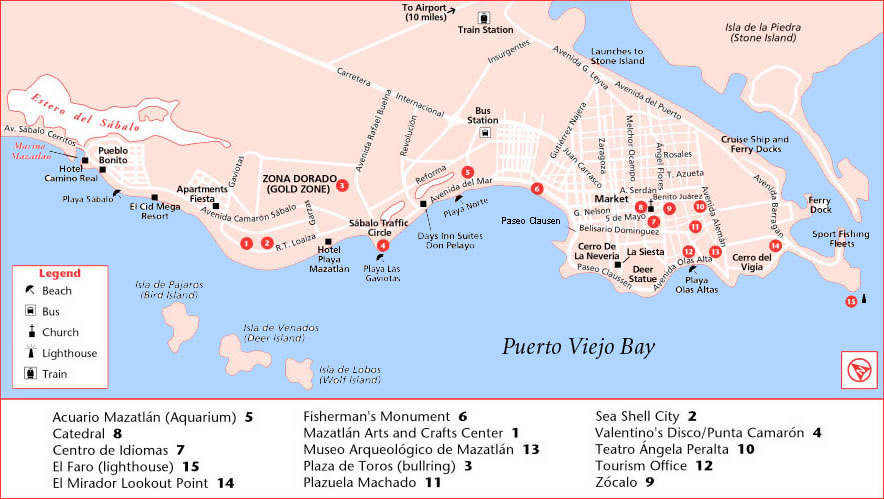
Isla de la Piedra lives in a different world from the rest of Mazatlán. The beaches of Mazatlán are bordered by a nearly continuous line of businesses, hotels and restaurants. In back of these lies a very busy city. Carole and I heard about Isla de la Piedra (Stone Island) from our neighbors in Hotel La Siesta. They spoke of thatched palapas housing rustic restaurants along the initial stretch of beach, followed by quiet, palm-lined beaches stretching endlessly to the horizon. If solitude and serenity are what you want, just keep walking south along the beach and you'll quickly find it. It all sounded dreamy and we couldn't wait. To locate Isla de la Piedra in relation to Mazatlán, click here.

The journey to Isla de la Piedra


Frigate birds circle above fishing boats near the ferry dock. We embarked for Isla de la Piedra from a small, picturesque harbor filled with fishing skiffs. Clouds of frigate birds whirled above. There are several docks along the inner harbor where you can take a ferry across to Isla de la Piedra. We were looking for something quick and inexpensive, so we picked this dock. The cost is about $2.50 (USD) per person, and the journey takes about 15 minutes each way.


Our boatman and his craft. The boatmen are an efficient but easy-going bunch. The ride was smooth, with no untoward events. He graciously steadied his rocking boat so I could get a good shot.


More elaborate forms of transport are also available. These double-decker catamaran ferries are considerably more expensive, depending upon the tour you select. Some tours go around the inner harbor, and others out into the bay, stopping at some of the islands to view the wildlife. We didn't have time to do both a bay tour and Stone Island too, so we picked the island.


The Mazatlán-La Paz ferry gleams in its berth. This huge ferry crosses the Sea of Cortez to La Paz on the southeast coast of Baja California. The ship has cabins for passengers and space for their cars. The crossing to La Paz is one I would love to take, but since the ferry ride itself lasts 12 hours, it must wait until another time. 


Container ship Potrero del Llano. Mazatlán is not just the tourist-oriented beach resort envisioned by foreign visitors. The port is one of Mexico's busiest, and has been for 150 years. The ship's name means "Pasture of the Plains". 

About the island

A rustic palapa on a rocky hill overlooks Isla de la Piedra's crescent bay. After debarking at the dock, we followed a short path over a rocky hill to the beach. Along the way, we saw this picturesque dwelling. Palapas are open-sided structures, generally supported by rough wood pillars set directly into the sand. A ceiling of lighter branches is then roofed with inter-woven palm fronds. They are inexpensive and relatively quick to construct. Woven mats are sometimes put up as walls to protect from the breezes. On hot, bright days, they provide welcome shade. Often a woven hammock or two is strung up between the pillars
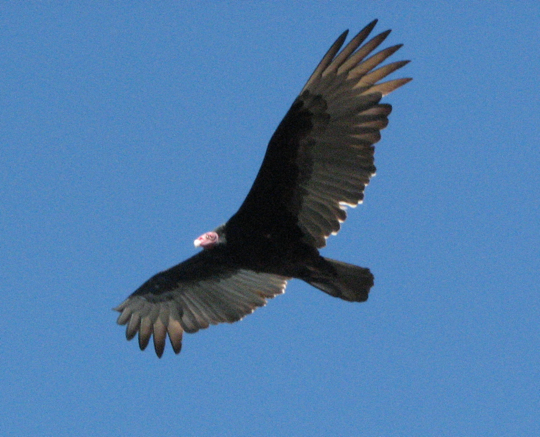

As we walked, Turkey Vultures swooped low over our heads. Known formally as Cathartes aura, these large birds are found throughout the Americas, the most widespread of the New World vultures. The Turkey Vulture consumes no live prey, being exclusively a carrion feeder. It possesses an excellent sense of sight and smell with which to find dead animals. While the body is relatively light (1.4 kg or 3.1 lbs) the wingspan is wide, ranging up to 183 cm or 72 inches. 


Thousands of coconut palms line the beach, their fronds gently swaying in the ocean breeze. Mexico's coconut palms, at least those on the West Coast, probably originated from coconuts drifting over from Polynesia. In any case, they were well established by the time Columbus arrived in the Western Hemisphere in 1492. The trees are cultivated in massive groves all along the coast. The coconut palm is an extraordinary plant, supplying meat, milk, oil, and a variety of materials for building and craft products. 


Isla de las Chivas sits at the tip of the crescent bay. Isla de las Chivas (Goat Island) used to be a separate island, but Mazatlán authorities built a causeway connecting it to Isla de la Piedra. Stone Island itself is not a true island, but is a peninsula which can be reached by car from the mainland. However, it is less trouble and much more fun to go by ferry. For a map showing both Islas de las Chivas and de las Piedras, click here.


Beachcombing the endless sands of Stone Island. After the first 1/4 mile, there are few man-made structures along the shore. Mile after mile of empty sand beaches fringed by rustling palm groves stretches away into the distance. Am I looking relaxed yet?


The schooner Patricia Belle rocks gently at anchor in Isla de la Piedra's cozy little bay. Athough there are fully equipped marinas to the north, near the Golden Zone, if I were a sailor, I would choose to anchor here. The Patricia Belle is available for tours of the area, if you have the $54 (USD) fare--$18 for kids.


Living his dream. The operator of Patricia Belle came on deck as I was photographing his boat. He looks pretty relaxed, himself. The boat seems to be of an older type, with little of the modern fiberglass and other synthetic materials used on newer sailboats. More beautiful, but harder--and more expensive-- to care for. As someone famously said "a boat is defined as a hole in the water into which you pour money."

Where to find something to eat or drink

Palapas on a grand scale. The initial stretch of beach was lined with palapa restaurants. We stopped in one for lunch. The floor was the bare sand underfoot, and a hammock was strung just behind our table. The fare included a variety of freshly-caught seafood, plus various Mexican dishes and other things like hamburgers and club sandwiches. In front of the restaurants was a line of small palapa umbrellas with lounge chairs underneath.


Quirky decorations covered the bamboo walls of the restaurant. Above, two colorful ceramic lizards appear to explore a piece of driftwood. 


Our waiter flagged us down as we walked by his restaurant. The perfect English spoken by this very amiable young man led us to inquire where he learned it. He grew up in the United States living with his Mexican parents, then decided to move down to Mexico and live on the beach. No doubt his employer makes full use of his English skills. Cruise ships dock just across the narrow channel and groups of passengers visit Stone Island on a regular basis. 


And now for a little tune (or two?). As always in Mexico, we encountered a group of wandering musicians. Since the day we visited was very slow for business, we took pity and ordered up a song. They played quite beautifully and were glad to pose for picture with Carole.

Whatever is there to do?

Roaming vendors also stopped at our table periodically. Many folks like to shop. Lolling in your chair, sipping your margarita, as the merchandise is brought to you is a pleasant, and very laid-back way to do it. Occasionally, I hear people gripe about the ubiquitous Mexican vendors in resorts. We have always found that a polite "no, gracias" sends them on their way, if we are not interested. We treat them with respect because they work very hard for very little.


There were a variety of modes of transportation available. I have read occasional reviews of Stone Island that claimed the horses are starving and mistreated. None of the ones above looked in bad shape, and I didn't see any that I wouldn't have rented, had I been inclined. Not that there aren't mistreated animals out there. We just didn't see any.


For those wanting a bit more speed. Vendors rent both motorcycles and ATVs. If I had been ambitious to explore the far reaches of the beach, this would have been the way.


And then there are the "banana boats". These are long inflated tubes with handles along the top. They come in various sizes and are towed by a boat. Above, two women are launched into the surf by the vendor. They appear to be grasping the handles for dear life.


And they're off! A banana boat speeds across the bay with its passengers clinging on as waves and the speedboat's wake buffet them. In the foreground, two children pause in their beachcombing to watch the show.


There is always the simple pleasure of digging in the sand. A toddler hugely enjoyed herself making holes as her mother looked on. She was so engrossed in her excavations that she never looked up while I took several pictures. Overall, we found the beach very clean, considering the amount of use it gets.


And, for the complete slug, there are always the lounge chairs under the umbrellas. As I grew sleepy in the warm afternoon sun, this particular activity looked increasingly appealing. 

The end of the day

Patriotic pelicans. As the day waned, we caught the ferry to mainland Mazatlán. Back in the small fishing harbor, I noticed this flock of brown pelicans hanging about under a Mexican flag flying over  one of the boats. I couldn't resist a photo.


Yet another spectacular sunset, as we finished our last day in Mazatlán. Intense bands of reddish-orange stripe the sky above two cruise ships setting out on a night-time voyage to another exotic seaport.

This completes my 6th and last post of my Mazatlán series. I hope you have enjoyed it, particularly those of you who have been happily frolicking in the snowdrifts up north. If you would like to leave a comment, please do so in the Comments section below or by return email. 

If you leave a question in the comments section PLEASE leave your email address so that I can respond.

Hasta luego, Jim

Thursday, February 24, 2011

Mazatlán Part 5: The ancient people


Ancient petroglyphs found in the Mazatlán area. This boulder, covered with mysterious designs, sits at the entrance to the Museo Arqueologia de Mazatlán (Archaeological Museum). Carole and I are fascinated by the ruins and other remains of Mexico's ancient cultures. When we heard about Mazatlán's small, but well-organized, museum in the Centro Historico, we put it on our "must see" list. The Museo is only a block or so from the Olas Altas malecon at Calle Sixto Osuna #76. Hours are Tuesday through Sunday, from 10:00 AM - 1:00 PM and 4:00 PM - 7:00 PM. For a map of the Centro Historico, click here. The petroglyphs shown above are very similar to those found at the wave-pounded volcanic rock of Las Labradas not far north of Mazatlán. The Las Labradas inscriptions may have been carved as early as 300 BC, attesting to the lengthy human occupation of the area.

Tatooed figure stands erect and proud. The markings on the small statue may represent some sort of clothing but more likely they are tatoos, because other statues representing humans show very little clothing, which would make sense given the climate at the beach. The figure above, like most of the rest of the collection I will show here, was crafted by the people of the Totorame culture. They were a peaceful people, living by agriculture and fishing. The Totorames did not construct grand temples and pyramids and I saw no representations of warriors among the artifacts of the Museo. There were certainly warlike people in the area, like the Yaquis in the mountains of northern Sinaloa, and the Totorames may have needed to defend themselves periodically. They knew the use of the bow and arrow and the atlatl spear thrower. However, there is no indication that the Totorames ever waged aggressive war, or engaged in human sacrifice.


Woman carrying containers. Many of the figures we saw were stylized and some combined human and animal features. These rather stout women are carrying large jugs supported by "tumplines" stretched around their foreheads. The woman on the right has raised her arms to grasp the tumpline in order to take the weight off her head, a very realistic detail by the sculptor.  These figures may be 1500 years old. I have seen modern-day indigenous women using the exact same tumpline method to carry large bundles. I continually marvel at the coexistence of the ancient and the modern in Mexico.


Beautifully carved cup or vase in the form of a kneeling man. The carving of this piece was very fine, portraying a man in a natural pose with very recognizable features. He kneels on one knee while supporting the large container on his back. He doesn't appear to be using a tumpline. Between the abundance of the sea and the fertile soil inland, the Totorames must have lived fairly well for their era. They could grow squash, beans, and corn, hunt deer and various small game, and collect mollusks and fish from the innumerable bays and coves of their coastline near Mazatlán. This abundance would have provided enough leisure for a craftsman to carve such a fine piece.


"The Thinker", Totorame version. I sometimes find the smaller pieces to be the most evocative. Above, a  human figure sits quietly, in a very natural pose. He leans forward slightly, with his elbows resting on his drawn-up  knees. He appears to be listening attentively, or perhaps contemplating some problem. The ancient paint on his body probably indicates bracelets, armlets, and anklets, along with a loincloth. Little more in the way of clothing would have been required for much of the year.


Trade networks

The Totorames traded extensively and collected goods brought over long distances. The map above shows that they traded for obsidian brought from the border area between modern-day Guanajuato and Michoacan States. There were a fine pair of copper axe heads in the Museo, which I was unable to photograph because of light reflections off the glass case. The axe heads may have come from deposits in northwestern Oaxaca. Archaeologists have also found copper bells thought to have been crafted by artisans in the Toltec capital of Tollan (Tula). The Totorame's peak period (750 AD - 1200 AD) was contemporaneous with the height of the Toltec Empire, located hundreds of miles to the southeast in the modern State of Hidalgo, .


This finely-worked obsidian blade probably originated in one of the great deposits to the south. Obsidian is a natural glass, formed volcanically. It was much prized by all the ancient inhabitants of the Americas because of its easy workability, the sharpness of the edge which could be obtained, and its beauty. Obsidian sources are not evenly distributed, but come in large, widely-separated deposits. These deposits became a major source of wealth for many of the ancient Mesoamerican civilizations in much the same way that the possession of oil deposits can make a nation rich today. A knife like this was almost certainly imported from someplace like the Toltec Empire.


Projectile points of obsidian, silex, and perdernal. The points above were created for different purposes. Those on the bottom row were for large game, or possibly warfare. The smaller points on the top would have been for small game or birds. Again, these may have been imported, either as finished products, or as raw material to be worked locally. Archaeologists have learned to analyze the obsidian itself to determine its point of origin, and thus reveal important trade networks. Obsidian was not only used to create utilitarian objects, such as blades and points, but was also widely used for jewelry, vases, masks, and for religious objects. The fact that it is found in many elite tombs indicates the high value placed upon obsidian in these ancient cultures.


Implements of daily living

Totorame three-legged pot. The lovely shape and beautiful, detailed paint work of this piece attests to the skill of the potter. Literally tons of pottery and pottery fragments have been recovered from Totorame sites. Their culture was not urban, in the sense of dense collections of buildings. The people lived in small houses, dispersed fairly widely. The houses usually had one room, with a vestibule in the front for cooking and domestic activities. Red painted pots were common, with unadorned red surfaces for cooking and highly decorated surfaces, such as seen above, for serving.


After dinner, a relaxing smoke. Above are a collection of beautifully shaped ceramic pipes, finely etched with abstract designs from the peak Totorame period. I can just imagine the previously-seen "Thinker" lighting up one of these after a fine dinner served in intricately painted bowls and cups. 


And, of course, an after-dinner drink. This lovely little cup is decorated with the head of a jaguar. The paint work is extraordinarily fine. It may have once been filled with pulque, a mildly alcoholic drink made from the maguey plant, which is widely distributed throughout Mexico. Indigenous people have brewed this beverage since long before the arrival of the Spanish. Pulque was widely used in Mexico until the end of the 19th Century, when European immigrants introduced beer. However, pulque can still be purchased from roadside stands in many rural areas of Mexico. 


After good dinner, and relaxing himself with a smoke and a drink, a man likes to sit quietly by the fire with his dog. This charming little ceramic piece from the early Totorame period shows a dog apparently scratching itself with a hind leg. The hole on the top of the dog's head may have had some practical purpose, such as holding copal incense.


Rituals and games

Ceremonial headress, known to Nahuatl speakers as copilli and to the Spanish as penacho.  This kind of headdress was used throughout ancient Mesoamerica.  Copillis are still used in indigenous dances and ceremonies such as those I witnessed on Los Dias de los Tres Reyes (Three Kings Day) in Cajititlan near Lake Chapala. Perhaps the most famous copilli of all was the one worn by the Aztec Emperor Moctezuma when he met Hernán Cortéz. Moctezuma's capilli was full of exotic green feathers from the quetzal bird, held together with threads of pure gold. Cortéz sent it to Charles V, whose Empire included both Spain and Austria. Moctezuma's head dress still exists and is on display in the Archaeological Museum of Vienna, Austria. Mexico and Austria continue to dispute whether it should be returned. I support the Mexican claim, since it was described as "stolen" from Moctezuma's palace by none other than Hernán Cortéz himself in a letter to Emperor Charles V.


Ceramic figure of a shaman or curandero (healer). This shaman figure is dated somewhere between 500-750 AD, during the early period of Totorame occupation. The figure appears to be part animal and part human. Adorned with antlers and large earrings, the shaman sits behind what may be a drum. Typically, in Mesoamerican cultures the shaman, or curandero, used rituals and often hallucinogenic drugs like peyote in their healing ceremonies. Particular animals had important powers which could be tapped in this healing process.


Implements used in the ritual Ball Game. Archaeologists believe that the Ball Game originated with the Olmecs more than 3600 years ago. I was amazed to find that it is still played by indigenous people in a handful of places around Mexico, including Mazatlán where it is called Ullama. Players use fields called tastes bordered with stones. There is still a ceremonial aspect to Ullama, which requires that the players practice total sexual abstinance before the game. Ullama typically played as part of community festival. Between games, the tastes are used as meeting places for a variety of activities. The ball is played using the hip, with the use of hands or feet prohibited. There is no evidence that the Totorame game involved human sacrifice, unlike the games played throughout most the rest of Mesoamerica. The mallet displayed above the ball is from the Tarahumara, a tribe which still clings to its ancestral lands in northern Sinaloa State around Copper Canyon. The Tarahumara use of the mallet in their game sets them apart from the ancient Mesoamericans.


Burial customs

The "final resting place" of these Totorames turned out to be the Archaeological Museum. For centuries the Totorames used coffins of straw, or sometimes no coffin at all, in their burials. Gradually, they adopted a post-mortem ritual that involved cleaning the soft tissues from the bones, dismembering the body, and then placing it inside a large funeral urn. The larger bones would be placed in the urn first, with the skull on top. Sometimes, an urn might contain the bones of several family members as you can see above. The ritual was meant to portray a return to the womb of the Earth-Mother, the goddess of agriculture worshipped in the Sinaloa area.


To the Totorames, certain aspects of dogs were sacred. The dog figure above is similar to the famous "Colima dogs" found in many ancient Teco tombs in the Colima area, far to the south. When Carole and I visited Colima we saw many funerary dogs in the Regional Museum there, although they were of  much better craftsmanship than this one. How this relatively unsophisticated little ceramic sculpture came to be in a Totorame tomb is a small mystery. It may have been imported from the Teco Kingdom, or it may have been a rough copy of one that the Totorame sculptor had seen.  These canine burial totems, called Xolotzcuintli, were related to resurrection myths surrounding the regular disappearance and reappearance of the planet Venus (the Morning Star).  

There is a great deal that we don't know about the Totorames, including what became of them. About 200 years before the Spanish arrived, the culture simply disappeared. Archaeologists don't know whether they were wiped out by tribal enemies or disease, or if they simply migrated to another area. However, after all the bloodthirsty, warlike civilizations I have studied in Mexico, it is somewhat of a relief to find one that was peaceful, artistic, and apparently immune to the temptations of human sacrifice.

This completes Part 5 of my Mazatlán series. In Part 6, my final part, I will take you to Isla de la Piedra (Stone Island) for endless, palm-fringed beaches, beautiful sailboats, and some unusual modes of transportation. I always appreciate hearing from people. If you would like to leave a comment, you can do so in the Comments section below, or just email me directly.

If you leave a question in the Comments section, PLEASE leave your email address so I can respond.

Hasta luego, Jim


http://cookjmex.blogspot.com/2010/01/colima-part-2-regional-museums-ancient.html

Thursday, February 17, 2011

Mazatlán Part 4: The Aquarium

Bony the Sea Lion enjoys a quiet swim at Acuario Mazatlán.  One of our most entertaining and memorable experiences at Mazatlán was our visit to the Acuario (Aquarium). Carole and I thought that viewing tanks of exotic fish might be interesting enough, but we found that the Acuario contains much more than that. In addition to the live fish, there is a considerable oceanic museum, a live crocodile pen, a tank full of performing sea lions, an aviary, and an entertaining flock of well-trained and vividly colored parrots. Bony the Sea Lion was the star performer among a whole group of these very intelligent animals. Above, he has just finished one of his regular performances and, with his tummy full of fishy rewards, he is cruising quietly around his tank. The Acuario is located in the middle of Playa Norte about 1 block east of the malecon, about 1/2 way between Playa Olas Altas and the Zona Dorado. To locate the Acuario Mazatlán, click on this map.


This giant statue of Neptune led us to believe we might be close to the Acuario. Neptune stands in the middle of the aquarium parking lot, seeming to silently hawk his finny displays. The Acuario address is Avenida de los Deportes #111. The facility is open seven days a week, from 9:30 AM to 6:00 PM. The fee for adults is $30 pesos ($2.50 USD). For a map of the Acuario displays, click here.


One of our first encounters was this huge skeleton of a grey whale. Many other beautifully stuffed fish, such as the spear-snouted blue marlin, were displayed on the walls. This was the only part of the Acuario not containing living creatures. Grey whales can reach a length of 16 meters (52 ft.) and a weight of 36 tons. The grey whale is descended from creatures that developed 30 million years ago and is the only living species in its genus and family. They were feared by whalers as one of the whale species that would fight back fiercely if hunted. The grey whale was hunted to extinction in the Atlantic Ocean by the early 18th Century, and became endangered in the Pacific until whaling was restricted in the late 20th Century. The biggest remaining population of grey whales migrates along the Pacific Coast between Alaska and Baja California. In May of 2010, a grey whale was sighted off the coast of Israel, leading scientists to believe they may be repopulating areas of the Mediterranean that have not seen these creatures for many centuries.


Cirujano Gris swims placidly in its tank. Also known as Acanthorus xanthopterus, the Cirujano Gris is found in a huge area from the coast of Africa, across the Indian Ocean to the Pacific Coast of the Americas between Baja and the Galapagos Islands off Ecuador.  Scores of tanks were filled with similarly colorful fish from around the world.


A California spiny lobster clambers slowly up a rock in its tank. This creature, officially named Panulirus interruptus, looks like a huge underwater insect. Its appearance beautifully matches the color and texture of the rocks in its tank. The lobster was so well camouflaged that it was a moment before I even saw it. The spiny lobster lacks the large claws of its Atlantic cousin, and is found along the Pacific Coast from Monterey California to the Gulf of Tehuantepec in Mexico. The female can carry up to 680,000 eggs. It lives on sea urchins, mussels, clams, and worms and is in turn hunted by a variety of predators including humans.


A mother Moray eel and her baby peep out of their hiding place. Some among the 200 species of this creature can reach a length of 4 meters (13 ft.). Moray's don't see very well with their tiny eyes, and rely on a highly developed sense of smell. They like to hide in rocky crevices and holes waiting for prey to wander by. Morays have large jaws with sharp teeth developed for tearing flesh. They are unusual in having a second set of jaws inside their throats which launch out and grab prey and drag it into the throat. This is probably because, with their narrow necks, they can't swallow prey like other fish. Morays are the only animal that does this. Morays can and do inflict serious injuries on humans. Watch your fingers!


Perruno cruises his world, possibly wondering at the strange creatures on the other side of the glass. The formal name of this fish is Perrunichthys perruno, and its range is Venezuela and Brazil. It is sometimes known as the leopard catfish, and originates in the Lake Maracaibo, a brackish bay in northern Venezuela connected to the ocean by a narrow channel. It is the largest lake in South America.


Pez Tigre, also known as Cirrhitus rivulatus. This creature, which gets its common name from its tiger-stripe markings, is found from the Gulf of California to the Galapagos Islands. It is also known as the Giant Hawkfish, and is found around reefs under fairly shallow water. The Pez Tigre is a favorite of divers because of it's sociability as it interacts with them.


Catsharks swim with a variety of other species in a large central tank. Catsharks, of the family Scyloirhinidae, are sometimes also known as dogfish. They live in temperate and tropical seas and can be found in depths from shallow intertidal waters to 2000 meters (6600 ft.). The ones shown above range in size up to 2.5 meters (8.2 ft.).


As John Lennon wrote "All you need is love..." To our surprise, the sharks were soon joined in their tank by a young Mexican diver. These potentially dangerous animals seemed accustomed to this intrusion, and allowed themselves to be held and caressed. One of them even towed the diver around while he hung on to its dorsal fin. For a substantial fee, you too can swim with these sharks. Having (fortunately) left my swimming suit at the hotel, I declined.


Looking like contestants on a TV game show, sea lions wait for their trainer's command. The delighted shrieks of children led us up a ramp to the sea lion tank. The Acuario is home to 6 well-trained sea lions. They are Bony, seen in the first picture, Cyli (left above), Toby (right above) and Ely, Lili, and Tito, whom we did not see that day. These enormously appealing creatures are intelligent, active, and mischievous, as well as naturally beautiful. Their expressive faces are vaguely dog-like and they share with their canine compatriots a desire to please and play.


Toby earns his treat the hard way. Standing on a rock platform, the trainer hung onto a bit of rope while he leaned out over the pool with a fish in his mouth. Toby swam several circles around the pool to gain momentum, then surged up to snatch the fish.


Bony, the star. Balancing his bulk on his flippers, Bony holds a ball on the tip of his snout. The trainer pretended to ignore the sea lion as he walked around the edge of the pool. Bony followed him everywhere, still holding the ball on his nose, while he tried to get the trainer's attention. What he really wanted, of course, was his fish treat. As soon as he gulped it down, he flipped the ball so that it bounced off the trainer's head and dove back into the water. The crowd went wild.


Bony, the Don Juan of sea lions. To the delight of the large crowd of school kids, the trainer invited one of their teachers to come forward. When she extended her cheek, Bony gave her a wet, fishy kiss. The kids were beside themselves.


Looking for volunteers. The trainer next asked the kids if anyone wanted to see one of Bony's special tricks, one for which they would have to come close to observe. There were many takers. Suspecting what was up, I readied my camera but moved to a safe distance.


Bony, the acrobat. The big sea lion circled the tank rapidly to prepare for his trick. Suddenly he surged out of the water into an airborne flip. The kids cheered deliriously.


Next, the deluge! When Bony's huge bulk hit the water, a tidal wave surged over the mass of kids at the end of the tank. Far from unhappy, the soaked and dripping kids howled with laughter and called for more.


Bony takes a bow. After his prank on the children, Bony mounted his podium and clapped his flippers, applauding his own performance. He was joined in this by everyone in the crowd. Bony was amazingly agile both in and out of the water for a 300 kg (660 lb.) animal. According to my research, the sea lions at the Acuario were orphaned or injured at an early age and could not be released back into the wild. They are well cared for by staff veterinarians. They seem to enjoy their own performances as much as the audience does.


Outside the fish tank area, crocs snooze in the morning sun. It was a chilly morning and the cold-blooded reptiles were sluggish and seemed only interested in finding a warm ray of sunshine. American crocodiles (Crocodylus acutus) inhabit the Pacific coastal lagoons and mangrove swamps of Mexico. Periodically, they injure or kill unwary or careless humans. 


Say ahhh! As he slept, this croc held his mouth open. Since they do not have sweat glands, crocodiles release body heat through their open mouths. Crocodiles as a species are at least 200 million years old. They were contemporaries of the dinosaurs, which went extinct 65 million years ago. Crocs survived the great extinction event and share the world with us today. This croc's posture, and proximity to the fence, helped me get a closeup shot of the fearsome teeth that grip and tear the flesh of his prey. I was tempted to see if I could wake him up by reaching in and tickling the roof of his mouth, but sanity prevailed.


Acuario Mazatlán also contains an extensive aviary and botanical garden. Above, a Brown Pelican suns itself inside the aviary. We walked the pathways around the inside of the large aviary cages and approached astonishingly close to the birds. The Brown Pelicans like this are quite large, with a weight of up to 5.5 kg (12 lbs.) and a wingspan of up to 2.5 meters (8.2 ft.). Even so, they are the smallest of the eight species of pelicans. Brown Pelicans are coastal birds, and dive dramatically for their fish prey.


Closeup shot of Great White Egret. Residents of areas around Lake Chapala, where I live, will recognize this creature, formally called Ardea alba. It inhabits much of the tropical and temperate regions of the world. In the Americas, it is found from the US Sunbelt states to the rain forests of South America. The Great White Heron feeds on snakes and small fish at the edge of bodies of water.


Parrots are another extremely varied and ancient bird. Parrots belong to 372 species in 86 genera of the order Psittaciformes. Some studies show that they may have originated 65 million years ago, about the same time as the dinosaur extinction. Parrots are some of the most intelligent of all birds, and some can imitate human voices. These capacities have caused them to be exploited more than any other bird species. This has also led to conservation efforts as their habitat has been progressively reduced. The parrot above quietly posed as I set up my shot.


A pair of white parrots dances from foot to foot in time to music. Some of the Acuario's trainers had worked with a group of parrots and put on a little show to demonstrate their intelligence and trainability.


As with the seals, trainers won the birds cooperation through treats. Above, the trainer prepares to reward a colorful red parrot as the two white ones anxiously wait their turn. The use of such rewards is part of something called "operant conditioning."


Pulling his weight. The trainer set the tiny cart on a table and seated the white parrot as a passenger. The green parrot proceeded to pick up the tongue of the cart with his beak and pull it down the table, to the cheers of the crowd.


Playing seesaw. Although a bit difficult to see against the foliage, a green parrot sits on the upper end of the curved ladder, and another sits on the bottom end. In the middle, a larger bird sits on a bar that connects the two ends. The large bird began rocking back and forth, giving his two smaller pals quite a ride. All the birds seemed well treated by the trainers, who handled them gently and with affection.

This completes Part 4 of my Mazatlán series. In my next installment, I will take you to Mazatlán's Archeological Museum to see some of the artifacts from the ancient cultures which once thrived here. As always, I welcome feed back. If you'd like to leave a comment, please either use the Comments section below, or email me directly.

If you leave a question in the Comments section PLEASE leave your email address so I can respond.

Hasta luego, Jim