Showing posts with label Costa Rica. Show all posts

Monday, July 4, 2016

Costa Rica Part 11: Puntarenas Coast & Manuel Antonio National Park

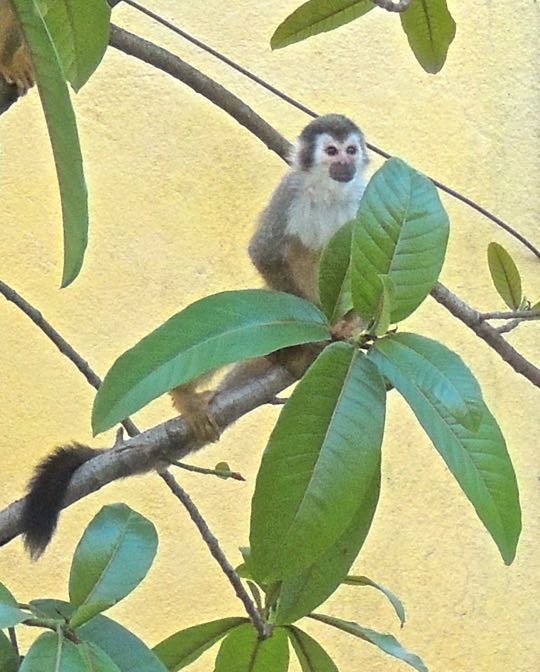
A Central American Squirrel Monkey clambers among the trees in Quepos. As our bus eased through the small resort town's thick traffic, the curious monkey followed along, scampering from tree to tree to observe us. The Squirrel Monkey (Saimiri oerstedii) is one of the several species of monkey native to Costa Rica. It can only be found along the country's central and southern Pacific Coasts and the coast of northern Panamá. This species of monkey is omnivorous and lives in groups of 20-75 individuals. Its population has declined since the 1970s due to deforestation and capture for sale as a pet. Efforts at conservation have improved the Squirrel Monkey's situation, although it is still listed as "vulnerable". The last leg of our Costa Rica tour before returning to San José took us along the coast of Puntarenas Province to the seaside pueblo of Quepos. One of the country's most famous wildlife preserves, Parque Nacional Manuel Antonio, adjoins the town. For a Google map of this section of Costa Rica, click here.

The coast of Puntarenas

The province of Puntarenas possesses spectacular beaches, some lined with luxury hotels. The beaches can sometimes be found along broad bays like the one shown above. Other times they lie along small crescent-shaped coves with rocky points at either end. The coastal mountains sometimes drop right down to the sea, but elsewhere they may be set back several miles, providing space for towns and farms.


One of the many luxury hotels fronting the beach along Puntarenas's coast. Tourism is a very large part of the nation's economy. Well-heeled visitors from North America and Europe, as well as elsewhere in Latin America, come every winter to bask in the sunshine. 


Off-shore islands like these dot the coast. Most are uninhabited, but some contain nature preserves and can be visited by boats rented at nearby resort towns.

A Scarlet Macaw munches on wild fruit growing in a tree beside the coast road. There were several of these colorful birds dining in the roadside branches when our bus came by. The driver stopped so we could get some photos. The blissful birds ignored us as they consumed the succulent fruit. The Scarlet Macaw (Ara macao) is found along the Caribbean Coast of Mexico and in Central America, Colombia, Bolivia, Venezuela, and Brazil. Like the Squirrel Monkey, they are threatened by habitat destruction as well as the pet trade. Macaws are monogamous animals and will stay with the same mate for life. Eggs are incubated by the female and the chicks reach adulthood after five years. 


Hotel San Bada, in Quepos is adjacent to the main entrance of Parque Nacional Manuel Antonio.  Hotel San Bada possesses luxurious grounds, including this beautifully landscaped swimming pool. Of all the hotels where our Caravan Tour stopped, this was the only one that was not isolated from the local community. Quepos is a popular beach town, with accommodations ranging from luxury to rustic. Restaurants, bars, and night-spots are plentiful, as are street vendors eager to sell you their handicrafts. Also plentiful are various ecological adventures such as tree-top zip-lining and parasailing.


A para-sailor drifts through a Pacific sunset. This was one of several we observed from the roof-top bar of the hotel. After a long day of traveling the coast, we dropped our luggage in our room and made a bee-line for the bar. A tall, cold, adult beverage was definitely in order.


My long-range zoom lens revealed that one of the parachutes supported a trio of adventurers. I never knew that they could be group experiences. I tried out one of these rides in Cancun, Mexico, years ago. I recall looking down several hundred feet to the ocean below and suddenly realizing that the only things attaching me to the parachute harness were a couple of small metal clips of unknown quality. It was a sobering thought.


Parque Nacional de Manuel Antonio

Stairways, wooden ramps, and bridges wind through the park's jungle. The idea is to allow visitors to enjoy the experience without trampling the flora or fauna. This makes sense given the mobs of people we found thronging most of the pathways. Perhaps it was because our visit coincided with Christmas Week, a popular family vacation time. We couldn't believe there were 75-80 people at the front gate at the 7 AM opening time. When we left the park at mid-day, there were several hundred more lined up, waiting their turn to enter. Fortunately, most folks kept to the main walkways and missed this one, leaving us with a bit of peace and quiet. For a map of Manuel Antonio Park, click here.


A Ceiba tree's broad roots spread out over the jungle floor. The Ceiba was considered holy by pre-hispanic peoples and is still revered by their modern descendants. Although this national park is Costa Rica's smallest, it is one of the most famous. The land area encompasses 1,700 acres, and its ocean protectorate covers 136,000 acres. The land area of Manuel Antonio contains tropical forest, lagoons, mangrove swamps, and white, sandy beaches. 109 species of mammals, as well as 184 of birds, make it one of the most biodiverse parks in the world.


A female Golden Orb Spider tends its web, hoping for the arrival of a meal.  The Golden Orbs (Nephila clavipes) are quite amazing creatures. They are famous for their webs, the strands of which are five times stronger than steel and more flexible than nylon. The web is so tough and resilient that if one could be built in the right proportions, it could catch an airliner in mid-flight! In addition, the spiders can change the color of the web to match the background, making it invisible to prey. There is a huge disparity in size between the large female and the much smaller male. In fact, the male is so much smaller that it can inseminate the female without her even noticing. Males of this species sometimes become free-loaders. Their small size allows them to live in the web and eat the prey without the female catching on. I suspect some feminists out there are probably already saying "just like a man!"


The remarkably spiky bark of this tree attracted my attention.  Pejibaye palms (Bactris gasipaes) grow wild in the park but are cultivated elsewhere for their fruit and the edible heart of the trunk. The tree is also known as a peach palm for its reddish/orange fruit. It is found in the hot, humid, areas of Latin America, including Central America, Colombia, Ecuador, Peru, and Brazil. In the 1920s, it was introduced into the US, the Philippines, and India. 


This peach palm fruit is still green. The fruit may grow in clusters as large as 50-300. Some may weigh up to 11.4 kg (25 lbs). The spiny trunk of the tree makes climbing it nearly impossible so the fruit is harvested using long-handled poles with cutters at the end. Pejibaye fruit contain carotene, phosphorus and ascorbic acid as well as 1500 times the recommended daily dosage of Vitamin A. It must be cooked 1-3 hours before it can be eaten.


A Two-toed Sloth hangs lazily in the branches. This upside down posture is typical of the animal. Oddly, while they can fairly easily be spotted in the forest, it is very difficult to get a photograph of theis faces. Perhaps they are just shy. The formal name of this sloth is Choloepus hoffmanni.  It has two toes on the front legs, but three toes on the back ones. That is what differentiates this species from its cousin, the Three-toed Sloth, which has three toes all around. Sloths eat only leaves, which are generally a low-nutrient food and such a diet results in lethargy. Hence, the name.

Playa de Manuel Antonio is one of several lovely beaches along the park's shoreline. This relatively small cove is very popular with sunbathers, swimmers, and picnickers. Troops of monkeys regularly visit the shore, looking for a handout. These animals are accustomed to human contact and have become notorious for stealing food and other items from unguarded daypacks and purses.


A vulture contemplates the sunset from a perch near our hotel. The day after our visit to Manuel Antonio, we headed back to San José, the capital. We had seen a great deal of Costa Rica in nine days, but by no means everything. There is still much we'd like to see, including some of the reputedly wonderful museums, ancient ruins, and the nation's Caribbean Coast. Maybe next time?

This concludes Part 11 and ends my series on Costa Rica. I hope you have enjoyed sharing the journey with us. If so, please leave any thoughts or questions in Comments section below or email us directly. If you leave a question in the Comments section PLEASE leave your email address so I can respond.

Hasta luego, Jim

Saturday, June 18, 2016

Costa Rica Part 10: The Pacific Coast

A pensive young girl strolls along as the surf breaks behind her on the nearly empty beach . Costa Rica's Pacific Coast contains hundreds of miles of beautiful beaches. Following our stop at the Hanging Bridges of Arenal (see Part 9 of this series), our Caravan Tour headed for the coast. In this posting, I'll give you a little taste of what you might find along the coastal areas of Guanacaste and Puntarenas Provinces.


Relief map of Northwest Coast Rica. The capital of San Jose, where we began our journey (Part 1), lies in the Central Valley in the lower right corner of the photo. Our tour took us into the mountains north of San Jose to visit the Poas Volcano and then up to Rio Frio on the Nicaraguan border near the top of the map. After the river cruise, we traveled back south to Lake Arenal (center of photo) where we visited the Hanging Bridges. Then we drove west to the coast of Guanacaste Province to visit a sea turtle sanctuary before stopping for the night at a beach resort. The following day, our journey took us back across the neck of the Nicoya Peninsula and down the eastern shore of the Bahia de Nicoya. Along the way, we stopped to take a ride on an aerial tram up through a deep jungle-filled canyon. In Part 11 (the next, and last, of this series) I'll show the Central Coast down to the beach town of Quepos and the adjacent Parque Nacional Manuel Antonio, our last stop before returning to San Jose.

The beach communities

The beach at Leatherback Turtle National Park was almost empty when we visited. The park's Spanish name is Parque Nacional Marino La Baulas, While the central and southern coasts are warm and humid, Guanacaste's coast is hot and dry. Sunblock and plenty of water are essentials for those considering a visit. The park consists of Langosta, Ventanas, and Grande beaches and a protected undersea area extending 12 miles out to sea. The estuaries and mangrove swamps behind the beaches are also included. In total, the protected area covers 175 sq km (109 sq mi). Leatherbacks (Dermochelys coriasea) are the biggest turtles in the world and can weigh as much as 907 kg (2000 lbs). These beaches provide their most important nesting areas along the whole Pacific Coast.  While local environmentalists are doing their best to protect the creatures, it is a very difficult fight and the Leatherbacks' future is in doubt. Unfortunately, we saw no live Leatherbacks during our short visit. However, we did visit the small museum and viewed a informative video. Caravan Tours has been very supportive of local efforts to aid the turtles.


One creature we did encounter was this large Neotropical rattlesnake (Crotalus durissus). The snake, about 1.22 m (4 ft) long, was slowly slithering across the highway as our bus approached. Being environmentally conscious, our driver quickly stopped to avoid crushing him. In the shot above, the snake has safely crossed the road and is making his way into the forest. You can see the tail rattles in the lower left of the photo. This poisonous species can grow as large as 2 m (6 ft) and its lightning-fast strike can be very serious, even fatal. The poison not only renders its prey immobile but contains neurotoxins to break down tissues. You probably don't want to trip over this guy while thrashing through the jungle.


One of the less-commonly encountered reptiles of Costa Rica's jungles. This full-sized Tyrannosaurus Rex was hanging out near the parking lot of a restaurant where we stopped for lunch. About 60 million years ago, meeting this fellow might have caused some concern. However, the only thing consumed that day was a considerable quantity of Costa Rica's traditional meal: chicken, rice, and beans.


A graceful foot-bridge extends across a narrow neck of the pool at the J.W. Marriott Hotel.  While swimming in the pool, I underestimated the strength of the sun and neglected to use my sunblock. After only about 10 minutes, I acquired a bad burn that remained uncomfortable for nearly a week. Visitors should keep my experience in mind. This large resort-hotel complex is located some distance from Pinilla, the nearest town. While the J.W. Marriott property was beautiful, we found its remoteness to be confining and its atmosphere a bit too manicured. The only way to visit Pinilla to sample the local culture was by taxi, costing $14 (USD) per head. In addition, drink prices at J.W. Marriott were exorbitant. A beer cost $5.00 and a half a glass of house wine was an eye-popping $10.00. On the up-side, our rooms were comfortable, the hotel food was good, and staff was friendly and attentive.


Tide pools formed from volcanic lava mark the southern boundary of the hotel's beach. I took this shot in the late afternoon as the sun's golden rays bathed the volcanic rock, creating a rosy glow. The water was calm and the fierce heat of mid-day became balmy as evening approached.


Aerial tram

An aerial tram gondola passes over a waterfall deep in a gorge of the coastal range. A short drive up into the coastal mountains will bring you to one of Costa Rica's many aerial  trams. Taking a ride on one of these will give you, literally, a bird's eye view of the countryside. Each gondola will fit only a handful of people so, if you arrive at the same time as a tour group, or are part of one, you may need to wait a bit to get aboard.


The forest on either side of the gorge grows thickly up its steep sides. Rainforest Adventures Costa Rica Pacific operates this tram. The ticket price was included in the cost of our Caravan Tour but, for those going "a la carte", the cost is $60 (USD) per adult and $30 for a child. The turnoff from the Coast Highway (#34) is at Jaco, a few miles south of Bahia Herradura.


Bright yellow primavera flowers sprout from the trees along the gorge. In some places you can almost reach out and pluck the flowers from the tree tops as you pass.


Gondolas glide slowly through the forest canopy. The two gondolas on the left are rising while the ones one the right are heading back. Each gondola seats nine passengers: eight tourists and one bi-lingual (Spanish-English) naturalist guide.


A small waterfall rushes over a rock face near where the gondolas turn to head down. There are 18 gondolas and one arrives every few minutes at the small station far below. It takes a few minutes to debark one set of passengers and embark another, so the other 17 gondolas periodically halt in the air along the way. This makes photography a bit easier since shooting while moving can be tricky.


A monitor lizard greeted us when we debarked from our gondola. This fearless creature was about 0.6 m (2 ft) long. Native to Africa, Asia, and Oceania, monitors are an invasive species. They probably arrived in Costa Rica as pets. When released, they rapidly adapted to their new environment, probably at the expense of some native species.

This completes Part 10 of my Costa Rica series. I hope you have enjoyed it and, if so, you will leave your thoughts or questions in the Comments section below or email them to me directly. If you leave a question in the Comments section, PLEASE also leave your email address so that I can respond.

Hasta luego, Jim


Saturday, June 11, 2016

Costa Rica Part 9: Crocs and critters along Rio Tarcoles

Say ahhhhhhhh...  A young American Crocodile lounges on a muddy riverbank along Rio Tarcoles. During this stop on our Caravan Tour we took a boat trip through the estuary formed where the river meets the Pacific Ocean in Costa Rica's Puntarenas Province. The country immediately around the river is flat, with swamps and lagoons where crocodiles abound. For a Google map showing the mouth of Rio Tarcoles, click here.


Launching the cruise

Our boat captain expertly maneuvered his craft around the river's islands and inlets. The boat is part of a small fleet owned by Jungle Crocodile Safaris. In addition to the boat captain, the tour included a bilingual guide to help us spot the animals. The company was founded in 1993 by Mario Fernando Orjuela Castro, a veterinarian who specialized in species such as crocodiles, boas, and iguanas. Tours last about two hours.


The boat captain's choice of a t-shirt provoked nervous chuckles among his passengers. While the boats are safe and this species of croc is not supposed to be aggressive toward people, I wasn't eager to test the theory. The Rio Tarcoles runs along the edge of Parque Nacional Carara before emptying into the ocean. The park is large, with an area of 5,242 hectares (12,953 acres), and it contains multiple ecosystems.


The tour boat was roomy and afforded good views from every seat. The craft was long, narrow, and had a flat bottom. This enabled the captain to move up narrow channels and drift along close to shore. While most folks wore their life jackets, you can see that a couple of youthful types decided against it. I guess they figured "why worry about drowning if you are going to get eaten anyway?" Or maybe they just counted on the invulnerability of the young.


Another tour boat approaches from up-river. This view gives an idea of the terrain. Near the shore, the country is relatively flat and covered with palms and other vegetation. A bit further back are heavily wooded foothills while, in the far distance, the Coast Range looms.


The river crocs

A tour boat employee warily eyes a croc floating a few feet from the boat stairs. The ridge of the croc's back can be seen just below the vegetation to the left of the photo's center. The creature could easily be mistaken for a floating log, which is one of the croc's prime hunting strategies. This species of American Crocodile (Crocodylus acutus) is not traditionally aggressive toward humans. However, some tour guides have been known to entertain tourists by feeding the crocs. This has led the creatures to associate humans with food, not a good idea. After a series of attacks on people, environmental officials began to enforce an existing law against such feeding.


A young croc floats lazily in the brown water. This one was probably about 2m (6 ft) long. Although not big for a croc on this river, he might still be capable of pulling you under or at least giving you a very nasty bite. It's well to remember that you are not in a petting zoo. Only one fatality has occurred on Rio Tarcoles since 1995, but there have been numerous non-fatal attacks. Some of these have resulted in the loss of limbs. The one fatality occurred when a drunken man decided to take a swim near a bridge from which tourists regularly throw meat to the crocs. The inebriated swimmer was literally ripped to shreds by a pack of crocs as the tourists above watched in horror.


Osama, King of the River. Near the middle of the river, we encountered this guy, affectionately dubbed Osama by the boatmen. At about 6m (18 ft), he is the largest croc in the area. This is close to the maximum size that this species reaches. He is estimated to weigh 907kg (2000 lbs). Osama floated serenely past us, before turning to continue on another leg of his patrol. Crocodiles have inhabited the planet for over 200 million years and are considered living dinosaurs. American Crocodiles can be found from southern Florida to Brazil and all along the Pacific Coast from Mexico to Central and South America. Their territory is primarily coastal, but they can also be found in rivers with a degree of salinity, such as Rio Tarcoles.


Another view of the young croc on the shore. Keeping his mouths open like this is a strategy for cooling his body. Fish, reptiles, birds, and small mammals are the usual diet, along with the occasional deer. One way to distinguish a crocodile from an alligator is the snout. A croc's is narrower and more V-shaped than the blunt, rounded snout of an alligator. Alligators can tolerate colder temperatures than crocodiles and so their territories don't usually overlap.


A baby croc slithers along a mudflat. This one was about 0.3m (1 ft), not much bigger than a hatchling. He was well camouflaged and difficult to spot at first. The mother croc will fiercely defend her eggs and newly hatched young. When danger threatens, she will gather the hatchlings in her mouth and carry them to the safety of nearby water.


Birds along the banks

An Osprey inspects the river below, possibly looking for a tasty bit of fish for lunch. As we cruised the channels and riverbanks, we saw a wide variety of birds. The Osprey (Pandion haliaetvus) is Costa Rica's largest raptor. It's talons are especially adapted to fishing, with two toes facing forward and two back. This enables the bird to grip with the fish's head forward, making for more efficient flight. The Osprey also has valves in its nostrils that close when it hits the water. It is a migratory bird, traveling from Florida to Brazil, with stops in Costa Rica or elsewhere along the way. Most of the birds I show here were identified for me by either Tom Holeman or Georgia Conti, my two bird experts. My thanks to both.


The Black-necked Stilt is a wading bird. Its legs are longer than some other wading birds, allowing the bird to fish in deeper water. This species of Stilt (Himantropus mexicanus) has an extremely sensitive bill that it uses to probe the mud for worms, tadpoles, crustaceans, and small fish. Most Black-necked Stilts are residents of Costa Rica's coastal areas, but some are migratory from the Caribbean. (Bird i.d. by Tom Holeman)


Yellow-crowned night-herons live in marshes and estuaries. They can be found along Costa Rica's Caribbean and Pacific Coasts. The Yellow-crown night-heron (Nyctanassa violacea) gets the last part of its common name because it is a night-hunter. However, the bird will also feed during the day if the tidal conditions are right. Its thick bill is especially adapted to catching crabs and crayfish. (Bird i.d. by Georgia Conti)


The Tri-colored Heron is one of several species of heron found in Costa Rica. It can be distinguished by the white and chestnut stripe down its throat. The Tri-colored Heron (Egretta tricolour) is found along both of Costa Rica's coasts in river estuaries, marshes, and mangrove lagoons. In addition to striding slowly through the water while feeding, it will also use its feet to stir up prey from the bottom. Sometimes the Tricolored Heron will crouch, hop, and then spear its prey with its sharp beak. (Bird i.d. by Tom Holeman)


The Wood stork's head and beak give it a dinosaur-era appearance. In fact, the Wood Stork (Mycteria americana) looks strong enough to carry a baby in a cloth sling from its beak, as seen in the cartoons. It is the second tallest bird in Costa Rica, after the Jabiru. This stork may look similar to an egret, but it is actually more closely related to vultures. When feeding, the bird doesn't spear prey with its beak but wades along with its beak open in the water. When prey is contacted, the beak snaps shut. The Wood Stork feeds on small to medium-side fish, crayfish, frogs, and even recently hatched caimans. (Bird i.d. by Tom Holeman)


Willets are part of the sandpiper family and are very common on Costa Rica's coasts. Willets (Catoptrophorus semipalmatus) are locally called Pigüilo. These birds are quite noisy, making sounds like "keeek" and "whreek." Some Willets migrate from Costa Rica through Panama to the South American coasts, but others remain in residence here. And why not? The Costa Rican humans' favorite saying is Pura Vida ("Pure Life").  If you listen closely, you may hear the resident Willets call out the same thing. (Bird i.d. by Tom Holeman)


A small flock of Neotropic cormorants perches on the dead branches of a tree. Neotropic Cormorants (Phalacrocorax brasilianus) are also called Olivaceous Cormorants. They are about the size of small ducks and have been around for a long time. Fossil evidence for cormorants goes back 30 million years. In order to better chase fish, their primary prey, the cormorants' legs are set far back on their bodies. Like Brown Pelicans, they will sometimes dive to fish. Other times, like White Pelicans, they swim in groups in order to herd the fish close to shore so they can more easily gobble them up. (Bird i.d. by Tom Holeman)

Other interesting river residents

A Double-crested basilisk lizard suns itself on a riverbank boulder. We saw another of these on our Rio Frio cruise, but that one was bright green. The proper name for this creature is Basiliscus plumifrons. The common name comes from the two separate crests along the lizard's body and tail. They can be found along river banks throughout Central and northern South America.


A pair of white-breasted bald-headed marimba players. Very common in this region. They are generally found in pairs or even trios near commercial feeding areas. To attract attention, and thus sustenance, they create a peculiarly pleasant musical sound. Their major method of feeding themselves is through something called "tips".

This completes Part 9 of my Costa Rica series. I hope you enjoyed it and, if so, you will leave any questions or comments in the Comments section below or email me directly. If you do leave a question in the Comments section, PLEASE include your email address so that I can respond.

Hasta luego, Jim


Wednesday, June 1, 2016

Costa Rica Part 8: The Hanging Bridges of Mistico Arenal

A hiker pauses on a bridge shrouded with mist and suspended high over the jungle. This hanging bridge, Puente Vista Arenal, is one of several spanning the deep arroyos of Mistico Arenal Hanging Bridges Park. Our Caravan tour visited this mountain jungle on our way to the northwest coast of the country. To locate Mistico Arenal on a Google map, click here.

Overview

A map of the park shows the walkway and its many bridges. The pedestrian-only trail wanders along the steep mountain slopes and crosses deep arroyos on six suspension or "hanging" bridges. In addition there are nine shorter bridges. Had the day been clear, we would have been able to view Arenal Volcano, one of Costa Rica's several active volcanos. However, the swirling mists provided a charm of their own.


A tiny snake lies curled on a plant growing in Mistico Arenal's garden. We encountered this fellow near the entrance to the hanging bridges walkway. The snake was so small that I could easily have missed it if our guide had not pointed it out. The creature was only a few inches long and, curled as it was, I could have easily mistaken it for a caterpillar or even something inanimate. I have been unable to determine the species and, if there are any reptile experts out there, I would greatly appreciate an i.d. This was about the only animal I saw in the park, although others in our party saw various creatures.


The misty jungle was thick with vegetation. This shot will give you a feel of both the place and the day. Periodically, we were spattered with rain from the squalls that moved through the area. In the early 20th century, the land comprising Mistico Arenal was undeveloped jungle, and very inaccessible. The property was inherited through marriage by Doña Landelina Rodriguez and Don Adrian Castillo. The couple loved the area and wanted to preserve it to share with others.


Puente Vista Arenal


We approached Puente Vista Arenal from underneath.  The bridge is 45m high and 75m long (148 ft x 246 ft). Because of the vegetation and mist, it was difficult to see where the bridge started and where it ended. We hoped it would be sturdier than it looked from a distance.


A small waterfall tumbles down the mountain slope. There were many of these and they joined together into raging streams in the canyons below. Don Adrian and Doña Landelina hired a company called Arenal Hanging Bridges to convert their dream into reality. The first step was to build an access road up to the area from the Arenal dam, far below. Construction started in 2000.

A few of the jungle's wide variety of leafy plants. Vines, ferns, and broad-leafed vegetation abounded. Construction of the road, the trails, and the hanging bridges was completed in 2002. It must have been quite a task, given the precipitous terrain and wet conditions.


View from a hanging bridge


I peered over the railing of Puente Vista Arenal. Upon closer inspection, the bridge seemed quite sturdy. However, it did have a rather unnerving tendency to sway when crossed by several people at a time.


Another view from Puente Vista Arenal. The puente (bridge) gets its name because, on a clear day, Arenal Volcano can be seen from here. What we could see was a deep, misty arroyo stretching off into the distance. Just to the right of the photo's center you can see another hanging bridge.


Looking directly down, you can see a white cascade of water rushing through the arroyo. The water looks closer than it actually is because I used my extreme telephoto zoom. The Mistico Arenal Hanging Bridges were opened in 2002 and, until 2014, were operated by a development company, called Arenal Hanging Bridges. The company operated in partnership with the property's owners.
.

Huge seed pods hung from this palm. I have never seen anything like these pods on any other palm. They were about 1.2m (4 ft) long and didn't grow from branches but directly from the palm's trunk. In 2014, the Arenal Hanging Bridges departed. The family owning the area took over under their own company, called Nalavi Verde SA.


Palm fruits hung on long strings from one of the seed pods which has opened. You can see the unopened pod shown previously, hanging from the trunk of the same tree. The seed strings looked like sparks curling down from a bursting skyrocket.

Puente La Catarata

Two people from our Caravan group cross a deep arroyo on Puente La Catarata. This bridge is 45m high and 92m in length (148 ft x 302 ft). The hanging span gets its name from the waterfall (catarata = cataract) that tumbles down the canyon far below. The weather had briefly cleared, allowing a ray of sunshine to bathe the bridge.


Catarata Morpha is the waterfall that can be seen from the hanging bridge. The water cascades through a narrow slot before tumbling down into the base of the gorge.


The rain forest trail


Tangled with vines, a large tree towers over the forest trail. In the distance, a couple of hikers wend their way through a tunnel of emerald foliage. The canyon wall rises steeply on the right and drops off even more steeply to the left.


Vivid clusters of red berries stand out among the greenery. Although the jungle is beautiful, it tends to be somewhat monotonous in it colors. The berries were a welcome relief from all the different shades of green and brown.


The thick roots of this tree spread out above the ground to help support its weight and height. The root structure looked similar to that of a ceiba tree, but I am not sure of this identification. In Guatemala, Yucatan, and other parts of Central America, the ceiba is revered as the Tree of Life. The roots represent the underworld; the trunk represents everyday reality; and the canopy represents the heavens.


I emerge from the white mist engulfing the bridge. Puente El Pilón stands 21m high and 53m long (69 ft x 174 ft). At each end of every hanging bridge are a pair of tall steel girders. The wires suspending each are strung from these girders.

This completes Part 8 of my Costa Rica series. I hope you enjoyed this visit to Mistico Arenal and, if so, you will leave any thoughts or questions in the Comments section below or email me directly. If you leave a question in the Comments section, PLEASE leave your email address so that I can respond.

Hasta luego, Jim