Frans Blom, a real-life "Indiana Jones," shown as a young man. The original photograph is dated 1922 and is located in the museum at
Na Bolom (House of the Jaguar), his former home and expedition headquarters.
Na Bolom is one of the must-see locations in
San Cristóbal de las Casas. My Danish friend Erik had previously urged me to visit the museum and to feature Blom and his wife Trudi in one of my postings. Carole and I took his advice and stopped by
Na Bolom while exploring the area northeast of
San Cristóbal's Zócalo (main plaza). To locate
Na Bolom on a Google map,
click here.
Frans and Trudi Blom's amazing story
In 1924, while still a very young man, Blom was inducted into the famous Explorer's Club. The late 19th and early 20th Centuries were an Age of Exploration. Intrepid men launched expeditions into the snowy wastes of the Arctic and Antarctic, the deserts of Mongolia and southern Libya, and into the jungles of the Congo and the trackless forests of the Maya heartland. This was the era portrayed in the popular "Indiana Jones" film series, and the much earlier movie "King Kong". Frans Blom's work in the jungles of Yucatan, Chiapas, and northern Guatemala gained him international recognition and membership in the
Explorers Club, an illustrious society founded in 1904. Its early members included Roald Amundsen (first to the South Pole), Robert Peary (first to the North Pole), and Roy Chapman Andrews (Gobi Desert explorer). Later members have included Edmund Hillary (conqueror of Mt. Everest), and Neil Armstrong (first man to step on the Moon). The Explorers Club is not just a back-slapping group of adventurers, however. It supports the scientific and educational aspects of exploration, and
Frans Blom himself was an internationally recognized archaeologist and anthropologist as well as an explorer.
Blom, in middle age, leads his horse through Chiapas' Lacondon jungle. With his square jaw and piercing eyes, he looks every bit the intrepid explorer. I suspect he was trying for that effect in this photo. Frans Blom was born in 1893 into a family of middle-class antique merchants in Copenhagen, Denmark. He was a restless young man and traveled to Mexico in 1919 to work for the oil industry. During his work as a paymaster, he had occasion to visit many remote posts in the Yucatan and Chiapas. Becoming intrigued with the ancient Maya ruins he encountered, Blom made drawings of them and documented his findings. His work so impressed the Mexican National Museum of Anthropology that they financed further explorations, thus launching his career. Through this work, he met the famous archaeologist Sylvanus G. Morley who persuaded him to attend Harvard University. There, Blom achieved a Masters Degree in Archaeology, apparently his first formal education in the field. After accepting a job with Tulane University in New Orleans, he continued his expeditions into the Maya country all through the 1920s and into the '30s.

An exhibit of Frans Blom's personal effects includes his hat and saddles. Through the 1920s, Blom's career was meteoric. During his expedition to
Palenque in 1923, he documented a number of features missed by previous archaeologists. Trekking into the vast and roadless Petén jungle of northern Guatemala in 1924, Blom performed the first detailed investigation and mapping of the ancient city of
Uaxactun. The area where southern Yucatan and northern Guatemala meet is so trackless and wild that as late at 2013--almost 90 years after Blom's expedition--archaeologists have only just discovered
Chactun, a large and previously unknown Maya city. But Frans Blom didn't confine his work to the Maya areas. He also explored the Isthmus of Tehuantepec, where he uncovered various
Olmec sites. When Tulane University created a new Department of Middle American Research in 1926, Blom was appointed to head it. This was only seven years after first setting foot in Mexico as an oil industry employee.
A much older Frans Blom camps in the jungle with his wife Trudi Duby. Blom had an earlier marriage, from 1932 to 1938, to the American Mary Thomas. Their divorce may have been due, in part, to his developing problem with alcohol. Alcoholism eventually brought about Blom's retirement from Tulane University. However, he continued to work with the Mexican National Museum of Anthropology, which financed more expeditions into Southern Mexico. While on a trek to visit the ruins at
Bonampak, he met Gertrude "Trudi" Duby. She was a Swiss-German photographer who was documenting the
Lacandon Maya, a very isolated group who had never been conquered by the Spanish.
Trudi Duby was an extraordinary character in her own right. As a young woman, she engaged in dangerous anti-Nazi work in Germany and Paris until she was deported by the Nazis in 1939. She joined the mass exodus of Europe's leftists, pacifists, labor leaders, and Jews to Mexico at the invitation of President Lázaro Cárdenas. Duby took a job with the government documenting the conditions of Mexico's indigenous people and joined several expeditions to research the
Lacandon Maya. During the second of these trips, she met Blom and teamed up with him for several more expeditions. This cooperation resulted in the two-volume study called
La Selva Lacandon (The
Lacandon Forest
). In 1951, they married and moved from Mexico City to
San Cristóbal de las Casa in order to set up a headquarters for future expeditions. Their new home and headquarters became
Na Bolom.
No trim laptops for Frans and Trudi! Viewing the huge old typewriter, I pitied the poor horse or burro that had to lug this monster through the jungle mud. In addition to co-authoring
La Selva Lacandon, both Blom and Duby wrote numerous books and articles on their own. Blom's include
In the Jungle: Letters from Mexico;
Tribes and Temples; and
Conquest of Mexico. Duby wrote (among many other books)
Bearing Witness;
Heirs of the ancient Maya: a portrait of the Lacandon Indians;
The Lacandons, their past and present;
Indigenous Chiapas; and
Lacandon Images. Trudi's writing productivity was substantially greater than Frans because she was essentially a photo-journalist, while Frans focused on his explorations and archaeology. Of, course, it helped that she outlived him by twenty years.
Trudi and Frans in their later years. Though the two seem mellow enough here, they must have had a tempestuous relationship. They both had very powerful personalities, and between Blom's alcoholism and Duby's reportedly fierce temper, life must have been interesting at
Na Bolom. All through the 1950s and early 1960s, the pair continued searching for Maya ruins and working with the
Lacandon Maya.
Na Bolom was not only a home and a base for their expeditions, but they also used it as a cultural and scientific center. Over the years, they collected materials for a huge library and made it available to outside researchers. Always looking for ways to fund their activities, they accepted paying guests at
Na Bolom. These included not only visiting archaeologists, but notables such as Diego Rivera, Francois Mitterand, Helen Hayes, and Henry Kissinger. Trudi sometimes acted as a paid guide for various expeditions looking for Maya ruins. In 1963, at the age of 70, Frans Blom died. During the twenty years after his death, she was extremely active. Trudi became one of the first modern environmentalists as she led the fight against deforestation of the
Lacandon jungle. She worked incessantly to support the
Lacandon culture, giving lectures in Mexico, the United States, and Europe. During this period she wrote hundreds of widely-published articles, appeared on numerous television programs, and distributed thousands of free trees for replanting the forest. A film on her life, called
Reina de la Selva (Queen of the Jungle) was made in 1989. Trudi Duby Blom died in 1993, at the age of 92, and was buried in the tiny village of Naha, Chiapas. She rests next to her husband and their best friend, Chan K'in Viejo, a
Lacandon Maya.
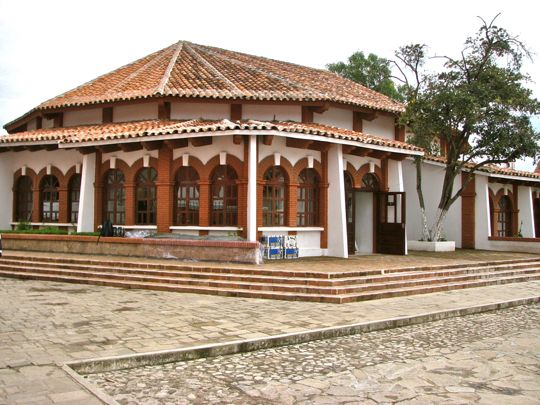
Na Bolom is a museum, hotel, and research center
Na Bolom occupies most of a block in northeast San Cristóbal. The entrance to
Na Bolom is on Calle Vicente Guerrero, just north of Calle Comitan. The museum hours are 10:00 AM to 6:00 PM and there is a small entrance fee of approximately $44 pesos ($3.50 USD). For a bit more you can take the tours scheduled at 11:30 AM and 4:30 PM. The facility is located in the
Cuxtitali Quarter, an old indigenous neighborhood established in 1528. The building was originally a mill for grinding corn, but in the 1891 it was rebuilt as a Seminary College. When Frans and Trudi bought it in 1950, the old Seminary was in ruins, possibly as a result of the government repression against Catholics during Cristero War of the late 1920s.
Like many old Mexican buildings, Na Bolom was built around a series of open courtyards. Entrances to the various rooms are located under the covered walkways behind the arched
portales. Above, one the indigenous staff walks toward the building entrance. Local Maya often make and sell their crafts in this cobblestone courtyard. I took the shot while sitting at a table of the small café facing onto the patio. The café serves excellent Chiapas coffee as well as pastries and light lunches. There are 22 rooms in the facility, including the museum, the library, and some rooms rented to guests. Other rooms are kept available for the free use of visiting
Lacandon Maya. In 1986, the Mexican government designated
Na Bolom as an historical monument.
A beautiful old marimba graces one of the hallways. Marimbas are very popular in Chiapas and San Cristóbal boasts a Marimba Orchestra that plays regularly in the Zócalo (see
Part 3 of this series). The marimba originated with African slaves who brought their traditional instruments to the Spanish Caribbean colonies. Its use migrated to Central America and from there to neighboring Chiapas.
Another of Na Bolom's sunny courtyards, complete with a colorful mural. Frans and Trudi officially named their home/headquarters The Institute for Ethnological and Ecological Advocacy, but visiting
Lacondon Maya dubbed it Na Bolom (House of the Jaguar) because of the similarity to Blom's name.
Bolom, or jaguar, is a common name among Maya. The jaguar, because of its great size, speed, strength, cunning, and reputed connection with the Underworld, is viewed with great respect by the Maya. The name they gave conveys their respect for their lifelong champions and benefactors.
Fray Bartolomé de las Casas Library has 10,000 volumes in its collection. The library contains many important works on Maya history and culture and on the Lacandon people. It fell to Trudi to manage
Na Bolom, even before Frans' death. It was a big job that consumed much of her time for 40 years. By the time she was in her 80s, the effort beyond her and supporters in the community persuaded her to form a non-profit organization to take of the day-to-day responsibility of running Na Bolom.
I found this colorful, hand-painted iguana lurking on a niche. The Maya have been talented craftspeople for thousands of years. Today, many of them support themselves by making and selling artifacts like this.
Na Bolom continues to operate as a museum, a hotel, a restaurant. and a center for research. Volunteers run the operation, and money raised through fees, room rentals, etc. go towards various projects to help the
Lacandon Maya.
The Museum's ancient Maya artifacts
The museum contains many ancient artifacts, including this bust of a proud Maya noble. Many of the artifacts come from a Classic Era site near
San Cristóbal called
Moxviquil, an area also famous for its orchids. The Maya were among the
best sculptors of Mesoamerica, and were particularly noted for their "sculpture-in-the-round".
Two female heads, with wild hairstyles. These were undoubtedly noblewomen, since the commoners generally didn't engage in such elaborate hairdos. The smaller bust seems a bit more finely made and the face is very lifelike.
Male and female heads. The male, on the left, has an
elaborate tattoo on his cheek. Neither of these shows the long sloping forehead caused by deliberate deformation of the skull in infancy. This was practiced by the noble class in many Maya areas, but not all. The female has her head cocked, as if she were listening.
Pot adorned with the rather fierce face of a nearly toothless old man. This piece closely resembles sculptures of
Huehueteotl, the "Old, Old God". He was one of the most ancient of all the gods worshiped throughout Mesoamerica. Fire, of course, was one of the most fundamental and important aspects of the ancient world and it is not surprising that worship of a god associated with it would have started in very early times. Another interesting aspect is the unmistakeable goatee beard. It is firmly believed by some that since indigenous Americans have very little facial hair, they don't grow beards. The ancient sculptor who crafted this piece would seem to disagree.
A bird's face adorns this nicely crafted, three-legged pot. Pottery was often crafted with animal as well as human themes.
Human jaws and incised pottery from burial sites located by Frans Blom. He discovered many caves throughout Chiapas that will filled with bones and skulls, and others that contained large jars full of human ashes. In a
monograph he wrote about these finds, he couldn't resist complaining that although his discoveries were being cited by other archaeologists at Tulane University, his name was never associated with the finds in their papers. Apparently, many years after he departed from Tulane in an alcoholic haze, he was still considered persona non grata.
Ball game marker in the shape of an elongated human head. This carved stone head, shown in profile, was used as a marker in a ball court. The head was inserted into the wall of the court using the flange at the back side. The head shows the
deliberate skull elongation seen among many noble Maya families. Parents tied special boards against the heads of their infant children to deform the skulls in a manner that was considered a mark of beauty and status. While this might seem barbaric today, think about the plastic surgery practices flourishing in our time.
Copper axes, rings, and ear spools from the Post-Classic period. Items like these didn't appear in the Maya area until fairly late. They may have been imported through trade networks from the
Tarascan Empire in Michoacan and Guererro where metallurgy flourished.
The Hach Winik, or Lacandon People
Statue of a Lacandon Maya stands in a traffic circle in San Cristóbal de las Casas. The figure wears a
hach huun, the typical white tunic worn by
traditional Lacandon. The
Lacandon are great hunters in their thickly forested world. Although many now use guns, some still hunt with bows and arrows. The
Lacandon Maya call themselves
Hach Winik, meaning "True Men" or "Real People". They avoided conquest and conversion by the Spanish by simply retreating into their nearly impenetrable wilderness. According to an undated, hand-written sign at
Na Bolom, there are two groups of
Lacandon, the northern and the southern. At the time the sign was written, the northern group of about 200 people was the most traditional and had preserved the ancient Maya culture and religion. The southern group of about 80 people had recently been Christianized and had given up much of the old culture. The sign is apparently out of date, because a more recent report states that most of the northern group has now also been seduced away from the ancient religion, although they do preserve some aspects of the old culture. Today there are about 650
Lacandon speakers still living in the forest.
The traditional hach hunn was made of tree bark beaten into a fibre. It somewhat resembles a Mexican serape, with a split in the middle to fit over the head and the sides sewn up, leaving armholes. The
hach hunn extends down to mid-calf. In modern times, cotton has replaced the beaten tree fibre. This would usually be the only garment worn by a man. A
Lacandon woman would wear a skirt in addition to the
hach hunn, as well as jewelry made from seeds gathered in the jungle. Both men and women traditionally wore their hair long, with the women sometimes braiding theirs.
A traditional Maya na (house) sits in the Jaguar Garden across the street from the main museum. This house is typical of the highland Maya, but there are some similarities with the Lacandon. Both use thatched roofs and poles cut from jungle trees. The
Lacandon na generally do not have walls since the climate in their lowland area is very hot and humid. Many Maya still live in houses like the one pictured above.
Tools of life among the Lacandon. The grooved wooden object in the lower left is
baxak. The woman in the display photo is using it to beat tree bark into shape for use in a
hach huun. The bowl with the long-handled spoons was used to prepare paints and dyes for decorating the
hach huun. A typical
Lacandon na, with its thatched roof, can be seen in the background of the display photo.
Balché pot used for preparing the fermented and mildly alcoholic drink. Balché is consumed ceremonially as part of the ritual for worshiping
Kanankash, the main deity who protects the forest. Numerous, lesser gods are honored as well. The drink is made from a mixture of bark from the
balché tree and sugar cane. Large quantities are prepared before the ceremony and left to ferment in a canoe. Each family that still follows the traditional beliefs builds a "god house" next to the main house. The god houses are used to burn
pom (copal) incense and other small sacrifices and also for meetings.
This completes Part 7 of my Chiapas series. I hope you found the story of Frans and Trudi Blom as intriguing as I did. I encourage feedback, questions, and corrections and if you would like to make one, please use the Comments section below or email me directly.
If you leave a question in the Comments section, PLEASE leave your email address so I can respond.
Hasta luego, Jim