Showing posts with label Fiestas. Show all posts

Saturday, March 8, 2025

Valladolid Adventures Part 4 of 22: Handicrafts at the Fiesta

A pair of smiling Yucatecas display their wares. They wear the traditional Maya huipil (pronounced "weepeel" and sometimes spelled hipil). More of these garments hang behind them, including some in children's sizes. The women were warm and friendly, typical of the people you encounter in Valladolid.

Theirs was one of the wide variety of handicraft booths at the fiesta in the Parque Principal. (see Part 3 of this series). In this posting, I will show you a selection of the handicrafts, but there were many more than I have space for here. The Maya have been known as skilled artisans for thousands of years. Hand-made huipiles, for example, have been worn by Maya women since long before the Spanish arrived.


Huipiles are often worn as day-to-day garments, but some are more formal. The basic huipil is a tunic which can be worn on its own, but often is accompanied by a kind of petticoat called a fustán, as seen above. The fustán above extends down to the ankles and some of these petticoats are decorated with horizontal embroidery as well as lace.

All the huipiles that I have seen in Yucatan were white cotton, due to the hot and humid climate. However, wool is used in parts of the Maya world that have chilly mountain temperatures, such as the Mexican state of Chiapas and in Guatemala. In Yucatan, I have often seen Maya women wearing their white huipiles while sitting on the curb of a busy street selling vegetables. How they keep the garment so clean is a mystery to me.


A friendly vendor offers stacks of sombreros. Broad-brimmed hats for both men and women can be found almost anywhere in Mexico, but particularly in Yucatan where the sun is very bright. In fact, the Mexican word for a hat, sombrero, derives from the word sombra, meaning "shade". Sombreros come in all sizes and styles, from those with narrower brims, to cowboy-style, to the classic sombrero, with its very wide-brim and high peak. Today, few Mexicans wear the classic version, other than mariachi musicians and the charros of Mexico's rodeos. However, the classic sombrero dates back at least 600 years.

Wealthy landowners in Spain wore broad-brimmed hats as far back as the 15th century. In the 16th century, cattle were brought over from Spain to Nueva España (Mexico). Soon, strays went feral, creating immense wild herds. Early hacendados (hacienda owners) hired vaqueros (cowboys) to round up these cattle and drive them to market in Guadalajara and Mexico City. To protect themselves from the hot sun the vaqueros soon copied the hacendados' broad-brimmed hats. Thus was born the Mexican cowboy and his sombrero. It would be another 200+ years before the first American cowboy donned his hat!


Looks like this cobbler is hoping Big Foot will stop by. What caught my eye was the size of the shoe he is displaying on his table. If not for Big Foot, then maybe Paul Bunyan? Some of his other wares include huaraches (leather sandals) for normal-sized folks. These have become popular throughout Mexico. During the 1960s "counter-culture", huaraches were widely adopted in the US.

Huaraches are believed to pre-date the 16th century arrival of the Spanish. The word huarache derives from the Purépecha word kwarachi, which translates as "sandal". The Purépecha-speaking people live in Michoacan and their ancestors once populated the Tarascan Empire, which was the bitter rival of the Aztecs. Early versions of the huarache have also been found in the Mexican states of Jalisco and Guanajuato.


A booth selling carved wooden masks caused me to pause. Carole and I have assembled a small collection of indigenous masks over the years, including examples from Mexico, Costa Rica, and Panama. We are always on the lookout for interesting additions. The booth above contains masks of all sizes, as well as other wooden carvings. The imagination of the artisans who create the masks is extraordinary.

Masks were intended to disguise the wearers' identities and transform them into the animal, deity or monster portrayed during rituals, ceremonies, and dances. The use of masks probably dates back to the Paleolithic Age (Old Stone Age). Indigenous masks are usually constructed from wood, bone, obsidian, shells, and natural fibers. The most ancient ones found are usually made of stone, bone, or stucco, because those substances were able to survive the passage of time. Stone masks from very early Mexican civilizations such as the Olmecs (1500 BC - 400 BC) are examples. 


The duality of the cosmos emerges from the helmet of an Aztec Eagle Warrior. The face is bisected vertically, with the dark left side showing an indigenous face, while the lighter right side is a skull. Duality was a fundamental concept of the pre-hispanic world. It was believed that everything has its opposite and the two halves make up a whole: light and dark, life and death, etc. Neither part cannot be appreciated or understood separate from its opposite. This is still expressed during Mexico's annual Dia de los Muertos (Day of the Dead) fiesta.

Eagle Warriors, along with the Jaguar Warriors, were the most important Aztec military cults. Members of these warrior cults  dressed themselves to appear like their animal totems. Joining one of the cults required long training and lots of battle experience. The taking of war prisoners for sacrifice was considered an essential task for an aspiring cult member. All this didn't originate with the Aztecs, however. They borrowed the idea of the warrior cults from their predecessors, the Toltecs (900-1200 AD), who are considered one of the most militarized--and enigmatic--civilizations of ancient Mexico.


Elongated wooden masks lined the front of another booth. This sort of mask is popular not only in Yucatan, but in other places I have visited in Mexico and Central America. For example, we saw similar masks at the crafts fair in Tequisquiapan, a Pueblo Magico near the city of Querétaro, when we visited a number of years ago. Such masks are also popular in African cultures. There seems to be something appealing about the long, narrow form.

Valladolid, like Tequisquiapan, is also a Pueblo Magico (Magic Town). This designation is awarded to cities or towns that have particular cultural or artistic significance. Often these places have preserved beautiful colonial architecture and promote activities that demonstrate Mexico's deep cultural heritage. The program began in 2001 with a handful of pueblos and has grown to a total of 117 throughout the nation. However, that number was recently capped at 117 because of a perception that the designation has been over-used and that some communities may not measure up to the strict requirements. Most that I have visited do, however.

A grinning skull. This is another very popular format. Notice the "tattoos" on the skull's forehead and cheeks, as well as the small green dots on the teeth, representing jade. Pre-hispanic nobility inlaid their teeth with jade as personal beautification. This might seem a little bizarre until you remember the plastic surgery and tattooing that modern people undergo in order to "beautify" themselves. The decoration of actual skulls, as well as artistic representations of them, occurred in pre-hispanic cultures dating back thousands of years. 

Death was not seen as a final end, but as another form of being. The Aztecs, as well as people in other pre-hispanic civilizations, often kept the skulls of the deceased. They were de-fleshed and covered with with turquoise mosaics. The eyes were imitated by placing white shells and black obsidian in the sockets. In the civilization of Teotihuacán (100 AD - 650 AD), people not only kept the skulls of relatives, but sometimes also carved their de-fleshed bones into daily household implements. This was a way to keep a connection with loved ones who had passed.


There is a lot going on with this mask. The carved wood face has frowning eyes and a mouth that seems to howl. A pair of hands holds the model of a small temple under the chin. Resting on the head is a striped iguana, similar to many living versions I have seen in Yucatan and Central America. This mask was probably not intended for wearing, because it would be much too heavy. However, it is an eye-catcher, without a doubt. For those who are especially interested in indigenous Mexican masks, I highly recommend a visit to the great mask museums of Zacatecas and San Luis Potosi.


"Step right up and get it while it's hot!" A husband and wife team offer a selection of local delicacies for hungry passersby. Food was another popular item among the many fiesta booths. I am generally cautious about "street food", although some claim they eat it regularly without untoward results.  It is wise to watch the seller a bit before purchasing anything. Is the booth swarmed with customers? That's a good sign because locals generally know what tends to be safe. Also, does the person handling the food also handle the money? Money is especially unsanitary because it passes through so many hands.

Cases of turista (sometimes called "Montezuma's Revenge") are not uncommon, even among locals and long-time foreign residents. Stomach upsets and diarrhea are the usual result, but simple preventives and remedies are available. These include regular use of probiotics as a prophylactic. Loperamide (Imodium) is the usual over-the-counter treatment if you are unlucky. Sometimes stomach parasites can be a problem requiring a a doctor's visit. While not generally dangerous, they can be persistent and may require lab tests to determine the variety, with some being particularly resistant to treatment. 


A young European couple inspects the wares of another food seller. During our visits to various parts of the Yucatan Peninsula, most of the foreigners we met were young European "backpacker" types, with a sprinkling of Canadian retirees. People visiting from the US seem to stick to Cancun, Tulum, and other "tourist bubbles". Perceptions of safety may be the cause, since people in the US tend to view the areas outside the bubbles as far more dangerous than they actually are. This is not to say that there isn't crime and violence in Yucatan and Mexico in general. There is and it can sometimes be horrific. 

However, most of the violence is related to in-fighting among the drug cartels or between the cartels and the government security forces. Foreign visitors are rarely targeted. As someone once said, if you don't plan to deal drugs or join the Mexican police or Army, you'll probably have little trouble here. After after nearly 18 years of travel throughout the country, we have never had a problem. We do exercise normal caution, keep our valuables locked up, and avoid sleazy bars and walking down dark city streets. However, that's good advice for anywhere in the world, particularly in the US where random violence is truly horrific.


A Yucateca in a traditional outfit shops at another booth. This one is filled with a wide assortment of goods. These include Virgen de Guadalupe plaques, catrinas, jaguar masks, multi-colored turtles, dream catchers with vivid feathers, and much more. A friend of mine used to use the yiddish word tchotchkes (small inexpensive trinkets) to describe such things. There were many more booths at the fiesta, but I have given you a fair taste of what you might find here. If you have a chance to wander through a handicrafts fair like this, you won't regret your experience, although your wallet may be a bit lighter at the end.

This completes Part 4 of my Valladolid Adventures series. I hope you enjoyed it. If so, please leave any thoughts or questions in the Comments section below or email me directly. If you leave a question in the Comments, please remember to include your email address so that I can respond in a timely manner.

Hasta luego, Jim


Friday, February 28, 2025

Valladolid Adventures Part 3 of 22: Fiesta in the Parque Principal


Dancers with tambourines entertain the crowd at a  fiesta. We wandered through Valladolid's Parque Principal one day and found ourselves engulfed by a large, colorful celebration. We were somewhat mystified by what it was all about, since there were no fiestas or holidays listed on our calendar for that day. I was so absorbed in my photography that I forgot to ask. However, everyone was cheerful and friendly and it was lots of fun. 


View over the Parque's fence. As we approached the Parque, itt was apparent that something was happening. There were lots more people than usual and the walkways were lined with booths selling handicrafts and food. The rickshaw-style vehicle just over the fence is one way that people with limited mobility (or who are just tired) can enjoy the sights here.


People waving a variety of flags lined both sides of the walkway. Other than the Mexican national flag, I didn't recognize the others. I thought at the time that they might be the flags of Mexican states. However, when I downloaded the photos to my computer, I began to notice that they were the national flags of various countries. The flag in the right foreground appears from the Caribbean island nation of Trinidad and Tobago. I believe the next two on the right are from Palestine and Ukraine.


This participant is brandishing the national flag of Spain. I was able to identify it by closely studying the emblem in the middle. After examining several of the flags, I now think that the fiesta had something to do with international friendship. However, when I googled the United Nations website listing international celebrations, there is nothing listed for January 15, the day of the fiesta. So. the mystery continues.


Singers belt out a tune in Spanish as a participant waves the Mexican flag. Although we didn't understand the words, the singers were energetic, the tune was catchy, and the crowd was really excited.


Several people blew animal horns as the tambourine girls danced. The flag in the upper left corner of the photo is that of the South American nation of Colombia. The whole fiesta was very colorful, if somewhat bizarre. But then, that's the way I experience most of Mexico. Upon further reflection, I suppose a lot of U.S. celebrations could rightly be called "bizarre."


The tambourine girls dance sedately while waving yellow cloths in time to the music. Dance performances of various kinds are a popular feature of Mexican fiestas. Often they have pre-hispanic themes, but the girls' costumes seemed to reflect a classical Greco-Roman theme. Along the walkway in the distance, still more flags flutter. 


The crowd cheered lustily and waved their arms in appreciation of the performances. Everyone, including Carole and I, was having a great time. Still, we had no idea--and still don't--what it was all about. You never know what's around the next corner when you live in Mexico. But that's the fun of it!

This completes Part 3 of my Valladolid Adventures series. I hope you enjoyed it. If so, please leave any thoughts or questions in the Comments section below. If you leave a question, please include your email address so that I can respond in a timely way.

Hasta luego, Jim


Tuesday, January 2, 2024

Mexicans love dancing!

The "Owl Man" at the Ajijic Center for Culture and Arts. This fellow was part of a group whose musicians played replicas of pre-hispanic instruments. I nicknamed him the "Owl Man" because of his headdress. His wings were attached to his arms so that he could extend them fully and the total effect was definitely bird-like. I later found out from a friend that his real name is Sergio and he is from San Cristóbal de las Casas, Chiapas. On Facebook he is called Xiu Ocelotl. For more on this performance, click here

In this posting, I will show you some of the dance performances we have witnessed during our travels around the country. Some were connected to important religious fiestas, while others celebrated national holidays. Still others, like the one with the Owl Man, were performances in local cultural centers. All of them were wildly colorful and full of deep cultural meanings.


Sonajeros at the Candelaria Fiesta, Tuxpan. Sonajeros get their name from the rattles they carry. A long piece of wood is embedded with metal disks similar to miniature cymbals. Holding the handle at one end, the dancer shakes the instrument and the disks clash together. When hundreds of these are rhythmically shaken by large troupes of dancers, the sound is impressive. The Sonajeros dance in formation, and I was struck by the similarity of their movements to the close-order drill I learned in the military. It turned out that there is a reason for this. 

The Sonajeros originated in pre-hispanic times. Their vests, made of braided ribbons, mimic the cotton armor worn by Aztec warriors. The Sonajero rattle resembles the basic Aztec hand-weapon, called a macuahitli. It was about the same size as the Sonajero instrument, but instead of small metal disks to make music, it was edged by razor-sharp obsidian blades. The macuahitli was a fearsome weapon, capable of cutting off a man's arm with one swipe. However, it could do little damage against Spanish armor and the cotton vests were no protection against steel swords or cross-bow arrows, much less bullets from the early firearms carried by the Spanish.
 

Chayacates at the Candelaria Fiesta, Tuxpan.  Chayacates wear masks that mimic the appearance of colonial-era Spaniards, but their antlered headdresses are indigenous. Their rattles are made from gourds filled with pebbles or seeds. Like the Sonajeros, there were hundreds of them. Both sets of dancers were composed of people from the various neighborhoods of Tuxpan. After suiting up, they all danced through town and converged into a huge parade which ended at the Plaza.

The Chayacate tradition arose separately from the Sonajeros. In 1774, a great epidemic hit Tuxpan. The local priest called everyone together and asked that they pray to San Sebastian, the patron saint for those afflicted by epidemics. They did and, miraculously, the epidemic subsided.  To celebrate this, a great fiesta was established to coincide with Candalaria (Februrary 2). The Chayacate tradition has been handed down through the generations and San Sebastian's statue is carried during the parade to honor his intervention on behalf of the people of Tuxpan.


Danza de los Viejitos (Dance of the Little Old Men), Patzcuaro. This is now performed in many parts of Mexico, but it originated in Michoacan during the colonial era. There are various stories about the origin of the dance, but the one I like best was given to us during our first visit to Michoacan. It seems that the Spanish conquistadors and their descendants viewed any kind of physical labor as below their status as hidalgos (gentlemen). In fact, even the lowliest soldier with a peasant background considered himself an hidalgo in relation to the indigenous people.  

As the story goes, the Spaniards would sit on their horses and watch while the indigenous people did all the actual work. Consequently, the lack of exercise weakened the Spaniards and turned them into viejitos at a fairly early age. The natives were forced to provide free labor as a form of tribute under the oppressive encomienda system. The indigenous folks invented this dance to mock the Spaniards covertly because any overt mocking would have resulted in immediate and severe punishment. 


A Danzante struts his stuff, Patzcuaro. The dancers are known as Danzantes. They wear 
white cotton shirts and pants, sometimes embroidered. Over this, they wear colorful blankets called serapes. On their heads, they wear straw hats adorned with ribbons of various colors. Their sandals have wooden soles to create a tapping sound. This is accompanied by taps from the dancers' canes as they mimic the hobbling of an arthritic old man. However, the performance is really quite athletic, so the Danzantes are usually young men wearing masks which imitate the faces of old Spaniards.


A male expat tips his hat to his female partner at the Ajijic Plaza. The woman was one of several who performed at the Michoacan crafts market that is held each December in the Plaza. The crafts people travel up to Lake Chapala to sell their beautiful wares to people who are looking for presents to give for Christmas. The dancers often entice members of their audience to join them. The confetti on the expat's head is contained in the hollow eggshells sold during fiestas. People have great fun cracking them over the heads of unsuspecting friends, relatives, or even random bystanders.


A Güegüe dances with his female partner at the Michoacan crafts fair. Güegües (pronounced "gway-gway") wear horrific masks. They are usually found dancing on the fringe of the main performances. Their purpose is to scare away evil spirits. They must be successful at this because I have never seen any such spirits at fiestas where güegües are present.


Traditional dancers at Dia de los Muertos, Ajijic Plaza. They wear clothing which approximates the 19th century attire of Jalisco's haciendas. The style above is probably recognizable to north-of-the-border folks, who may think it is typical of all of Mexico. However, traditional clothing styles vary greatly from one part of Mexico to another. The variety of clothing, food, and cultural traditions is an aspect of Mexico that I find particularly fascinating. To see more of the dancers at the Day of the Dead fiesta, click here.


Beautifully gowned dancers at Day of the Dead Fiesta, Ajijic Plaza. Gowns like these would have been more typical of Mexico's 19th century upper  classes. As they dance, the women whirl and twirl their gowns in a dizzying display of color and movement.


Dancers at Chapala's Cultural Center.  The jarocho costumes of these dancers are from Veracruz, on Mexico's Gulf Coast. They show a mix of colonial Spanish and indigenous influences. For example, the white color of the costumes is related to the indigenous purification rituals of the area. 


Female dance troupe at Chapala Cultural Center. The costumes these women wear are from Yucatan. The white, embroidered tops are tunics called huipils and are worn over the red skirts. Huipils are worn by the women of Yucatan for daily activities, not just for "dress up" or for dance performances.  In fact, while walking the streets of Mérida, we marveled at the women sitting on the curb and selling vegetables while wearing beautiful white huipils. How they could keep the dresses so clean remains a mystery to us.


Cross-dressing stilt dancer at Carnaval (Mardi Gras), Veracruz. When we visited Veracruz during Carnaval, we never knew what would happen next. I was listening to some street musicians when this person suddenly appeared. S/he was unusual enough in appearance, but the spectacularly vigorous dance performance was entirely on stilts. The only other time I have seen stilt dancers was also during Carnaval, but in Chetumal, capital of the Yucatan peninsula state of Quintana Roo.


Spontaneous dancer at Carnaval, in Veracruz. This very large woman lunged into the center of things and began dancing to the marimba music played by these street musicians. Her spontaneous performance soon had the crowd clapping and cheering.


Dancers in Mérida, Yucatan. These young women were performing for our tour group at one of the hotels where we stayed on an early trip through Mexico. The young man who was our tour director had arranged for them to entertain us. I commented to him that working with such lovely young women must be one of the perks of his job. He grinned at me and said "it's a tough job, but somebody has to do it." There was a group of rather severe-looking older Mexican women sitting in the background, obviously the chaperones. No doubt, our young tour director had to handle his arrangements rather carefully.

This completes my posting on Mexican dancing. I hope you enjoyed it and, if so, please leave any thoughts or questions in the Comments section below or email me directly. If you leave a question in the Comments section, please include your email address so that I can respond in a timely manner.

Hasta luego, Jim


Friday, March 3, 2023

The Virgin of Guadalupe parade at Concepción de Buenos Aires: Part 2 of 2

A lone devotee prays at the chapel of the Virgen de Guadalupe. The flower-bedecked chapel is located in the Parroquia (parish church) on the Plaza, which was the end point of the parade. The Virgen de Guadalupe is not only a powerful religious symbol in Mexico but has great political and historical significance. In 1810, a banner with her image was chosen by Miguel Hidalgo, the Father of Mexican Independence, as his battle standard. 

In Part 2 of this series, I will show you the parade held in her honor on December 12 at Concepción de Buenos Aires. I'll wind up this posting with a great little spot for lunch, should you choose to visit this pueblo in the future. To locate the town, check out the map and directions I provide in Part 1.

The Virgen de Guadalupe Parade

A tractor from a local farm towed the lead float. Everything about the parade was obviously put together by the local people with great care and devotion. Nothing about it pandered to foreigners like us. All that made the experience even more interesting and downright charming.


View of the lead float from its rear. Almost hidden by the mounds of flowers, a lone charro stands watch over the statue in the front of the float. The Virgen de Guadalupe is nearly always portrayed in exactly the same posture and clothing. She first appeared to a Christianized Aztec man near Mexico City in 1531. Everything about her image and the legends that surround her carries both Catholic and pre-hispanic pagan meanings. 


A second float carried a live tableau. A woman kneels reverently before a young girl who is dressed as the Virgin. Mexicans are very attracted to religious pageantry and living tableaux. Sometimes, living actors even portray inanimate statues.


Children are often incorporated into the tableaux. Rural communities like Concepción de Buenos Aires are deeply religious. While parades like this are entertaining for everyone, there is always an underlying seriousness to these kinds of religious events.


In the back of the second float, another tableau. A pretty young mom and her daughter ride quietly by a spectator watching the parade. The mom gave me a Mona Lisa smile but her little girl looked a bit concerned by my photographic efforts.


And here come the charros. These were the last three in the line of horsemen, but certainly not the least. The streamers they ride under are in the colors of the Mexican flag. Along with the music, it was this set of streamers that originally attracted our attention to the point far down the street from the Plaza where the parade had originally gathered.


The local band brought up the rear. The group was made up of two drummers, a pair of saxophonists, one trumpeter and a tuba player sporting a large blue instrument. They banged and tootled along merrily, if somewhat off key at times. 


A cohetero prepares to fire. A cohete is a small rocket, about the size of a cigar, attached to a long stick. They are lit off by men known as coheteros, who are ubiquitous at fiestas of all kinds. Their rockets don't set off a visual display, other than the small cloud of smoke that appears when they explode high in the sky. The main effect is the deafening blast. Individually, this is startling but tolerable. However, when shot off in a barrage, the effect is akin to the Battle of Stalingrad. 


Small groups of spectators gathered  to watch. Multiple generations crowded together in doorways and storefronts. I particularly liked the little girl who wears a huge heart on her chest.


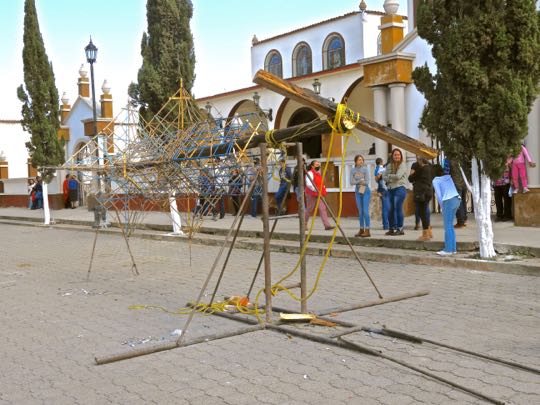
A castillo lies on its side in front of the Parroquia at the Plaza. A castillo (castle) is a pyrotechnic structure that vaguely resembles a Christmas tree. To erect it, a street will sometimes be dug up and the center post set in the ground. In this case, the castillo has a cross- piece to rest upon when it is upright. It will become the focus of the fiesta this evening.

The structure is festooned with small rockets that are interconnected by fuses. When the castillo is lit off, the many small circular devices connected to it will spin wildly, propelled by the rockets attached to them. The whole affair will be quite a spectacle as it showers sparks in every direction. However, we will be long gone by then.


Lunch at El Tio Lucas Bar and Restaurant

Jerry approaches Tio Lucas Bar and Restaurant. In Spanish, Tio Lucas means "Uncle Luke". The one-story brick structure occupies the corner of the Plaza at Calles Aquiles Serdán and Álvaro Obregón. I found it a little odd that the structure is entirely brick since wood is so heavily used in this town. The style suggests a 19th century creation.


A bearded barman, presumably Tio Lucas, sat ready to take any orders. The restaurant-bar was very cozy and homey. While our waiter didn't speak English, we knew enough Spanish to read the menu and order without difficulty. Photos of local people covered the walls. Some were of charros, while others were of local school sports teams and families celebrating various rural events.


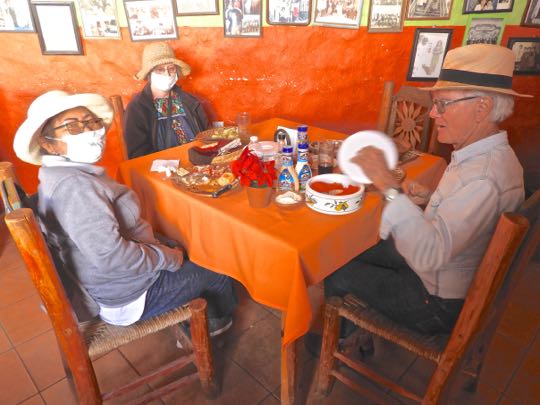
Jerry opens a dish of hot tortillas as we get ready to dive into lunch. The tasty menu mainly listed traditional Mexican dishes. These included the usual standards of enchiladas and tacos, along with salads and frijoles, but there were also some local specialties. Tio Lucas is definitely a good spot for a meal during a visit here.

The masks Lori and Carole are wearing were due to the heightened level of covid-19 in the area during December. Quite a number of our friends and acquaintances came down with it at the time. I wear one too, when in crowds or confined spaces like this. Better safe than sorry.


This friendly pair agreed to a photo as I passed through the Plaza. The guy is probably the abuelo (grandpa) of the young girl. He looks like a prosperous local farmer, in town for the big event. I get some of my best "people" shots when I encounter folks sitting in plazas like this. They almost never say "no" to a photo.

This concludes Part 2 of my series on Concepción de Buenos Aires and completes the series itself. I hope you have enjoyed it and, if so, you will leave any thoughts or questions in the Comments section below or email me directly. Please remember that if you leave a question, you need to include your email address so that I can respond in a timely manner.

Hasta luego, Jim


Tuesday, February 21, 2023

The mountain pueblo of Concepción de Buenos Aires celebrates the Virgin of Guadalupe Fiesta - Part 1 of 2

A local charro awaits the beginning of the Virgin of Guadalupe parade. A charro is not just a cowboy, but a skilled horseman who performs in charreadas (Mexican rodeos) and other events like fiestas. Last December, Carole and I and some friends decided to visit Concepcion de Buenos Aires. The small pueblo lies deep in the mountains of the Sierra del Tigre south of Lake Chapala. It was a crisp, gorgeous day, but it didn't occur to us at the time that it was the December 12. 

That is the day when the Fiesta de Virgen de Guadalupe is celebrated in Mexico. So, our short trip was rewarded not only with the pleasure of visiting this beautiful little town, but we were able to enjoy their local fiesta as a bonus. This two-part series will first focus on the pueblo itself and the charros and others who gathered for the parade. Part 2 will follow the parade itself. I'm hoping to provide you with a feel for how Mexicans in these small towns celebrate their fiestas. 


17th century aqueduct that once fed water to ex-Hacienda Toluquilla. The little pueblo of the same name is located about 1/2 way between the turnoff of Highway 405 and Concepcion de Buenos Aires. If you want to visit, watch carefully for the sign because Toluquilla itself is almost invisible from the road. The aqueduct can be found behind a gate across the road from the street that leads into the pueblo. Little else remains of the hacienda except a few adobe walls in the town.

In Part 3 of my 2012 Sierra del Tigre series, I show ex-Hacienda Toluquilla, and detail some of its 19th century history, along with how Concepción de Buenas Aires was founded on its lands. The hacienda was begun by Don Alonso de Ávalos, a captain under Conquistador Hernán Cortéz. The descendants of Ávalos eventually sold it to the Echuarri family, one of the three richest in Guadalajara during the 18th century. 

The Echuarris held it as part of a mayorazgo (entailed estate) for about 150 years from the beginning of the 18th century until 1853. A majorazgo was a hacienda (or collection of them) which couldn't be broken up but had to be passed intact to a designated heir. This was a strategy to avoid the fragmentation of estates that was a common problem during the colonial era. 

Among the various estates within the mayorazgo, the family also owned Hacienda San Francisco Javier, near Tizapan on Lake Chapala's South Shore, and Hacienda San Jose de Gracia, on the far side of the mountains that rim the South Shore. Both are sites that I have visited over the years.

How to get there. The route is fairly simple and requires about a 90 minute drive. The roads are all well-paved and quite good. Follow the road from Ajijic through Jocotopec to Highway 15. Then head to Tuxcueca on the South Shore, where you turn right on Highway 405 toward Mazamitla

After ascending the South Shore mountains, you descend into a valley where you turn right at the sign for Concepción de Buenos Aires. When you get there, you will see a large colorful sign on your right with the name of the town. Continue for another 7 blocks to Calle Constitución. Take a right and go 4 blocks to the Plaza Principal, also called the Jardin Central.


A town right out of a cowboy movie

A saddled horse waits patiently for its rider in the Plaza. This town could almost be a movie set for a Clint Eastwood western. I was reminded of one of those scenes where a gunfight is imminent and the whole town seems eerily empty. The word that always comes to my mind in describing Concepción de Buenos Aires is "pristine". 


Pillars line the arcade along Calle Constitución. Golden winter sunshine bathed the walls and streets, making for great photographic opportunities. The altitude of the town is 2126m (6975ft) which provides for a mild-to-cool year-round temperature. Light jackets or sweaters were all we needed in mid-December. The feel of a 19th century cowboy town was further enhanced by the almost complete lack of motor vehicles on the streets around the Plaza.


Calle Aquiles Serdan, looking west along the side of the Plaza. The mountains all around are thick with forests, so most of the pillars and rafters of the arcades around three sides of the Plaza are made from wood. Most of the buildings around the plaza and the area surrounding it are 1-2 stories, which helps maintain the old-fashioned feel of the place.


A small girl sits in the center of Calle Aquiles Serdan. She sat there for quite a long time, totally undisturbed by vehicle traffic of any sort. This underlined just how quiet the town was when we arrived. The church overlooking the Plaza is the Parroquia Inmaculada Concepción, devoted the the version the Virgin Mary who has the same title.


Calle Constitución, looking east toward Hotel Linda Vista. Only a single motor scooter and a couple of pedestrians break the spell of an old-west movie set.


Corner of Calle Constitución and Calle Ignacio Silva Romo. The old-fashioned building above is the Hotel Linda Vista. When I occasionally stay in a small Mexican town, I will often seek out an old hotel like this. The amenities are often limited, but the atmosphere is wonderfully antique. I have found the owners of such places always eager to tell stories about their hotel's history. Soon it is a case of "mi casa es su casa" (my house is your house).


Plaza Principal, also known as the Jardin Central. The Plaza is spacious, with lovely gardens, fountains, cast iron benches, and the almost obligatory kiosco (bandstand). As was the case everywhere else, it was virtually empty when we arrived.


Gathering for the Virgin of Guadalupe Parade

A motorcyclist passes under patriotic streamers on Calle Constitucíon. The colors are red, white, and green, the same as the Mexican national flag. The Virgin of Guadalupe is a political symbol in Mexico, along with her religious importance. In the distance, we could faintly hear a band playing so we decided to investigate. Mexicans often leave fiesta decorations up long after the celebration, so, at this point it still hadn't dawned on us that this was the 12th of December.


Ermita de la Virgen de Guadalupe. This elaborate monument sits in a small plaza at the south end of Calle Hidalgo, seven blocks south and one block east of the the Plaza. When we looked down the street toward the music, we could see more streamers and a small crowd of people, so we decided to walk down and investigate.


At the monument, charros were gathering for the parade. As soon as we saw the monument and the charro outfits, it dawned on us that we had stumbled into one of Mexico's annual Virgen de Guadalupe events. While vaqueros (cowboys), with their traditions and techniques, have been around since the Spanish Middle Ages, charros are a phenomenon that followed the Conquest of Mexico.

Ironically, although charros are respected and honored today, the term was once one of contempt. It used to mean uneducated, unpolished, rough, rustic, clownish, and ill-bred. The term probably originated from Arabic or possibly from the Spanish Basque term txar

It first appears in 1627 and it wasn't until 1803 that it began to have a more neutral meaning. The status of charro steadily improved during the 19th century, particularly during and after the War of Independence, when charros played key roles as mounted militia organized by hacienda owners to fight against insurgents and bandit gangs.


The distinctive charro outfit has become a symbol of Mexico. It is worn not only by horsemen, but mariachi bands and others seeking to invoke the tradition. The most obvious part of the charro outfit is the wide-brimmed sombrero. Its high crown and the up-turned edges of the broad rim are often embroidered. Tight-fitting shirts or jackets, along with tight pants, are often adorned with silver trimming. Tooled leather boots and jangling spurs complete the picture.

The man who legitimized charros more than any was Emperor Maximilian, who was installed by France between 1862-67. He both admired charro horsemanship and sought to ingratiate himself with the people. Later in the 19th century, the dictator Porfirio Diaz recruited charros into his rurales (rural police) to chase down bandits as well as workers fleeing debt-slavery on haciendas. The association with the rurales conveyed manhood, strength, and nationhood.  


A charro practices his rope work. The practical use of the rope is to capture and restrain cattle and horses. A skilled charro can do extraordinary things with a lariat, sometimes approaching ballet. Completing the charro image is the horse and its associated gear. 

Everything you see above was invented by the colonial Spanish and 19th century Mexicans long before the first Texan pulled on his spurs. American cowboys were truly "johnnies-come-lately" and borrowed virtually their entire tradition and technology from Mexico. You would probably never get them to admit it, though.


What is a Mexican fiesta without the local brass band? A saxophone player tunes up next to a drum. This was one of the fellows who had first attracted our attention. Usually, a band like this marches behind the charro delegation, playing earnestly, if sometimes off-key. The charros train their horses to dance to the music, creating a highly entertaining spectacle.

This completes Part 1 of my series on the fiesta at Concepción de Buenos Aires. In Part 2, we'll follow the parade as it makes its way to the Parroquia at the Plaza. I hope you have enjoyed Part 1 and, if so, you will leave any thoughts or questions in the Comments section below or email me directly.

Hasta luego, Jim