Friday, April 16, 2021

Calakmul Part 3 of 6: The Royal Tombs within the great pyramid called Structure II

The tomb of Yuknoom Yich'aak K'aak' (Claw of Fire). He was one of the three great kings of the Kaan (Snake) Dynasty, who ruled Calakmul during the 7th and first half of the 8th centuries AD. The display above is located in the Museum at Fuerte San Miguel in the city of Campeche. This is how the tomb would have appeared a few years after his burial. 

The display is a reproduction because much of the original material, including the shroud and the wooden platform under the body, had largely disintegrated during the 1,300 years that elapsed before the tomb was discovered in the mid-1990s by the Archeological Project of the Calakmul Biosphere

In this posting, I'll talk about the contents of the tomb, how it was discovered, and a bit of the history of the person who was buried in it. In addition, I'll show some of the contents of other tombs found within Structure II, as well as discussing some of the ancient funerary beliefs and practices of the Maya. 


Structure II, viewed from its northeastern corner. A system of staircases leads up to the pyramid's seventh level. On that level, the doorways of Structure IIb (the ruler's palace) can be seen above. It was built during the 8th century AD, during the last phase of Calakmul's occupation. On the lower part of the main staircase, you can see a white stela. The image carved on it may be the mother of Claw of Fire. 

During the Early Classic (250-600 AD), a building now called Substructure IIb was constructed on level seven. Tombs for rulers and other top-level elites were constructed under the floor of Substructure IIb. This added a political function to a pyramid that had previously been devoted to religious purposes. Several decades after Claw of Fire's burial, the building within which he was buried was covered over by Structure IIb, the ruins of which we see today.
Structure II, viewed as a cross-section, looking west. North is to the right. At the bottom of the stairs you can see two of the five stelae that were erected in 702 AD by Yuknoom Took' K'awiil, Claw of Fire's Kaan Dynasty successor. Part way up the stairs is the white stela containing the image of Claw of Fire's wife (or mother?).  

Substructure IIb stands on level seven of the pyramid and has two tombs buried beneath its floor. Tomb 4 contained Claw of Fire, while the body in Tomb 3 was that of a young boy. Ancient graffiti found within the substructure show that in approximately 725 AD, it was covered over by the Structure IIb palace. The burials were discovered when archeologists tunneled down through the floor of Structure IIb. (Photo from A Dynastic Tomb From Campeche, Mexico


Tomb 4: Burial Site of Yuknoom Yich'aak K'ahk'


Detail of the reproduced tomb of Claw of Fire. The tomb has an east-west orientation. The head was toward sunrise, an important celestial event for the Maya. The walls of the tomb had been painted with glyphs, but they are unreadable due to deterioration. The body was interred on its back in an extended position with the right arm crossed over the chest and the left alongside the torso. It was richly surrounded by grave goods.

Claw of Fire was a robust man between 45 and 60 years old when he died. At 164 cm (5'4 in), he was slightly taller than the average Maya of his time. Three of his upper front teeth were inlayed with jade, a beautification method common among the Maya elite. Although his bones show signs of osteophytosis (ossification of the tendon insertions), the cause of his death is still undetermined. It may have been from battle wounds during his defeat by Tikal in 695 AD.

Cinnabar pigment was applied to the body. Its red color symbolizes sunrise and blood, both of deep importance to the Maya. The cloth shroud was sealed with  resin and then covered with latex, both in a liquid state when applied. This careful treatment was responsible for the level of the body's preservation. Finally, the cloth shroud was covered with an animal skin. 


Plate with glyphs declaring it was owned by Claw of Fire. It was common practice for Maya elites to possess ceramics containing declarations of their ownership. In the center of  the plate is the image of a god named for his jester-like hat. The Jester god was closely associated with Maya rulers, who often wore his image on their headgear. This plate in the tomb, along with other ceramics that establish a date range, strongly indicate the tomb is that of Claw of Fire. (Photo from Distribution Analysis of the Central Maya Lowlands)

In addition to the ceramics, the grave goods included Spondylus shell jewelry and eight sets of feline paws, possibly from jaguars. A wide variety of jade necklaces and bracelets were found on or near the body. Some perforated jade pieces had been sewn into cloth. Also present was the ruler's head dress, made of palm material which was polychromed and decorated with a jade mosaic. Finally, the tomb contained a spectacular jade mask


Claw of Fire's jade mask was found on the right side of his chest. The mask was made from a mosaic of jade pieces, along with gray obsidian and Spondylus shells for the eyes. The round devices below the ears represent the ear plugs worn by elite figures. Such masks were called k'oh by the Maya and were thought to be animated. It was quite common for k'oh to be buried with rulers. One of the most famous masks was found in Pakal the Great's tomb at Palenque.

Claw of Fire's mask was associated with the god of maiz (corn) and symbolizes the rebirth of life during the agricultural cycles. The Maya creation myth includes the story of Hero Twins who went into Xibalba (the underworld) to play the Ball Game against the Lords of Death. The Twins won, but the Lords killed them after the game. However, by a trick, they come back to life. After escaping Xibalba they became the sun and moon. Their father became the god of maiz.


Tomb I: Burial Site of a Great Ruler's Wife


Mask and ear plugs from the tomb of the wife of Yuknoom Ch'een II. His name means "He who makes the cities tremble." Yuknoom the Great was the father of Yuknoom Yich'aak K'ahk', so she may have been his mother. However, Maya rulers were known to have more than one wife. If she was Claw of Fire's mother, she might also be the figure portrayed on Stela 116, the white monument in the middle of Structure II's main steps. 


Drinking vessel painted with the image of the young maiz god. The glyphs on the tumbler indicate that it was to be used for drinking "fruity cacao". Cacao beans were (and still are) used to make chocolate, a drink reserved for the elite. The drink was sometimes enhanced by adding the dried blood of warriors. The beans were considered so valuable that they were sometimes used as currency. 

The image on the vessel shows the birth of the maiz god as he emerges from a split skull. Once again, a funerary connection is made to the death and re-birth cycles of agriculture. The Codex Style of this ceramic piece was given that name because the colors are similar to a Maya hieroglyphic codex. Ceramics like this were made for royal family members, particularly during the Kaan Dynasty of the 7th and 8th centuries. (Photo from National Museum of Anthropology)


Other Elite Tombs and Their Contents


Tomb reproduction from the Museum of Fuerte San Miguel. The contents of this tomb, called grave goods, are probably quite similar to those found in Tomb 3, a burial found next to that of Claw of Fire. The occupant of Tomb 3 was buried during the Early Classic era (250-600 AD), making the tomb at least 100 years older than Claw of Fire's burial and possibly much older than that. Tomb 3 was desecrated in Pre-hispanic times, but some items were recovered.

These included the bones of a boy aged between six and eight years. In addition, the tomb contained four ceramic pieces. These included two dishes and a vase in the Aguila (Eagle) style and a black tripod cylinder in the Teotihuacan style. The Early Classic styles of these ceramics established the time frame of the burial. The identity of the boy is unknown, although he must have been a member of the top-level elite to be buried in this site.


Jade pendent in the form of an articulated serpent. This jade serpent was found in one of Calakmul's tombs and has been dated to the Early Classic era. The pieces are all perforated lengthwise and were once connected by a fibre cord so that, when moved, it would writhe back and forth like a serpent. Jade was considered to be extremely valuable at this time, so beautifully-made piece was probably not a toy.

Jade has often been found in burial sites, sometimes in the form of round beads left in the mouth of the deceased. These symbolized planting and the re-birth of the maiz god. Serpents were considered to be the vehicles by which the sun and stars crossed the heavens. The periodic shedding of a serpent's skins was looked upon as a symbol of rebirth and renewal.


Early Classic pot and lid decorated with fish and fantastic faces. Pots like this have often been found in the tombs of elite figures who died in the Early Classic era. Possession of objects like this was a marker of status and wealth

The ceramic artists who made and decorated these kinds of ceramics were often sponsored by Calakmul's royal courts and those of other Classic Maya cities. Beautifully made ceramics were often used as diplomatic gifts by rulers desiring to cement relationships with subordinate officials, as well as being used as grave goods in high-status burials. 


Terminal Classic era remains of a child interred in an urn. Such burials often included flutes, whistles, small jade objects, and shells. It appears, in this case, that the child's body was disarticulated before it was placed in the urn. Although it is not shown here, mouths of funeral urns were often covered by an upturned plate.

The Maya deeply mourned the dead and feared Xibalba. They believed that there were nine levels and each was full of awful dangers through which the dead must pass. These included roaring waters, high mountains, rivers of blood, and spinning blades of razor-sharp obsidian. Grave goods placed in tombs were intended to assist the dead on their journey.

This completes Part 3 of my Calakmul series. Next time, we'll look at several other buildings around the Central Plaza that form an astronomical observatory. I hope you enjoyed this posting and, if so, you will please leave any thoughts or questions in the Comments section below, or email me directly.

Hasta luego, Jim


Wednesday, April 7, 2021

Calakmul Part 2 of 6: Structure II's palace, elite residences, and temple

View of the lower part of the north facade of Structure II. At what appears to be the very top, you can see the remains of three doorways that were the entrances of a palace. What are not visible from the ground level are the several additional levels that make up the Structure II pyramid. These unseen levels contain the ruler's palace, elite residential areas, and a large temple. They will be the subjects of this posting.  

In addition to the pyramid's architecture, I will talk about Calakmul's great dynasties and some of the major changes in our understanding of them. Much of this knowledge has been developed only recently through new discoveries or re-examination of existing sources.


The great pyramid called Structure II. This is how it would have appeared in 800 AD, during the Terminal Classic Era (600-900 AD). By this time the functions of Structure II had changed considerably from those of Pre-Classic times (500 BC - 250 AD). In that earlier time, the pyramid was used exclusively for religious and ceremonial purposes. However, in the Early Classic era (250-600 AD), a political function was added, when rulers began building their tombs within the structure. 

Then, in the Terminal Classic period (600-900 AD), the structures on the pyramid's seventh level (Structures IIb, IIc, IId) were rebuilt into a palace for rulers and housing for elite families. The lower levels of the north facade were used for workshops and housing for the artisans' families. In total, the pyramid has thirteen levels. This number  probably refers to the thirteen levels of heaven in the Maya cosmos. (Drawing from Extending the Calakmul Dynasty Back in Time)


Structure IIb


View of the west side of Structure IIb, located on level seven. At the top of the main staircase are the three north-facing doors of the palace. Previous to the Terminal Classic era, another structure (called Substructure IIb) stood here. Under it are several royal tombs. This earlier structure was covered by Structure IIb, which became the palace.

Archeologists who study ancient Maya sites like Calakmul have a difficult job. Imagine working on an immense, three-dimensional jigsaw puzzle with only a vague idea of the final picture. Most of the pieces have been lost and many that remain are damaged, some severely. Further, the puzzle has a fourth dimension: time. What you are trying to understand has changed several times over the centuries. This is the complex task archeologists face. 

Early Europeans who encountered Maya ruins refused to believe they were built by the ancestors of the Maya farmers they saw about them. The Europeans preferred to believe that the ancient cities were built by Egyptians, or perhaps a Lost Tribe of Israel. Then, in the mid-19th century, John Stephens and Frederick Catherwood explored Yucatan and Central America. What they found convinced them that the highly sophisticated builders were indigenous Maya. 


Drawing of Structure II, viewed from above. The stairways lead up to the seventh level on which the Structure IIb palace stands. Structures IIc and IId, on either side, provided housing for top-level elites. These probably including the ruler's extended family. Not shown in the drawing is the temple which also stands on the seventh level, directly behind Structure IIb. (Drawing from A Dynastic Tomb from Campeche, Mexico)

Archeologists who followed Stephens and Catherwood to the Maya areas over the next 125 years couldn't decipher the hieroglyphic inscriptions they found. As a result, they speculated that the Maya had been peaceful astronomers, mathematicians and artists, with little conflict among their various cities. Then, in the 1970s, the Maya code was finally deciphered. The results were startling. 


View of Structure IIb's interior from the center door. Originally, the structure had only three parallel east-to-west rooms. Later, walls were put up to break the three long rooms into nine smaller ones. The front rooms were used for food preparation and cooking. One of the rear rooms was used as a temescal (sweatbath).

When the ancient hieroglyphic codes were deciphered, they revealed that Maya warfare was both incessant and bloody. The prevailing belief was that all these conflicts were just local squabbles between individual city-states. That view began to change as archeologists studied the "emblem glyphs" found within the inscriptions. These are dynastic symbols that are usually associated with the name of a city or ruler.


Snake head emblem glyph of the Kaan'ul, or Snake Dynasty. The carving shows a left profile of a  snake head with a toothy and rather sinister smile and a large frowning eye. Emblems such as this were usually found on stone monuments such as stelae and hieroglyphic stairs, as well as wooden door lintels. In addition to Calakmul, Kaan'ul emblems have been found in city-states all over the Petén region, indicating a broad network of power and influence. 

Most of the emblem glyphs found at Calakmul have been those of the Kaan'ul, leading archeologists to believe that the Snake Dynasty originated at Calakmul. However, all of the Kaan'ul emblems found here carry dates from the 7th and early 8th centuries. Only two of Calakmul's monuments contain earlier dates. One of these carries the the emblem of the Chatahn Winik (Lords of Chatahn) and the other carries the Bat Dynasty emblem. Neither has a Kaan'ul glyph.


A tourist stands on the roof of one of the east-west rooms. Because Maya architects never mastered the true arch, they used the corbel arch, which allows only narrow rooms. While the rooms may seem cramped, particularly for a palace, we should remember that the climate allowed outside living most of the time. Elite Maya residences usually had comfortable patios and terraces where most of daily living occurred. 

Stela 43 contains the earliest Chatahn Winik emblem at Calakmul. It is dated 514 AD, placing it within the Early Classic era. "Chatahn" is the archaic name for the basin surrounding the great Pre-Classic civilization called El Mirador (600 BC-100 AD). Calakmul was founded in 500 BC and is located only 38 km (24 mi) north of El Mirador's ruins. The two cities were linked by a raised limestone road called a sacbe, portions of which still exist.

It is possible that the Lords of Chatahn may have ruled Calakmul at the time El Mirador was abandoned around 100 AD. Adopting such a dynastic name might have been an attempt to establish themselves as the successors of the lost civilization. It is also possible that members of El Mirador's elite fled the collapse, took power at Calakmul, and adopted a dynastic name which emphasized their link to a glorious past.


View of Structure IIb from the rear, looking north. I took this shot from the terrace of Structure IIa, the temple-pyramid behind it. Poking through the foliage at the top of the photo you can see the temple called Structure VII, which faced south from the north end of the central plaza. Structure VII will be shown in a subsequent post.

The Bat Dynasty's emblem appears on Stela 114 (see Part 1 of this series). Its date, 431 AD, is earlier than the one on Stela 43. However, since only two Early Classic Stelae have been found at Calakmul so far, it is difficult to say that the order of the dates indicates which dynasty came first. 

There was a peaceful, power-sharing arrangement between these two early dynasties, possibly based on intermarriage. This relationship lasted throughout Calakmul's history, although the Bat Dynasty seems to have become the predominate partner at times. Bat emblems are sometimes linked with the title kaloom'te (overlord), which implies an authority that extends beyond one city-state. By contrast, the Chatahn Winik never get a title higher than Ajaw (lord), which signifies authority in a specific location. 


The Elite Residential Area of Structure II

Structure IId stands on the west side of the IIb palace. This was constructed during the Terminal Classic period when a residential function was added to the pyramid's religious and political functions. This building provided living space for elites, probably including members of the extended royal family.

Archeologists once believed that the Kaan'ul had originated at Calakmul, but they were puzzled that the earliest date associated with the Kaan'ul at Calakmul is 631 AD. Then, in 1994, a Snake Head emblem dated to 495 AD was found in the city of Dzibanche, 201km (125mi) to the northeast. The date and emblem were linked to a ruler thought to have been from Calakmul. Evidence began to accumulated that the Kaan'ul had ruled Dzibanche for at least 400 years prior to their appearance at Calakmul. 

Needless to say, this thunderbolt overturned many long-accepted views of the Classic Maya period. One of the seminal events in that history was the defeat of Tikal in 562 AD by a coalition of city-states. They were led by Sky Witness, a Kaan ruler previously believed to have been from Calakmul. Instead, he was part of a whole list of supposed Calakmul rulers who were actually based in Dzibanche!


Narrow hall in Structure IId. The changes to Structure II during the Terminal Classic era were not unique. At about the same time, something similar was happening to the north, at the Pyramid of the Five Levels at Edzna as well as at the Great Palace at Sayil. Not coincidentally, during this period, Calakmul was re-focusing to the north, away from the collapsing civilization of the Petén to the south and toward the still vibrant cities of the Yucatan Peninsula.

At La Corona, a Snake Dynasty ally, an inscription states that the seat of the Kaan'ul dynasty officially moved to Calakmul in 635 AD. Apparently, a fratricidal struggle had broken out at Dzibanche, possibly involving the very question of  the dynastic move. In the end, the faction that favored the move won. However, even after establishing itself at Calakmul, members of the winning faction continued to rule at Dzibanche for least 250 years. 

But why move to Calakmul? A practical reason may have involved the broader political interests of the Kaan'ul. They were allied with cities throughout the Petén region and Calakmul was simply more geographically central than Dzibanche. Another reason might have involved Calakmul's historical connection to El Mirador. Ruling from there would have allowed the Kaan'ul to position themselves as the political and cultural successors of El Mirador's glorious past.


View from above of Structure IIc, on the east side of the palace. This is another area of elite housing. 

The Chatahn Winik and Bat dynasties were sharing power at the time of the Kaan'ul arrival. Why did they peacefully submit to the takeover of their city? Perhaps the Kaan'nul were not seen as usurpers but as powerful partners. As well as existing linguistic and cultural connections, there were possible links through marriage. In addition, although the Kaan'ul began their move in 631 AD, they apparently did not become dominant for another four years.

Further, the Kaan dynasty had formed and led the great coalition which defeated Tikal and consolidated control over most of the Petén. Perhaps Calakmul's two resident dynasties viewed the arrival of the victors as an honor. The Kaan'ul apparently eased the transition by agreeing to leave the day-to-day control of the city in the hands of the two subordinate dynasties. The Kaan'ul simply used Calakmul as the headquarters for their growing empire.


Structure IIa: The Temple

Structure IIa sits just behind IIb on the pyramid's seventh level. It is the one part of the Structure II pyramid which never changed functions. It remained a religious site for more than a millennia. Since it sits behind Structure IIb at the back of the seventh level of the main pyramid, it is invisible from the level of the plaza.

In 636 AD, a year after the official establishment of Calakmul as the seat of the Kaan'ul, Yuknoom Ch'een II (He Who Makes the Cities Tremble) was seated as kaloom'te (overlord) of the new empire. Born in 600 AD, he was the son of Scroll Serpent, a Kaan ruler of Dzibanche who famously raided distant Palenque twice and died in 611 AD. Several of Scroll Serpent's sons ruled briefly between 611 and 636 AD. 

An inscription dated 631 names the third son, Yuknoom Head, as the first Kaan ajaw (lord) connected with Calakmul. This may be the name of the person who, after he acceded to the throne in 636 AD, re-named himself Yuknoom Ch'een II. Archeologists sometimes call him Yuknoom the Great, because he extended Calakmul's area of control over 13,000 sq km (8,078 sq mi), inhabited by more than 1.5 million people. He ruled for an extraordinary 50 years and died in 686 AD.


Ceramics belonging to Yuknoom Ch'een II and his successor. A statement of their ownership is written on the each piece in hieroglypic script. This was a normal practice by the Classic era Maya elite. (Photo from Distribution Analysis of the Central Maya Lowlands)

Yuknoom Ch'een II was the first of three Kaan rulers who dominated the Maya world during the 7th and early 8th centuries. His son Yuknoom Yich'aak K'ahk' was born in 849 AD. This was previously translated as Jaguar Paw, but the correct name is Claw of Fire. In his father's later years, Claw of Fire may have been responsible for the victories over Tikal in 677 and 679 AD. 

Claw of Fire took the throne after his father's death in 686 AD. Inscriptions at various Petén cities record his installation of local rulers, in his role as overload. However, in 695 AD, Calakmul was disastrously defeated by Tikal, which was trying to reestablish its preeminence after 130 years in the shadow of the Kaan'ul. It was once believed that Claw of Fire was captured and sacrificed after the battle, but he apparently escaped back to Calakmul.


Front view of the temple. Three staircases rise up the first level of the pyramidal structure to a broad terrace. From there, a single staircase reaches to the top, where rituals were once performed. This point of the temple is the highest in Calakmul. From here, there is an expansive view of the central plaza and the countryside around. 

The 695 AD defeat by Tikal was a turning point in Calakmul's history. Although Claw of Fire apparently made it back home alive, he appears to have died that same year, possibly from wounds received in the battle. His successor, Split Earth, appears to have been a puppet installed by Tikal. However, in 702 AD, Yuknoom Took' K'awiil acceded to the throne and restored the Kaan'ul to power. 

In spite of the restoration, the fortunes of Calakmul and its Kaan rulers continued to decline. About 20 years after becoming ruler, Yuknoom Took' K'awiil lost a battle with Tikal, was taken captive, and apparently sacrificed. His successor, Wamaw K'awiil, was the last of the Kaan'ul to rule Calakmul. In 726 AD, he visited the ruler of Quirgua and recklessly encouraged him to overthrow his kaloom'te, the ruler of Copán, an ally of Tikal. 


Ritual area at the top of Structure IIa. At the left-center of the photo you can see a niche which may have once contained a statue. Rituals conducted in this area would have been completely out of view of people standing at the base of the Structure II pyramid. It was not unusual for the Maya priests to consider certain religious acts to be too sacred to be conducted in public.

Wamaw K'awiil's interference apparently reignited hostilities with Tikal. Finally, in 736 AD, Tikal decisively defeated Calakmul.  The defeat succeeded in snuffing out the Kaan dynasty. After 736, the Kaan'ul emblem no longer appears in connection with Calakmul. B'olon K'awiil I took the throne in 741 AD. He and the rulers who followed are associated with the emblems of the Bat and the Chatahn Winik dynasties, who appear to have moved into a power vacuum. 


Fresco of Maya nobles at the Maya Museum of Chetumal. These men would have closely resembled those of the elite class at Calakmul, including those who lived in Structures IId and IIc.

Beginning with Claw of Fire's defeat in 695 AD, fewer and fewer of Calakmul's satellite city-states acknowledged its overlordship. By the beginning of the 9th century AD, climate change, environmental degradation and incessant warfare was causing a general collapse of Classic era Maya civilization. The rulers of Calakmul tried to cope by re-oriented their focus to the north, where cities like Edzna were still economically and culturally vibrant. 

The presence of royalty continued at Calakmul until the beginning of the 10th century. The last date recorded there was on a crudely inscribed stela showing the Maya equivalent of 909 AD. After that, the population drifted away. The jungle began to creep in and cover the great city, concealing it from the world for more than a thousand years. 

This completes Part 2 of my Calakmul series. In Part 3, I'll focus on the royal tomb of Claw of Fire found inside Structure II, as well as some of the grave goods from other Calakmul tombs. I hope you have enjoyed this posting. If so, please leave any thoughts or comments in the Comments section below or email me directly. 

Hasta luego, Jim 


Wednesday, March 17, 2021

Calakmul Part 1 of 6: A spectacular ancient city, deep in the Petén jungle.

Structure II is Calakmul's largest pyramid. It stands at the south end of the city's Gran Plaza. In the upper left of the photo, Structure I can be seen peeping out of the jungle. These two pyramids are the city's largest buildings. Calakmul means "Two Adjacent Mounds" but the name is not ancient. It was the invention of Cyrus Lundell, who discovered the city from the air in 1931. The name refers to these two great pyramids, the tops of which Lundell saw protruding from the jungle as he flew over. However, according to ancient Maya hieroglyphs, the city's real name was Ox Te' Tuun, meaning "Three Stones". This may refer to the three stones of the traditional Maya kitchen hearth. In order to avoid confusion, I will use Calakmul in this series, because it is the more widely-known name.

Structure II is a huge, complex, multilevel pyramid. What we see today is the last of multiple modifications that occurred over the city's 1,400 year history. The most recent of these was completed in the Terminal Classic era (600-900 AD). This period preceded Calakmul's collapse and abandonment. The base of Structure II measures 140m (459ft) on each of its four sides and the pyramid rises 55m (180.4ft) up from the plaza. From the ground to the very top there are at least eight levels. Structure II is the largest building in Calakmul and one of the largest in the whole Maya area. Levels three to six are connected by broad central staircase. There are also several smaller stairways. The remains of workshops and housing for ancient craftsmen can be found on the first few levels of the north facade. 

The central staircase ends at level six, which contains Structure IIb. At one time, this was the ruler's palace. The now-roofless building has three north-facing doors and contains nine rooms. On the east and west sides of Structure IIb are smaller structures called IIc and IId. They once housed high status individuals and their families. On the south end of level six, behind Structure IIb, is a temple pyramid with three staircases on its first level. A single, central staircase leads up to the top of the second level, which is the highest point on Structure II.  (Photo from the Maya Ruins Website)

Overview

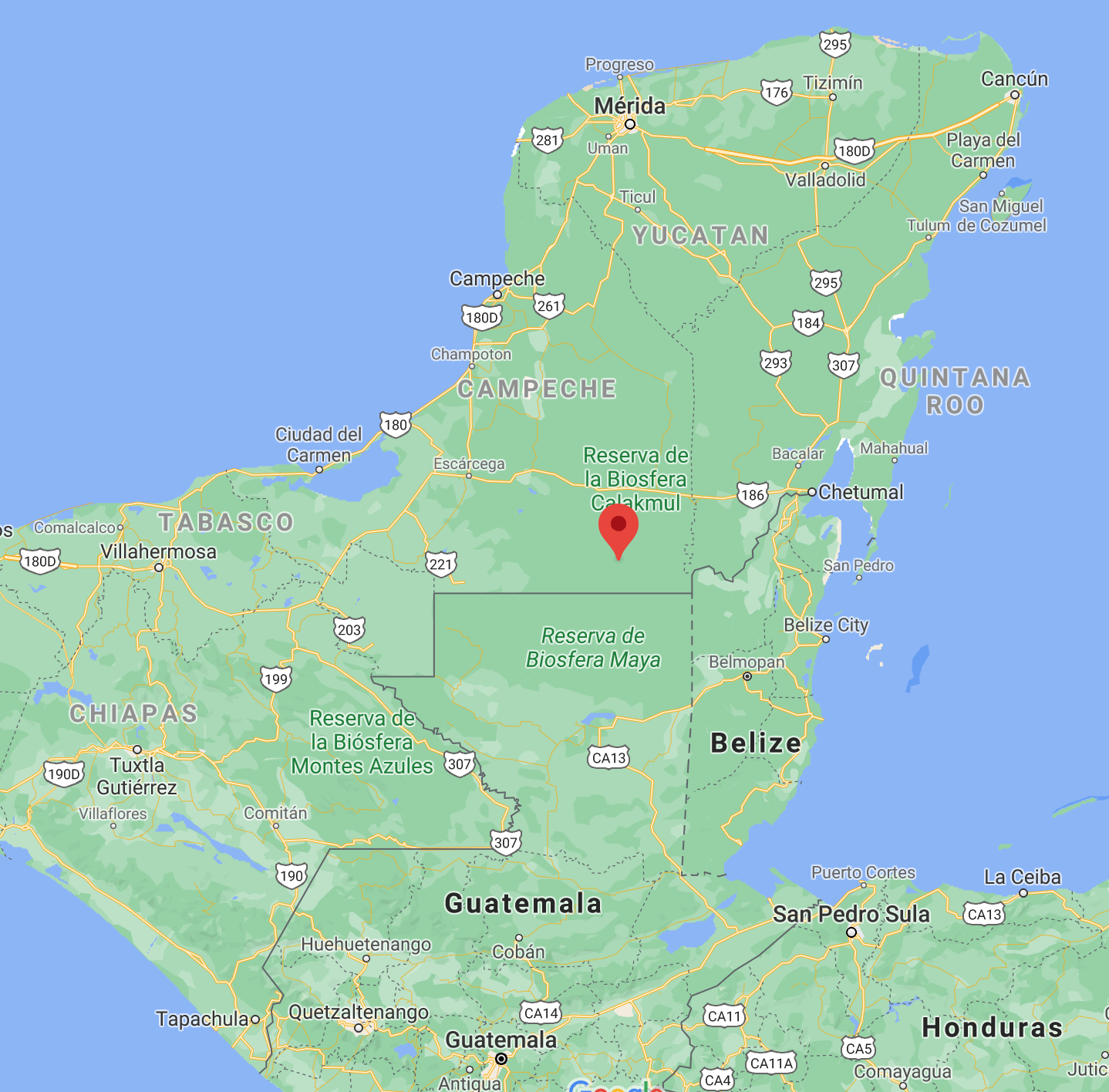
Calakmul is located in the approximate center of the ancient Maya world. The site is in the Mexican state of Campeche, approximately 35km (22mi) north of the Guatemalan border. This puts Calakmul about half way between the Caribbean and Gulf Coasts. From the northern tip of Yucatan to the Guatemala highlands in the south, Calakmul is again at about the half way point. The Petén lowlands cover the central part of this large area, which stretches from northern Guatemala well into the southern part of the Yucatan Peninsula. During the Classic Era (250-900 AD), the Petén was heavily populated. At its peak, Calakmul controlled about 13,000 sq. km (8078 sq.mi) of the Petén, which contained about 1.5 million inhabitants. Approximately 50,000 of these lived in the city itself, with another 200,000 in the rural areas immediately surrounding it. In addition to Calakmul's domain, the Petén region contained dozens of other substantial cities and many hundreds of towns and villages. Today, the heavily jungled region is almost devoid of human presence. Although timber companies and ranchers have made some inroads,  much of the Petén on both sides of the border is now within protected biosferas (biospheres). 

Calakmul was one of the two most important cities of the Classic Maya era. The other was its bitter enemy Tikal, lying 97km (60mi) to the south in today's Guatemala. Tikal draws many thousands of tourists each year, but Calakmul receives relatively few. Reaching these remote ruins requires a good deal of time and determination. The main highway passing through the Biosphera Calakmul is Mexico 186. This paved and well-maintained road spans the neck of the Yucatan Peninsula, connecting the Caribbean Coast with the Gulf of Mexico. Along the way, there are hotels, restaurants, and gas stations. However, conditions change once you turn south on the road leading to the ruins. 

From the Highway 186 turnoff to Calakmul is 61km (38mi). That may sound like a short drive but it can take from 1.5 to 2 hours. Although paved, the road is narrow and heavily potholed for much of the way, requiring low-speed driving. Except for a small museum about half way to the ruins, there is nothing along this road but jungle. If you decide to visit Calakmul, make sure to gas up in advance and bring lunch and plenty of water. When we arrived at Calakmul's parking lot, it contained less than ten cars, including those of the caretakers. The ruins themselves cover quite a large area and we rarely saw another person. However, monkeys, birds, and other wildlife were plentiful. To tell the truth, that's just how we like it when we visit an ancient site like this. Click this Google map to see the route. 


Calakmul's craftsmen produced beautiful ceramics during the Classic era. This four-legged vessel with a vulture-head handle stands 26cm (10.2in) high. Because the vessel is intact, it was almost certainly recovered from an elite tomb. Unfortunately, its sign doesn't list the precise location at Calakmul from which it was recovered. This was among several that I photographed at the little museum along the road to the site.

 The Maya considered vultures to be extraordinary beings. They were associated with war and the sun and their remains have been found in the tombs of rulers. Sculptures and paintings of Maya kings often portray them standing upon the bodies of live war captives or dead enemies. The association of vultures with rulers may have occurred because carrion-eating vultures often stand on the corpses of animals upon which they are feeding. 


Site map of the main ruins. The Gran Acrópolis is the large group of structures on the left. The Pequeña (small) Acrópolis is on the right. Sandwiched between them is the Gran Plaza. Structure II is at the south end of the Gran Plaza and Structure I is below it to the right. To the north of the Gran Plaza, but not shown on this map, is the Acrópolis Chii'k Naab, a residential area that I will show in a subsequent part of this series. 

Since the round-trip travel time between our hotel in Xpujil and Calakmul was about five hours, our time at the ruins was limited. We only explored the structures of the Gran Plaza and the Acrópolis Chii'k Naab . Together, those two areas make up about 1/4 of the total excavated site. In turn, the excavated site itself represents only a portion of the 6,250 structures that have been surveyed. In fact, the surveys conducted to date may not have captured all, or even most, of the structures that once made up this metropolis. The newly developed jungle-penetrating radar called LiDAR has not yet been used at Calakmul. However, in other parts of the Petén, it has revealed tens of thousands of structures where it was once believed none existed. 

In addition to limited time, we were also hampered by the lack of a hand-size map to guide us around the ruins. Unlike ancient sites in the northern part of the Yucatan Peninsula, those in the south often do not provide you with maps when you check in at the gate. While there were large display maps at Calakmul's gatehouse, there was nothing I could hold in my hand as we wandered blindly down the jungle trails. Before you visit, make sure to download and print out site maps of Calakmul to help you navigate this complex ruin.

Structure II over the centuries


Cutaway image showing Structure II's original and final forms. The blue image represents the original structure, built during the Late Pre-Classic era (100 BC-250 AD). Superimposed over it is the Terminal Classic version. Unlike modern practice, where older structures are simply torn down and then replaced, Maya architects typically covered an older building with a newer, larger one. By tunneling down into pyramids and temples, archeologists can discover the            structures of previous eras. Structure II underwent at least three major modifications over the centuries, along with numerous lesser changes. (Photo from Architecture of Petén at Calakmul: A Regional Comparison)


Remains of rooms once occupied by craftsmen and their families. These were among the Terminal Classic modifications made to the north facade during Calakmul's period of decline. Archeologists can tell the social class of those who occupied these rooms from the domestic debris and evidence of workshops found when this part of the structure was unearthed. Prior to the Terminal Classic period, access to Structure II had been restricted to members of the elite. 

Calakmul got its start during the Pre-Classic era (600 BC-250 AD). At that time, a civilization called El Mirador (The Lookout) dominated the Petén region. El Mirador Valley is located in northern Guatemala, about 38km (24mi) south of Calakmul. At one time, archeologists had thought that Calakmul had been founded by refugees from El Mirador, who were fleeing its collapse around 100 AD. However, it now appears that Calakmul developed during El Mirador's heyday and became important in its own right as El Mirador declined. It is certainly possible that some of the former residents of El Mirador migrated to Calakmul and thus helped transform it into a great city at the beginning of the Classic era.


More rooms along the north facade. During the Terminal Classic, warfare among Maya city states became intense. At the same time, natural and human-induced climate change led to long-term droughts and depopulation of the countryside. Many migrated away toward the northern areas of the Yucatan Peninsula where the economies were still vibrant because of better access to water. As the city's population shrank, common people began to live in elite areas previously forbidden to them. Structure II had formerly been dedicated to elite religious and political activities, but it now took on a residential function that included all classes.

The original settlers at Calakmul arrived around 500 BC. They built their community on a raised limestone area about 25 square kilometers in size that was surrounded by large bajos (low areas or swamps). The two largest were called El Labertino and El Ramonal. These bajos provided the new community with easy access to water. However, over the following centuries, increases in population required more water. Calakmul's inhabitants solved this problem by constructing a number of reservoirs to store water collected during the rainy season. Ultimately, the total reservoir capacity grew to the point where it could meet the needs of 50,000 people. 

The soil on the limestone ridge was thin, so the inhabitants brought fertile mud up from the swamps to create raised gardens. There, they could cultivate maiz, beans, squash, and other crops. The area also contained a large supply of chert, a stone from which tools could be fashioned. So, with plentiful water, access to good soil and chert for tools, and an unlimited supply of limestone for building materials, most of the elements were in place for Calakmul's success. The final great advantage was location. As outlined earlier, the growing city occupied the geographic center of the Maya world. This position held great strategic importance in terms of politics, trade, and military conquest.


Remains of a great mask. This structure is one of the two large masks located on either side of the main staircase. The flat gray protruding stone is the nose, with the mouth immediately below it. The two widely-spaced eyes are the whitish pits above and on either side of the nose. The masks are part of the decorations created during the Early-Classic period. They portrayed the faces of Maya gods and were once colorfully painted. At the beginning of the Eighth Century AD, the masks were covered over during one of the modifications of the north facade. Large masks were typical features of Maya temples and pyramids. A better preserved example can be seen at Edzna's Temple of the Masks

Structure II's modifications over the centuries began after the construction of the earliest version (see previous cutaway image). It was built sometime during the Middle Pre-Classic (390 BC-250 BC). The pyramid was intended to replicate the Witz (sacred mountain), which was believed to contain a portal that led to Xibalba (the underworld). In the Maya's cyclical cosmos, Xibalba was the place of death and rebirth. On top of Structure II's original main platform, there once stood a single-story building. This structure contained an altar and, reputedly, Xibalba's portal. On top of the building was a narrow, flat, upright panel called a roof comb. Its purpose was to support stucco decorations possibly including a large mask. 


During the Classic era, several new staircases were added to the north facade. One of these was the great stairway leading up to the triple doorways of Structure IIb. Two narrower stairways were built up on either side of the larger central one. The reasons for these multiple methods of access are not clear, but all these modifications must have required immense effort by a large workforce.

During the Late Pre-Classic (100 BC-250 AD) the building containing Xibalba's portal was covered over by a larger building. The new structure was used as a burial site for rulers and other high-status individuals. This modification not only changed the physical appearance of Structure II but added a political function to its on-going religious function. Eventually the great pyramid would contain the tombs of at least nine different kings. 

Some rulers were buried under the new building's floor and an effort was made to conceal the tombs from robbers, who seem to have been a problem even in those early times. Later, during the Early Classic (250 AD-600AD), the tomb building was, in turn, covered over by another new construction. The remains of that new building, which archeologists call Structure IIb, are what we see today at the top of the great staircase.


The supports of the three doorways of Structure IIb can be seen at the top of the great staircase. In the Terminal Classic, Structure II again underwent physical and functional changes. As previously noted, Structure IIb was transformed into a palace for the rulers, while IIc and IId became residential areas for top elites. On the lower levels of the north facade, workshops and housing for the artisans were added. The only part of the pyramid complex that maintained a purely religious function was the temple pyramid located immediately behind Structure IIb. 

These final changes are a reflection of Calakmul's decline. Prolonged drought depopulated much of the Petén. Some of the people left the area entirely and moved into the still economically vibrant northern areas of Yucatan. Those inhabitants of Calakmul's domain who remained withdrew into the city's center. As the Classic Maya world of the Petén lowlands collapsed, Calakmul's economic and cultural focus began to shift toward the north. 

The northern areas were not as much affected by the droughts. Some, like Edzna, had water systems of much greater capacity than Calakmul. Others, such as Dzibilchaltún had year-round sources in nearby cenotes. This shift in Calakmul's economic and cultural focus was also reflected in architectural design. Multifunctional pyramids like Structure II can also be found in Maya cities to the north, including Edzna's Pyramid of the Five Levels and Sayil's Great Palace. It is not clear whether Calakmul followed their example, or the northerners copied what they observed at Calakmul.


The stelae of Structure II


The north facade of Structure II as it appears today. The north facade is decorated with numerous stelae. These are upright, two-sided, stone monuments that look a bit like a tombstones. They are sometimes smooth but often covered with carved images and hieroglyphic text. Over the centuries, rulers commissioned them to commemorate special occasions. These might include an accession to power, a victory in battle, or the celebration of an important date in the Maya calendar. The five stelae in the foreground above were erected at the beginning of the Eighth Century. They stand at the base of the stairs, while others are located at various levels of the north facade. The white monument in the center of the stairway contains the image of the wife of an important ruler. The stelae shown in this section of my posting are among the most important at Structure II. 


The five stelae at the pyramid's base were erected in 702 AD. Since the limestone available to Calakmul's sculptors was of relatively poor quality, the glyphs and other images on many stone monuments have eroded over the centuries. What remains on the surface of the stelae above is only enough to establish the dates. For five stelae--all with the same date--to have been erected in such close proximity at the center of the very base of Calakmul's largest pyramid seems significant. Was the ruler's story simply too long to fit on fewer stelae? Did each stela contain the image of a different conquered opponent? Was the ruler attempting to establish a connection to the glorious history of several of his dynastic ancestors? Like so much of what we encounter in the Maya world, all this remains a mystery.


Until fairly recently, Stela 43 contained the earliest date found at Calakmul. Stela 43 was originally erected at a different location in Calakmul, but at some point in ancient times it was moved to its present site. The reason for the relocation is not known. The stela, still showing tinges of red pigment, stands in a small enclosure on the left side of the pyramid's first level. Carved in the stone is the Maya version of the date 514 AD. Up until 1994, this was the earliest confirmed date found on any monument at Calakmul. Archeologists knew, of course, that the city was much older than that. 

The discovery of this Early Classic stela was important because all other stelae found up until then were from the later in the Classic period. Specific dates are important, because they can be connected to specific rulers, dynasties, and events. From that, a chronology can be developed and compared to chronologies of other cities. Gradually, the complex history of a whole region starts to emerge. 

Sometimes there are references on one ancient city's monuments to other contemporaneous cities. For example, the earliest reference to Calakmul was found on a stela at the city of Balakbal. It contains the date 406 AD and its text indicates that Balakbal had a subordinate relationship with Calakmul at the time. This shows that Calakmul was already becoming an important regional power during the Early Classic era. 

The front side of the stela contains the image of an elite figure. The person is shown in left profile, standing on a captive. This stance is strongly associated with rulership and military power. As befits a king, the figure is richly dressed and wears a headdress incorporating ancestors and the masks of deities. Under his left arm he holds a scepter containing the figure of K'awiil, the Maya god of lightning, serpents, fertility, and maiz. The scepter is tipped with the two heads of the celestial monster. (Drawing from Latin American Studies website)


Left side view of Stela 43. The two narrow sides contain text, much of which is incomplete or undecipherable because of weathering. A partial name for the royal figure has been deciphered as Ah-K'uhul-?-bi-a, but archeologists don't yet know what the name means. The title K'uhul chatan winik is also included in the text. However this probably refers to the subordinates of the figure shown, because the title is associated with secondary leaders. While 514 AD is the earliest date on the monument, it also contains three later dates. It may be that the stela commemorates several battle victories, perhaps won by the secondary leaders.  The presence of the captive under the king's feet supports this possibility.


Stela 114 contains the Maya date corresponding to September 16, 431 AD. This discovery pushed Calakmul's earliest historical date back by 83 years before the date on Stela 43. These are the only two stelae at Calakmul from the Early Classic period. Stela 114 had previously be located somewhere else. During the Terminal Classic period, it was moved to a covered niche at Structure II near the bottom of the north facade. Its new location would have placed it out of the view of casual passersby, but still accessible to priests and other elites. 

An altar found in front of Stela 114 contains evidence of burnt offerings, including human bones. Sometime in the Late Terminal Classic, the niche was covered over by modifications to the pyramid. These very likely included the the homes and workshops of craftsmen. Stela 114 was not seen again by human eyes until 1994, when it was discovered by archeologists working under William Folan. (Photo from Architecture of Petén at Calakmul: A Regional Comparison)


The stela is carved on its front and back, as well as along the two narrow sides. On the front side is another richly dressed ruler with an extremely elaborate headdress. The figure holds a scepter vertically in his right hand. The two ends of the scepter each are tipped with a celestial monster head. Slanting from his lower left side to the upper right is a large object which appears to be an over-sized scepter. Archeologists believe this figure was the ruler who commissioned the great masks standing on either side of the main staircase.

The back of the stela and its narrow sides are covered with more than 90 glyphs containing a considerable amount of information. Unfortunately, the limestone surface is so eroded that only fragments of names remain. The order in which they appear, however, indicates that the names include not only the ruler, but those of his mother and father. (Drawing from Latin American Studies website)


Stela 116 was carved from white limestone and stands in the middle of the great staircase. The stela was erected in 692 AD, near the height of Calakmul's power. The figure on the front of the monument is a female who was probably the mother or wife of Yich' ak K'ak (Jaguar Paw). Her name is represented by the symbol for a god's head, paired with the glyph for female. Another glyph on the stela is the emblem for the city of Dos Pilas, one of Calakmul's subordinate allies. 

Jaguar Paw, whose tomb was found within Structure IIb, was one of Calakmul's great rulers. It is possible that the woman on Stela 116 was his wife, through a political marriage that cemented the alliance with Dos Pilas. Another possibility is that she was Jaguar Paw's mother, who may have married his father for similar political reasons. 

This completes Part 1 of my Calakmul series. In the next posting, I will show the tomb of Jaguar Paw and artifacts from other elite burials at Structure II. I'll also walk you through the palace and elite residential areas that once occupied level 6 of Structure II. I hope you have enjoyed this posting and, if so, that you will please leave any thoughts and questions in the Comments section below or email me directly. If you leave a question PLEASE leave your email address so that I can respond.

Hasta luego, Jim