 Pyramid of the Sun, Teotihuacan. In mid-March, Carole and I took off on an expedition we have long dreamed about. Caravan Tours runs a 9-day trip through the southern half of Mexico with stops at some of the most famous pre-hispanic ruins. In addition, we got to explore parts of Mexico City, Vera Cruz, Campeche, and Merida. We have been fascinated by ancient cultures ever since we stumbled across some Anasazi ruins while camping in a remote part of Arizona. After flying to Mexico City and receiving an evening briefing by Mauricio, our tour director, we set off the next day to visit Teotihuacan (Tayo-tee-wakan), the ancient capital of one of the most important of Mexico's great urban cultures.
The name Teotihuacan actually came from the Aztecs, who called the place "Where the gods were born". Teotihuacan was already ancient and had been abandoned for centuries when the Aztecs arrived. However, the site was so impressive that they attributed god-like qualities to those who had built it, and the Aztec emperors used to make pilgrimages on foot to Teotihuacan from their capital 30 miles away. In fact, no one really knows what people built this great city, or what name they gave it, or what they called themselves. And no one knows for sure why, in approximately 750 AD, they abandoned the great metropolis after 900 years of occupation and left it to fall into ruin.
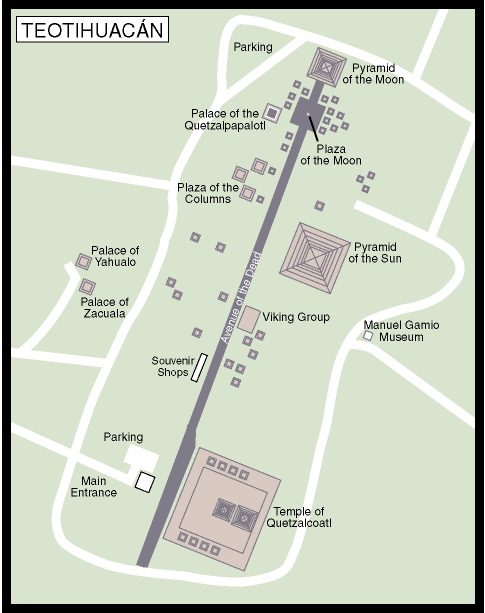 Map of the central area of Teotihuacan. The city was actually much larger than what is shown on this map. Its population may have reached 200,000, making it one of the largest cities in the world in 600 AD, certainly larger than anything in Europe at the time. We only had time to visit a few of the areas shown above, including the Pyramids of the Sun and Moon, the Avenue of the Dead which connects them, and the Palace of Quetzalpapalotl. For more extensive maps of Teotihuacan, click here. The city was carefully planned, and laid out in a grid pattern, very unusual for pre-hispanic urban areas in Mexico. The orientation was north to south, with the Pyramid of the Moon on the North. I should note here, that all the names attributed to the various structures, as well as the name of the city itself, were given by others many centuries after Teotihuacan was abandoned. I am including this map courtesy of Bill Giovanni of MexicoAdvantage.
 Pyramid of the Sun, from the Avenue of the Dead. The Pyramid of the Sun is staggeringly huge, the third largest in the world. Only two of the great pyramids of Egypt are larger. Some idea of scale can be gotten from the people than can be seen on top. Millions of tons of stone were quarried, moved, and raised to build the structure. This was accomplished by a culture that had no metal tools, and no draft animals or wheeled vehicles. The ancient Egyptians possessed bronze tools, as well as horses and wheeled carts, making the accomplishment of the Teotihuacan builders even more impressive. The structures seen in the foreground above are part of a series of temples built along both sides of the Avenue of the Dead, from end to end. They were for the worship of a bewildering array of gods.
 A priestly elite occupied palaces directly in front of the Pyramid of the Sun. These structures lie within a wall that extends forward from each side of the pyramid and across the front, sealing it off from the rest of the city and ensuring that the priestly class was set apart from the commoners. The Pyramid of the Sun was probably the first big structure built in Teotihuacan, around 100 BC, and was the center of the city. In 1971, scientists discovered a cave, actually a long volcanic tube, lying under the pyramid. Such caves were considered sacred in ancient pre-hispanic cultures, both as entrances to the underworld of the dead and as spiritual wombs for rebirth. This may have been why the pyramid was built on this spot. Ironically, scientists now believe that the pyramid was for the worship of the rain god, Tlaloc, rather than for the sun, as the 16th Century Spanish thought when they named it. A water moat has been found around the base of the pyramid, and sacrificed children were buried at each corner--typical offerings to Tlaloc. Since rain threatened us throughout our tour, perhaps Tlaloc was sending us a bit of a reminder of his power.
 The Pyramid of the Sun still exerts spiritual power. Above, a circle of young Mexicans gathers on the top of the pyramid to commune with the forces of the universe. Scientists have noted that the pyramid was built in such a way that from its top ancient priests would be able to determine the precise time of noon and midnight through use of the advanced astronomy they possessed at the time. Significantly, even after the city was abandoned, religious activities at the site continued for hundreds of years until well into Spanish times. The young Mexicans above are participating in this 2000-year-old tradition.
 Avenue of the Dead, looking south from the Pyramid of the Sun. In the foreground, a party of tourists trudges up the extremely steep stairway to the summit of the pyramid. The broad Avenue of the Dead extends from the base of the Pyramid of the Moon, past the front of the Pyramid of the Sun and far into the distance. It can be seen extending from the center right of the photo toward the upper left trio of low peaks. The ancient city stretched out broadly on either side of the Avenue, with densely packed houses and shops covering an area of over 8 square miles. Teotihucan was a cosmopolitan city, with neighborhoods for many of the ethnic groups found in Mesoamerica at the time, including a substantial neighborhood of Mayas, hundreds of miles away from their homeland. There is some evidence that the many temples along the Avenue of the Dead functioned in part as social, as well as religious, centers for these disparate groups.
 Avenue of the Dead looking south from the summit of the Pyramid of the Moon. On the upper left is the Pyramid of the Sun. Notice how the sillouette of the Pyramid of the Sun mirrors the mountain behind it. Similarly, the Pyramid of the Moon sillouettes the mountain behind it to the north. In the immediate foreground is a structure that formed part of the entrance area of the Pyramid of the Moon. In the center is an altar with stairways leading from the four cardinal points. The altar sits in the middle of a broad plaza surrounded by a group of temples which extend out from either side of the Pyramid of the Moon. Unlike the one in front of the Pyramid of the Sun, the plaza above is open, suggesting that it was the place of great public gatherings, and that the Pyramid of the Moon and its surrounding temples were open to the common people.
 Broad steps lead to the top of a temple along the Avenue of the Dead. Thousands of people once thronged the Avenue and the plaza in front of the Pyramid of the Moon. On top of these platforms once stood structures made of perishable wood and thatch in which various rituals were performed, possibly including human sacrifice. Now, all stand silent under an arc of blue sky, disturbed only by the quiet, somewhat awed passing of tourists like me.
 Vividly painted animals from an ancient world. This brightly colored painting was found on the wall of one of the temples along the Avenue of the Dead. The animal is a puma, or mountain lion. The wavy lines indicate a watery environment. The circles represent jewels, called chalchihuites. Some ancient artist of this lost world painted his vision on the temple wall almost 2000 years ago. It was only discovered by archaeologists in 1963.
 Pyramid of the Moon from the top of the Pyramid of the Sun. The Pyramid of the Moon was built later than its more massive mate, and slightly uphill, giving it an appearance of equality. Teotihuacan was not only a great city, but the center of a far-reaching commercial and trading empire. Its trading networks drew in products such as exotic birds from Guatamala and turquoise from the Arizona/New Mexico area, and other goods from the Gulf and Pacific Coasts. In turn, goods produced by Teotihuacan artisans found their way to those faraway locations. Scientists are still debating whether the artifacts of Teotihuacan got in those places solely by trade or in part through conquest. Since the people of this great civilization left no written language, we can only speculate until archaeology brings new answers. Clearly, though, Teotihuacan had an enormous influence on all the contemporary cultures of what is now Mexico and Central America as well as the succeeding civilizations which sought to emulate it.
 The Avenue of the Dead leads directly to the Pyramid of the Moon. Behind the pyramid, a great mountain mirrors the man-made structure, again probably not a coincidence. Although most the structures now existing give the appearance of rough stone, at one time they were covered by plaster and painted in vivid colors, including bright red, and many surfaces contained designs both abstract and of the natural world. The people who inhabited this civilization were highly intelligent, skilled in both engineering and the arts, and extremely well organized. While some of the other great ruined cities we visited were more aesthetically pleasing, or were set in more exotic locations, Teotihuacan left me with a unique sense of strength and power more akin to ancient Rome than to the other Mesoamerican civilizations that preceded or followed it. I can well understand why subsequent civilizations viewed Teotihuacan as a city created by giants, and as the birthplace of gods.
 Stepped temple pyramids adjacent to the Pyramid of the Moon. Teotihuacan did not originate the idea of stepped pyramids in ancient Mesoamerica. That probably came from the Olmecs, the "mother of cultures," centuries before. But Teotihuacan's influence in its own time and in succeeding centuries ensured that the design was wide-spread.
 Pyramid of the Moon. Although somewhat smaller than the Pyramid of the Sun, the Moon structure is still massive, as you can see from the people standing in front and walking up the steps. This structure was definitely built to impress.
 A steep climb. Even with a cable to clutch, the climb down was scary. A misstep and a tumble to the bottom could easily have fatal consequences. It was just such an accident at El Castillo in the Maya city of Chichen Itza that caused the Mexican government to forbid climbing the stairs there.
 The Palace of Quetzalpapalotl is one of the most elegant in Teotihuacan. Quetzalpaplotl means quetzal-bird butterfly. The palace stands behind and adjoins one of the temples just to the right of the plaza in front of the Pyramid of the Moon. You can see the stepped structure of the temple on the right side of the picture above. In fact, part of the palace was buried by the erection of the temple, and the burial protected some of the wall frescos and carvings in the pictures below. From its proximity to the Pyramid of the Moon, it is probable that a priest-noble of considerable importance lived here.
 An empty room reveals much. This large room is supported by stone pillars which were plastered with lime and then painted red. On the lower part of the walls are abstract red and white murals. The reconstructed ceiling is supported by large wooden rafters, over which are laid smaller sticks. Above the sticks is a layer of mud and plaster forming the floor of the room above.
 One of the areas once covered by the construction of the adjacent temple. Delicately cut designs adorn the stones covering the pillars. Below the platform are vivid paintings in multiple colors. While the great pyramids on the site impressed and even awed me, I was touched in a different way by the rooms of the Palace of Quetzalpapalotl. People lived here, carried on relationships, raised children, and conducted their lives in a period very remote from our own. Even so, I could identify with their humanity and love of beautifully decorated spaces.
 Detail of the palace wall decorations. These finely cut stone reliefs were once covered with bright paint. After 2000 years, some of the red pigment can still be seen. This conch shell trumpet design was repeated several times up the wall and in other places in the palace.
 Brightly painted birds adorn the walls of the palace. These were assumed to be quetzal birds, but their beaks and body shapes may also be those of macaws or parrots. The initial assumption of the birds' identity led to the naming of the palace. Unfortunately, the excavation of the palace has led to exposure to air and humidity, and the paintings are deteriorating rapidly.
 The Jaguar murals. The Quetzalpapalotl Palace is part of a group of dwellings known as the Jaguar Group, because most of them are embellished with beautiful murals of Jaguars, a very symbolic animal throughout Mesoamerican history. The one above was part of procession of Jaguars along the base of the wall in one of the Palace rooms. The Jaguar wears an elaborate feathered headdress, and along his back are a line of sea-shell trumpets. His left front paw clutches a conch-shell trumpet which is decorated with the long feathers of the quetzal bird. What emerges from the mouth of the trumpet are two drooping speech glyphs which represent the sound of the trumpet. The reach of Teotihuacan's trading empire can be seen in this mural. Both quetzal birds and seashells originate many hundreds of miles away.
 Tlaloc, the rain god, peers down on the trumpet-blowing jaguar. This representation of Tlaloc is repeated several times along the top of the mural. Tlaloc is everywhere, from the great Pyramid of the Sun to rooms in private homes. This may give a clue to the fate of Teotihuacan. This part of Mexico has long been semi-arid, and thus dependent on rain for its crops. Hence, the importance of the rain god. In the process of building the vast metropolis of Teotihuacan, the mountains in the area were denuded of timber. The walls of the great pyramids and temples, as well as private palaces, were plastered with lime. The builders burned limestone, using the wood from the forests, to produce the lime. Deforestation may have caused the climate to become dryer and the crops to begin failing. The common people had been dominated for 700 years by a priestly class whose main job was to act as intermediaries with Tlaloc and the other the gods and ensure that the rains came and that, ultimately, people could eat. As long as the priestly class held up their end, Teotihuacan's population put up with forced labor, taxation, even human sacrifice. After years of drought, and multiple failed harvests, the common people may have said to their priestly rulers, in essence, "what do we need you for?" Around about 600 AD a great fire consumed parts of Teotihuacan. Interestingly, the areas burned were the temples and the dwellings of the elites. The great influence wielded by Teotihuacan over a huge area of central Mexico came to an abrupt end. The common people continued to occupy their neighborhoods for over 150 years, until 750 AD. Eventually, even they drifted away. Gradually the huge city fell to ruin, and its history was largely forgotten. But the mysterious structures were so vast and impressive that succeeding civilizations, including the Toltecs and the Aztecs, did their best to emulate the lost greatness. In some ways, Teotihuacan became the Atlantis of Mesoamerica.
 Map of the central area of Teotihuacan. The city was actually much larger than what is shown on this map. Its population may have reached 200,000, making it one of the largest cities in the world in 600 AD, certainly larger than anything in Europe at the time. We only had time to visit a few of the areas shown above, including the Pyramids of the Sun and Moon, the Avenue of the Dead which connects them, and the Palace of Quetzalpapalotl. For more extensive maps of Teotihuacan, click here. The city was carefully planned, and laid out in a grid pattern, very unusual for pre-hispanic urban areas in Mexico. The orientation was north to south, with the Pyramid of the Moon on the North. I should note here, that all the names attributed to the various structures, as well as the name of the city itself, were given by others many centuries after Teotihuacan was abandoned. I am including this map courtesy of Bill Giovanni of MexicoAdvantage.
  Pyramid of the Sun, from the Avenue of the Dead. The Pyramid of the Sun is staggeringly huge, the third largest in the world. Only two of the great pyramids of Egypt are larger. Some idea of scale can be gotten from the people than can be seen on top. Millions of tons of stone were quarried, moved, and raised to build the structure. This was accomplished by a culture that had no metal tools, and no draft animals or wheeled vehicles. The ancient Egyptians possessed bronze tools, as well as horses and wheeled carts, making the accomplishment of the Teotihuacan builders even more impressive. The structures seen in the foreground above are part of a series of temples built along both sides of the Avenue of the Dead, from end to end. They were for the worship of a bewildering array of gods.
  A priestly elite occupied palaces directly in front of the Pyramid of the Sun. These structures lie within a wall that extends forward from each side of the pyramid and across the front, sealing it off from the rest of the city and ensuring that the priestly class was set apart from the commoners. The Pyramid of the Sun was probably the first big structure built in Teotihuacan, around 100 BC, and was the center of the city. In 1971, scientists discovered a cave, actually a long volcanic tube, lying under the pyramid. Such caves were considered sacred in ancient pre-hispanic cultures, both as entrances to the underworld of the dead and as spiritual wombs for rebirth. This may have been why the pyramid was built on this spot. Ironically, scientists now believe that the pyramid was for the worship of the rain god, Tlaloc, rather than for the sun, as the 16th Century Spanish thought when they named it. A water moat has been found around the base of the pyramid, and sacrificed children were buried at each corner--typical offerings to Tlaloc. Since rain threatened us throughout our tour, perhaps Tlaloc was sending us a bit of a reminder of his power.
 The Pyramid of the Sun still exerts spiritual power. Above, a circle of young Mexicans gathers on the top of the pyramid to commune with the forces of the universe. Scientists have noted that the pyramid was built in such a way that from its top ancient priests would be able to determine the precise time of noon and midnight through use of the advanced astronomy they possessed at the time. Significantly, even after the city was abandoned, religious activities at the site continued for hundreds of years until well into Spanish times. The young Mexicans above are participating in this 2000-year-old tradition.
 Avenue of the Dead, looking south from the Pyramid of the Sun. In the foreground, a party of tourists trudges up the extremely steep stairway to the summit of the pyramid. The broad Avenue of the Dead extends from the base of the Pyramid of the Moon, past the front of the Pyramid of the Sun and far into the distance. It can be seen extending from the center right of the photo toward the upper left trio of low peaks. The ancient city stretched out broadly on either side of the Avenue, with densely packed houses and shops covering an area of over 8 square miles. Teotihucan was a cosmopolitan city, with neighborhoods for many of the ethnic groups found in Mesoamerica at the time, including a substantial neighborhood of Mayas, hundreds of miles away from their homeland. There is some evidence that the many temples along the Avenue of the Dead functioned in part as social, as well as religious, centers for these disparate groups.
 Avenue of the Dead looking south from the summit of the Pyramid of the Moon. On the upper left is the Pyramid of the Sun. Notice how the sillouette of the Pyramid of the Sun mirrors the mountain behind it. Similarly, the Pyramid of the Moon sillouettes the mountain behind it to the north. In the immediate foreground is a structure that formed part of the entrance area of the Pyramid of the Moon. In the center is an altar with stairways leading from the four cardinal points. The altar sits in the middle of a broad plaza surrounded by a group of temples which extend out from either side of the Pyramid of the Moon. Unlike the one in front of the Pyramid of the Sun, the plaza above is open, suggesting that it was the place of great public gatherings, and that the Pyramid of the Moon and its surrounding temples were open to the common people.
 Broad steps lead to the top of a temple along the Avenue of the Dead. Thousands of people once thronged the Avenue and the plaza in front of the Pyramid of the Moon. On top of these platforms once stood structures made of perishable wood and thatch in which various rituals were performed, possibly including human sacrifice. Now, all stand silent under an arc of blue sky, disturbed only by the quiet, somewhat awed passing of tourists like me.
  Vividly painted animals from an ancient world. This brightly colored painting was found on the wall of one of the temples along the Avenue of the Dead. The animal is a puma, or mountain lion. The wavy lines indicate a watery environment. The circles represent jewels, called chalchihuites. Some ancient artist of this lost world painted his vision on the temple wall almost 2000 years ago. It was only discovered by archaeologists in 1963.
 Pyramid of the Moon from the top of the Pyramid of the Sun. The Pyramid of the Moon was built later than its more massive mate, and slightly uphill, giving it an appearance of equality. Teotihuacan was not only a great city, but the center of a far-reaching commercial and trading empire. Its trading networks drew in products such as exotic birds from Guatamala and turquoise from the Arizona/New Mexico area, and other goods from the Gulf and Pacific Coasts. In turn, goods produced by Teotihuacan artisans found their way to those faraway locations. Scientists are still debating whether the artifacts of Teotihuacan got in those places solely by trade or in part through conquest. Since the people of this great civilization left no written language, we can only speculate until archaeology brings new answers. Clearly, though, Teotihuacan had an enormous influence on all the contemporary cultures of what is now Mexico and Central America as well as the succeeding civilizations which sought to emulate it.
  The Avenue of the Dead leads directly to the Pyramid of the Moon. Behind the pyramid, a great mountain mirrors the man-made structure, again probably not a coincidence. Although most the structures now existing give the appearance of rough stone, at one time they were covered by plaster and painted in vivid colors, including bright red, and many surfaces contained designs both abstract and of the natural world. The people who inhabited this civilization were highly intelligent, skilled in both engineering and the arts, and extremely well organized. While some of the other great ruined cities we visited were more aesthetically pleasing, or were set in more exotic locations, Teotihuacan left me with a unique sense of strength and power more akin to ancient Rome than to the other Mesoamerican civilizations that preceded or followed it. I can well understand why subsequent civilizations viewed Teotihuacan as a city created by giants, and as the birthplace of gods.
  Stepped temple pyramids adjacent to the Pyramid of the Moon. Teotihuacan did not originate the idea of stepped pyramids in ancient Mesoamerica. That probably came from the Olmecs, the "mother of cultures," centuries before. But Teotihuacan's influence in its own time and in succeeding centuries ensured that the design was wide-spread.
 Pyramid of the Moon. Although somewhat smaller than the Pyramid of the Sun, the Moon structure is still massive, as you can see from the people standing in front and walking up the steps. This structure was definitely built to impress.
  A steep climb. Even with a cable to clutch, the climb down was scary. A misstep and a tumble to the bottom could easily have fatal consequences. It was just such an accident at El Castillo in the Maya city of Chichen Itza that caused the Mexican government to forbid climbing the stairs there.
 The Palace of Quetzalpapalotl is one of the most elegant in Teotihuacan. Quetzalpaplotl means quetzal-bird butterfly. The palace stands behind and adjoins one of the temples just to the right of the plaza in front of the Pyramid of the Moon. You can see the stepped structure of the temple on the right side of the picture above. In fact, part of the palace was buried by the erection of the temple, and the burial protected some of the wall frescos and carvings in the pictures below. From its proximity to the Pyramid of the Moon, it is probable that a priest-noble of considerable importance lived here.
 An empty room reveals much. This large room is supported by stone pillars which were plastered with lime and then painted red. On the lower part of the walls are abstract red and white murals. The reconstructed ceiling is supported by large wooden rafters, over which are laid smaller sticks. Above the sticks is a layer of mud and plaster forming the floor of the room above.
 One of the areas once covered by the construction of the adjacent temple. Delicately cut designs adorn the stones covering the pillars. Below the platform are vivid paintings in multiple colors. While the great pyramids on the site impressed and even awed me, I was touched in a different way by the rooms of the Palace of Quetzalpapalotl. People lived here, carried on relationships, raised children, and conducted their lives in a period very remote from our own. Even so, I could identify with their humanity and love of beautifully decorated spaces.
 Detail of the palace wall decorations. These finely cut stone reliefs were once covered with bright paint. After 2000 years, some of the red pigment can still be seen. This conch shell trumpet design was repeated several times up the wall and in other places in the palace.
 Brightly painted birds adorn the walls of the palace. These were assumed to be quetzal birds, but their beaks and body shapes may also be those of macaws or parrots. The initial assumption of the birds' identity led to the naming of the palace. Unfortunately, the excavation of the palace has led to exposure to air and humidity, and the paintings are deteriorating rapidly.
 The Jaguar murals. The Quetzalpapalotl Palace is part of a group of dwellings known as the Jaguar Group, because most of them are embellished with beautiful murals of Jaguars, a very symbolic animal throughout Mesoamerican history. The one above was part of procession of Jaguars along the base of the wall in one of the Palace rooms. The Jaguar wears an elaborate feathered headdress, and along his back are a line of sea-shell trumpets. His left front paw clutches a conch-shell trumpet which is decorated with the long feathers of the quetzal bird. What emerges from the mouth of the trumpet are two drooping speech glyphs which represent the sound of the trumpet. The reach of Teotihuacan's trading empire can be seen in this mural. Both quetzal birds and seashells originate many hundreds of miles away.
 Tlaloc, the rain god, peers down on the trumpet-blowing jaguar. This representation of Tlaloc is repeated several times along the top of the mural. Tlaloc is everywhere, from the great Pyramid of the Sun to rooms in private homes. This may give a clue to the fate of Teotihuacan. This part of Mexico has long been semi-arid, and thus dependent on rain for its crops. Hence, the importance of the rain god. In the process of building the vast metropolis of Teotihuacan, the mountains in the area were denuded of timber. The walls of the great pyramids and temples, as well as private palaces, were plastered with lime. The builders burned limestone, using the wood from the forests, to produce the lime. Deforestation may have caused the climate to become dryer and the crops to begin failing. The common people had been dominated for 700 years by a priestly class whose main job was to act as intermediaries with Tlaloc and the other the gods and ensure that the rains came and that, ultimately, people could eat. As long as the priestly class held up their end, Teotihuacan's population put up with forced labor, taxation, even human sacrifice. After years of drought, and multiple failed harvests, the common people may have said to their priestly rulers, in essence, "what do we need you for?" Around about 600 AD a great fire consumed parts of Teotihuacan. Interestingly, the areas burned were the temples and the dwellings of the elites. The great influence wielded by Teotihuacan over a huge area of central Mexico came to an abrupt end. The common people continued to occupy their neighborhoods for over 150 years, until 750 AD. Eventually, even they drifted away. Gradually the huge city fell to ruin, and its history was largely forgotten. But the mysterious structures were so vast and impressive that succeeding civilizations, including the Toltecs and the Aztecs, did their best to emulate the lost greatness. In some ways, Teotihuacan became the Atlantis of Mesoamerica.
Hopefully you enjoyed this posting on these wonderful ruins as much as we enjoyed visiting them. Feel free to send a link to this site to your family and friends. If you'd like to leave a comment, you can either use the comments section below or email me directly. If you leave a question in the comments section, PLEASE leave your email so that I may answer you.
Hasta luego! Jim


